Nepal Power Convertor Market Summary
The nepal power convertor market was estimated at USD 335 Million in 2025 and is projected to reach USD 460 Million by 2032, growing at a CAGR of 5.2% from 2026 to 2032.
Nepal Power Convertor Market Year-wise Growth Rate and Key Drivers
This graph highlights how the Nepal Power Convertor Market has steadily grown over the past five years, supported by major growth factors.
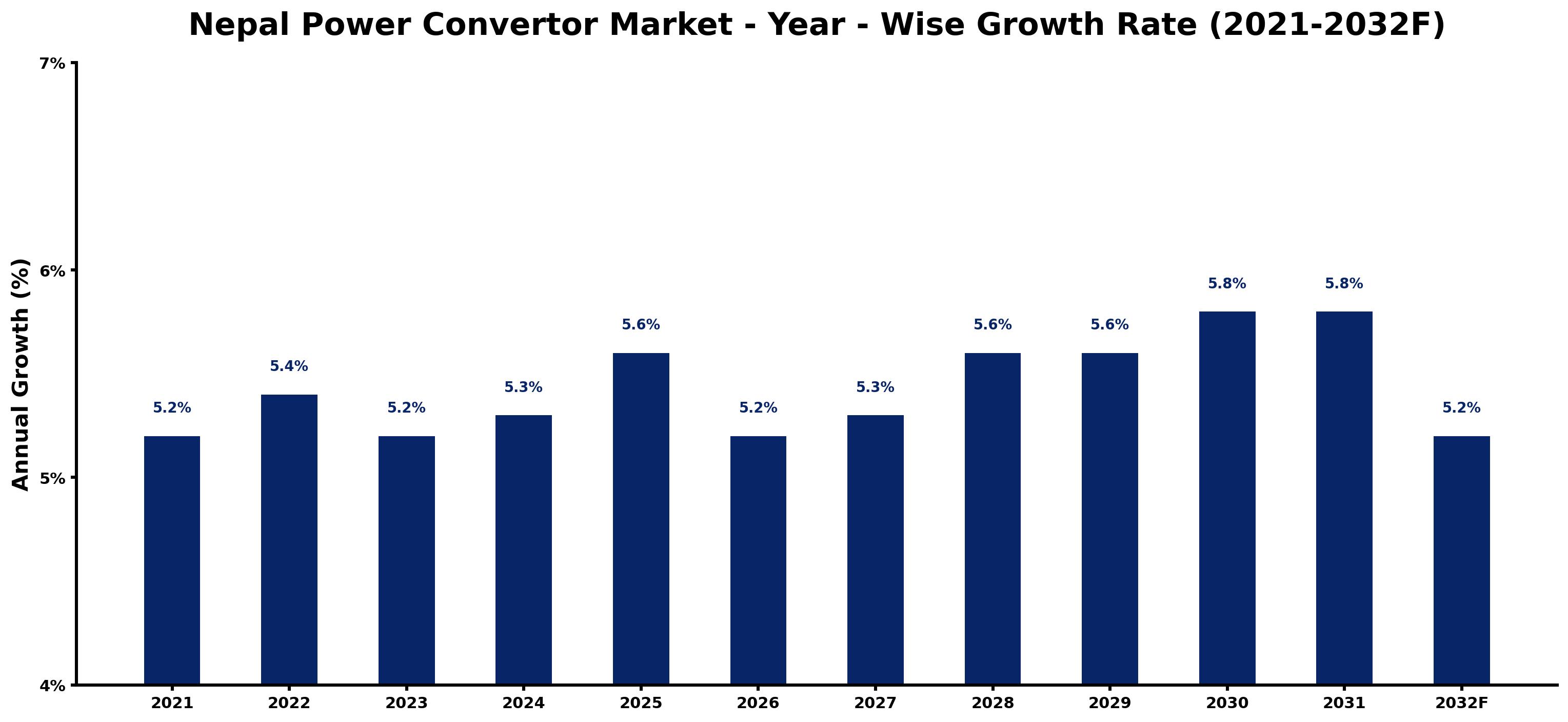
The table below presents the year wise growth rates along with the key drivers influencing the market
| Year | Growth Rate | Major Drivers |
| 2021 | 5.2% | Increased local production capabilities are creating a competitive edge in pricing. |
| 2022 | 5.4% | Investment in renewable energy projects is boosting demand for power converters nationwide. |
| 2023 | 5.2% | Urbanization trends correlate with a higher need for reliable power solutions in cities. |
| 2024 | 5.3% | Local manufacturers are exploring partnerships to enhance technology and product offerings. |
| 2025 | 5.6% | A shift towards sustainable practices is prompting businesses to upgrade power systems. |
| 2026 | 5.2% | Enhanced grid infrastructure is fueling the replacement of older power converter models. |
| 2027 | 5.3% | E-commerce growth is intensifying the need for efficient energy management solutions. |
| 2028 | 5.6% | Government incentives for green technology are encouraging innovation in power converter designs. |
| 2029 | 5.6% | Rural electrification projects are driving demand for portable and efficient converters. |
| 2030 | 5.8% | Technological advancements are enabling smarter power converters with IoT integration. |
| 2031 | 5.8% | Increased foreign investment is leading to sophisticated manufacturing processes in Nepal. |
| 2032 | 5.2% | Consumer awareness of energy efficiency is shaping preferences for high-performance products. |
Note - Market size estimations and growth projections presented in this report are based on 6Wresearch's advanced forecasting approach, validated with industry datasets as of June 2026.
Nepal Power Convertor Market Synopsis
The Nepal Power Convertor Market is projected to reach 5.2% and witness significant growth during the forecast period (2026-2032). This growth trajectory is primarily supported by an array of factors, including rapid technological advancements, a burgeoning demand for renewable energy sources, and heightened investments in infrastructure development projects within the country. The adoption of policies aimed at promoting renewable energy has positioned Nepal as an emerging market for power converters.
Nepal Power Convertor Market Growth Drivers
Several critical drivers are propelling the expansion of the Nepal Power Convertor Market. Firstly, the government's commitment to fostering renewable energy initiatives is a major catalyst. By decreasing reliance on imported fossil fuels, Nepal aims to enhance its electricity generation capacity from local resources. This initiative is expected to bolster demand for power conversion systems, specifically those converting direct current (DC) generated from renewable sources into alternating current (AC).
- The transition to renewable energy sources like solar, wind, and hydropower is reshaping the electricity landscape in Nepal.
- Investment in rural electrification projects has spurred the need for reliable power conversion technologies.
- Increased industrialization in Nepal is driving the demand for power converters in consumer electronics.
- Efforts to modernize electricity infrastructure underscore the growing importance of efficient power conversion systems.
- The rising demand for low-maintenance power systems is fueling interest in advanced converter technologies.
Nepal Power Convertor Market Trends and Opportunities
As the Nepal Power Convertor Market evolves, several trends are emerging that indicate potential opportunities for growth. The integration of Internet of Things (IoT) technologies into power converter systems is becoming prevalent, allowing for smarter energy management solutions. This trend not only enhances operational efficiency but also aligns with the broader digital transformation efforts within the energy sector.
- Advancements in smart grid technology enable better utilization of renewable energy resources.
- The proliferation of electric vehicles in Nepal presents new avenues for power converter applications.
- Consumer awareness regarding energy efficiency is driving demand for high-performance converters.
- Government incentives for green technologies are fostering innovation in the power conversion sector.
- Collaboration between stakeholders in the energy market is leading to the development of comprehensive energy solutions.
Nepal Power Convertor Market Challenges and Restraints
Despite the promising growth prospects, the Nepal Power Convertor Market faces several challenges that could impede its progress. Infrastructure constraints, among others, limit the reach and implementation of advanced power conversion technologies. Moreover, competition from low-cost imported products may impact local manufacturers.
- Limited access to investment for small and medium enterprises can hinder technological advancements.
- The need for skilled personnel in the power electronics sector remains a critical barrier to growth.
- Inconsistent power supply and grid reliability issues can deter the adoption of sophisticated conversion systems.
- Environmental regulations may pose challenges for the manufacturing processes of power converters.
- Import dependencies may lead to fluctuations in product pricing and availability.
Nepal Power Convertor Market Government Investment and Initiatives
The Nepalese government is playing a pivotal role in shaping the future of the power convertor market through various investment initiatives and policy frameworks. Recent strategic plans highlight a commitment to expanding renewable energy infrastructure, which is crucial for enhancing the country's energy independence. Various public spending initiatives aim to develop the power sector, particularly in rural areas where access to reliable electricity remains limited.
- Government policies are designed to incentivize the adoption of renewable energy technologies, including power converters.
- Investment in research and development is aimed at improving the efficiency of power conversion systems.
- Partnerships with international organizations are fostering knowledge transfer and technological innovation.
- Public funding is being directed towards capacity-building initiatives in the energy sector.
- Regulatory frameworks are being established to facilitate the deployment of smart grid technologies.
Nepal Power Convertor Market Latest Developments (May 2025 - June 2026)
The period from May 2025 to June 2026 has witnessed significant developments in the Nepal Power Convertor Market. Industry stakeholders have increasingly focused on enhancing collaboration amongst different sectors to accelerate the adoption of renewable energy solutions. Moreover, new market entrants have begun to explore innovative technologies aimed at improving power conversion efficiencies, thus driving competition. The emphasis on smart technologies in power systems is gaining traction, reflecting a broader trend in the energy market towards a more integrated and efficient energy grid setup.
- Organizations have reported increased investments in R&D focusing on advanced power conversion technologies.
- Local initiatives aimed at improving public awareness about renewable technologies are gaining momentum.
- Stakeholders are exploring partnerships for the deployment of pilot projects demonstrating smart power conversion systems.
- Regulatory reforms are paving the way for enhanced market access for new technologies.
- Digital transformation projects are being implemented, aiming to modernize energy management systems.
Nepal Power Convertor Market - Key Attractiveness of the Report
- 10 Years of Market Numbers
- Historical Data Starting from 2022 to 2025
- Base Year: 2025
- Forecast Data until 2032
- Key Performance Indicators Impacting the Market
- Major Upcoming Developments and Projects
Key Highlights of the Report:
- Nepal Power Convertor Market Outlook
- Market Size of Nepal Power Convertor Market, 2025
- Forecast of Nepal Power Convertor Market, 2032F
- Historical Data and Forecast of Nepal Power Convertor Revenues & Volume for the Period 2022-2032F
- Nepal Power Convertor Market Trend Evolution
- Nepal Power Convertor Market Drivers and Challenges
- Nepal Power Convertor Price Trends
- Nepal Power Convertor Porter's Five Forces
- Nepal Power Convertor Industry Life Cycle
- Historical Data and Forecast of Nepal Power Convertor Market Revenues & Volume By Product Types for the Period 2022-2032F
- Historical Data and Forecast of Nepal Power Convertor Market Revenues & Volume By Low Voltage Power Converter for the Period 2022-2032F
- Historical Data and Forecast of Nepal Power Convertor Market Revenues & Volume By High Voltage Power Converter for the Period 2022-2032F
- Historical Data and Forecast of Nepal Power Convertor Market Revenues & Volume By Applications for the Period 2022-2032F
- Historical Data and Forecast of Nepal Power Convertor Market Revenues & Volume By Electronics for the Period 2022-2032F
- Historical Data and Forecast of Nepal Power Convertor Market Revenues & Volume By Industrial for the Period 2022-2032F
- Historical Data and Forecast of Nepal Power Convertor Market Revenues & Volume By Infrastructure & Transportation for the Period 2022-2032F
- Historical Data and Forecast of Nepal Power Convertor Market Revenues & Volume By Power Utilities for the Period 2022-2032F
- Historical Data and Forecast of Nepal Power Convertor Market Revenues & Volume By Others for the Period 2022-2032F
- Nepal Power Convertor Import Export Trade Statistics
- Market Opportunity Assessment By Product Types
- Market Opportunity Assessment By Applications
- Nepal Power Convertor Top Companies Market Share
- Nepal Power Convertor Competitive Benchmarking By Technical and Operational Parameters
- Nepal Power Convertor Company Profiles
- Nepal Power Convertor Key Strategic Recommendations






































