Nepal Precious Metals Market Size, Share & Growth Rate
The Nepal Precious Metals Market was estimated at USD 208 Million in 2025 and is projected to reach USD 227 Million by 2032, growing at a CAGR of 1.3% from 2026 to 2032. This growth trajectory is driven primarily by rising consumer demand for gold as a safe-haven asset, particularly in light of economic volatility and inflationary pressures. Increased urbanization and an expanding middle class are also contributing to heightened interest in both investment-grade gold and silver.
Nepal Precious Metals Market Year-wise Growth Rate and Key Drivers
This graph highlights how the Nepal Precious Metals Market has steadily grown over the years, supported by major growth factors.
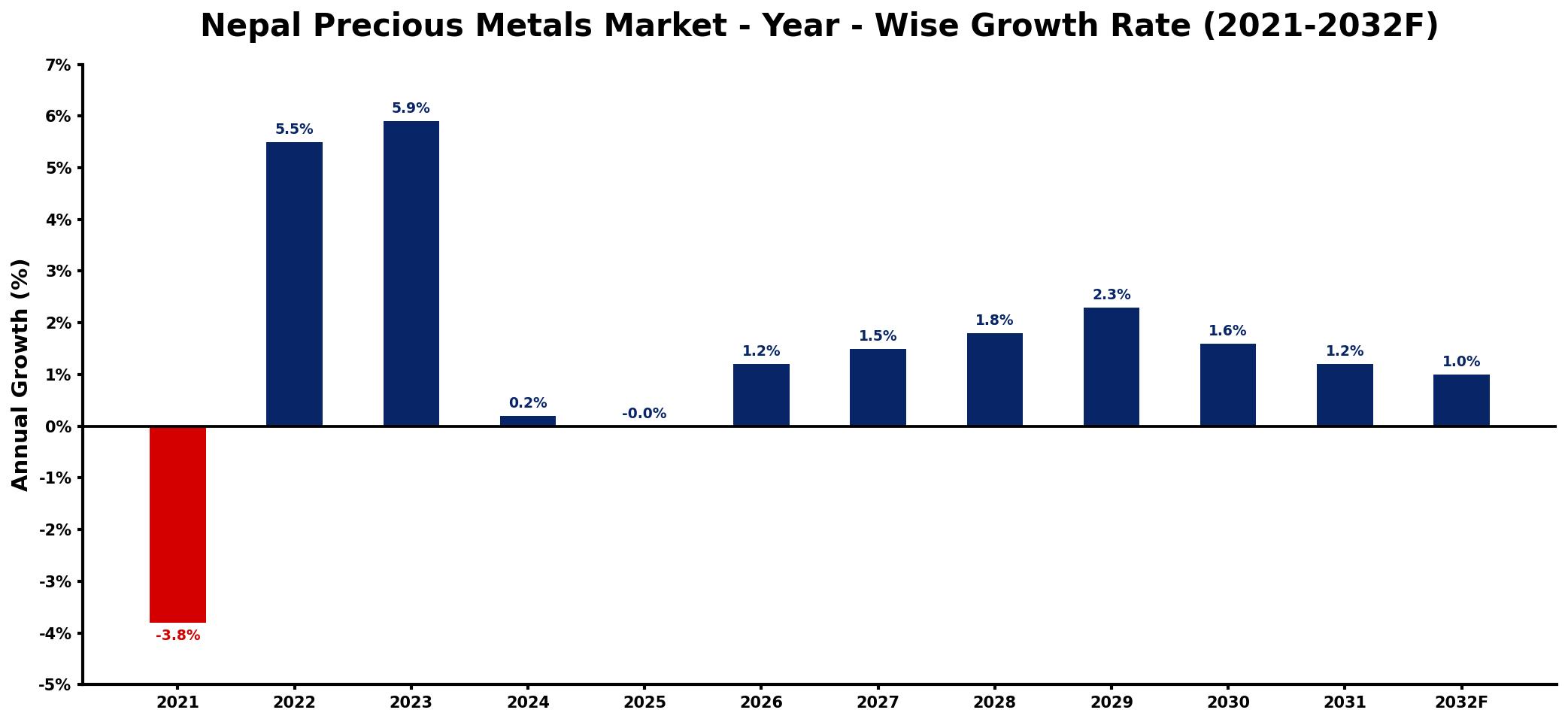
The table below presents the year‑wise growth rates along with the key drivers influencing the market
| Year | Growth Rate | Major Drivers |
| 2021 | -3.8% | global demand for luxury items |
| 2022 | 5.5% | increased investment in jewelry |
| 2023 | 5.9% | growth in industrial applications |
| 2024 | 0.2% | surge in consumer confidence |
| 2025 | -0.0% | expansion of e-commerce platforms |
| 2026 | 1.2% | rising interest in green technologies |
| 2027 | 1.5% | enhanced marketing strategies adopted |
| 2028 | 1.8% | growing popularity of collectibles |
| 2029 | 2.3% | increased production capabilities established |
| 2030 | 1.6% | strengthened trade agreements signed |
| 2031 | 1.2% | emerging trends in fashion industries |
| 2032 | 1.0% | greater focus on sustainable sourcing |
Note: Market size estimations and growth projections presented in this report are based on 6Wresearch's proprietary forecasting methodology, utilizing the latest available industry data, government publications, and primary research inputs.
Nepal Precious Metals Market Synopsis
In Nepal, gold is more than just a commodity; it is deeply intertwined with cultural and religious traditions, making it a staple in weddings and festivals. As such, local demand remains robust, further boosted by international price trends.
While silver is traded, it pales in comparison to gold's prominence. Recent years have seen a resurgence in consumer interest in precious metals as investment vehicles, reflecting a shift in attitudes toward wealth preservation amidst global economic uncertainties.
Nepal Precious Metals Market Key Takeaways
- The market is primarily driven by strong cultural demand for gold and silver, particularly in jewelry.
- Regulatory measures impact trade dynamics, including import duties and licensing processes.
- Investment opportunities are expanding, with growing interest in mining and ETFs focused on precious metals.
- Technological limitations hinder market competitiveness, despite a clear demand for modernization.
- The overall market outlook is positive, reflecting shifting consumer perceptions regarding the intrinsic value of precious metals.
Evaluation of Restraints in Nepal Precious Metals Market
Despite the promising growth potential, the Nepal Precious Metals Market faces significant restraints. The highly regulated nature of the industry creates barriers for new entrants, limiting competition and innovation. A notable lack of transparency in pricing further complicates consumer trust and market fluidity. Additionally, restricted access to advanced refining technologies constrains operational efficiency and the ability to meet rising demand. Addressing these challenges will be crucial for unlocking the market's full potential.
Nepal Precious Metals Market Trends
Currently, a notable trend in the Nepal Precious Metals Market is the increasing recognition of gold and silver as viable safe-haven assets. Amid ongoing inflation concerns and global economic instability, both consumers and investors are seeking the stability these metals provide. Furthermore, there is a growing emphasis on ethical sourcing and sustainable practices in precious metals trading, reflecting a wider global shift in consumer preferences.
Nepal Precious Metals Market Opportunities
The Nepal Precious Metals Market presents several lucrative opportunities for investors. With physical gold and silver maintaining their status as safe-haven investments, individuals looking to diversify their portfolios can consider these as primary options. Additionally, investments in local mining operations may yield significant returns given the countrys untapped mineral resources. Exchange-traded funds and mutual funds focused on precious metals also offer accessible routes for those looking to benefit from market growth.
Government Initiatives in the Nepal Precious Metals Market
The Nepalese government plays a vital role in shaping the precious metals market through a series of regulatory policies aimed at ensuring fair trading practices. The Department of Mines and Geology oversees licensing for businesses and individuals engaged in precious metals, fostering compliance with legal standards. Moreover, the government's policies regarding import duties and taxes are designed to stabilize the market and safeguard the economic interests of the nation.
Future Insights of the Nepal Precious Metals Market
Looking ahead to the period between 2026 and 2032, the Nepal Precious Metals Market is set to witness steady growth fueled by a combination of cultural affinity and rising consumer investment. As awareness of gold and silvers role as wealth preservation tools increases, market dynamics will likely shift in favor of these assets. Government initiatives aimed at promoting mining activities and easing regulatory burdens may further enhance market conditions, allowing for improved competitiveness and transparency.
Nepal Precious Metals Market Latest Developments (2025 - 2026)
Recent industry developments indicate a concerted effort to modernize the precious metals sector in Nepal. Regulatory adjustments are being discussed to improve transparency in pricing and streamline licensing procedures for new market entrants. Additionally, there has been an uptick in community initiatives aimed at promoting ethical sourcing and environmentally sustainable mining practices, responding to increasing consumer demand for responsible investment options.
Nepal Precious Metals Market - Key Attractiveness of the Report
- 10 Years of Market Numbers
- Historical Data Starting from 2022 to 2025
- Base Year: 2025
- Forecast Data until 2032
- Key Performance Indicators Impacting the Market
- Major Upcoming Developments and Projects
Key Highlights of the Report:
- Nepal Precious Metals Market Outlook
- Market Size of Nepal Precious Metals Market, 2025
- Forecast of Nepal Precious Metals Market, 2032
- Historical Data and Forecast of Nepal Precious Metals Revenues & Volume for the Period 2022-2032F
- Nepal Precious Metals Market Trend Evolution
- Nepal Precious Metals Market Drivers and Challenges
- Nepal Precious Metals Price Trends
- Nepal Precious Metals Porter's Five Forces
- Nepal Precious Metals Industry Life Cycle
- Historical Data and Forecast of Nepal Precious Metals Market Revenues & Volume By Product for the Period 2022-2032F
- Historical Data and Forecast of Nepal Precious Metals Market Revenues & Volume By Gold for the Period 2022-2032F
- Historical Data and Forecast of Nepal Precious Metals Market Revenues & Volume By Silver for the Period 2022-2032F
- Historical Data and Forecast of Nepal Precious Metals Market Revenues & Volume By Platinum Group Metals (PGM) for the Period 2022-2032F
- Historical Data and Forecast of Nepal Precious Metals Market Revenues & Volume By Application for the Period 2022-2032F
- Historical Data and Forecast of Nepal Precious Metals Market Revenues & Volume By Jewelry for the Period 2022-2032F
- Historical Data and Forecast of Nepal Precious Metals Market Revenues & Volume By Industrial for the Period 2022-2032F
- Historical Data and Forecast of Nepal Precious Metals Market Revenues & Volume By Investment for the Period 2022-2032F
- Nepal Precious Metals Import Export Trade Statistics
- Market Opportunity Assessment By Product
- Market Opportunity Assessment By Application
- Nepal Precious Metals Top Companies Market Share
- Nepal Precious Metals Competitive Benchmarking By Technical and Operational Parameters
- Nepal Precious Metals Company Profiles
- Nepal Precious Metals Key Strategic Recommendations






































