Nepal Public Cloud Market Size & Growth Rate (2026-2032)
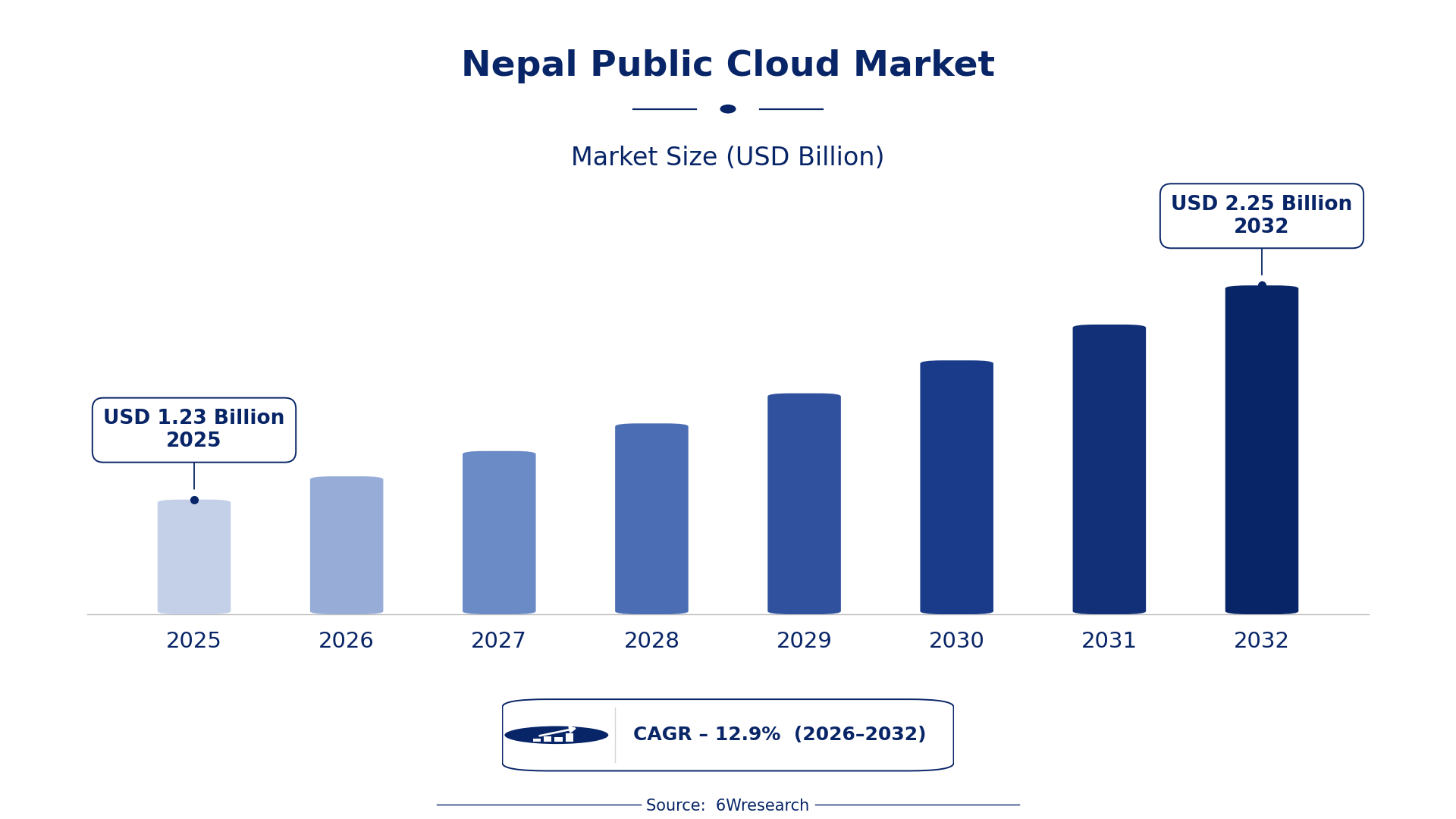
The Nepal Public Cloud Market was estimated at USD 1225 Million in 2025 and is projected to reach USD 2254 Million by 2032, growing at a CAGR of 12.9% from 2026 to 2032.
Nepal Public Cloud Market Synopsis
The rise of digital services in Nepal is driving a remarkable shift towards public cloud solutions. Businesses are increasingly recognizing the need for scalable and cost-effective IT infrastructure, leading to a surge in cloud service adoption across sectors.
This growth is supported by a tech-savvy population eager for modern solutions, as well as government initiatives aimed at enhancing digital infrastructure. Local providers are also stepping up to cater to specific business needs, complementing the offerings of global cloud giants.
Nepal Public Cloud Market Year-wise Growth Rate and Key Drivers
This graph illustrates the annual growth rates of the Nepal Public Cloud Market from 2021 to 2032, highlighting a steady upward trajectory and projected expansion over the forecast period.
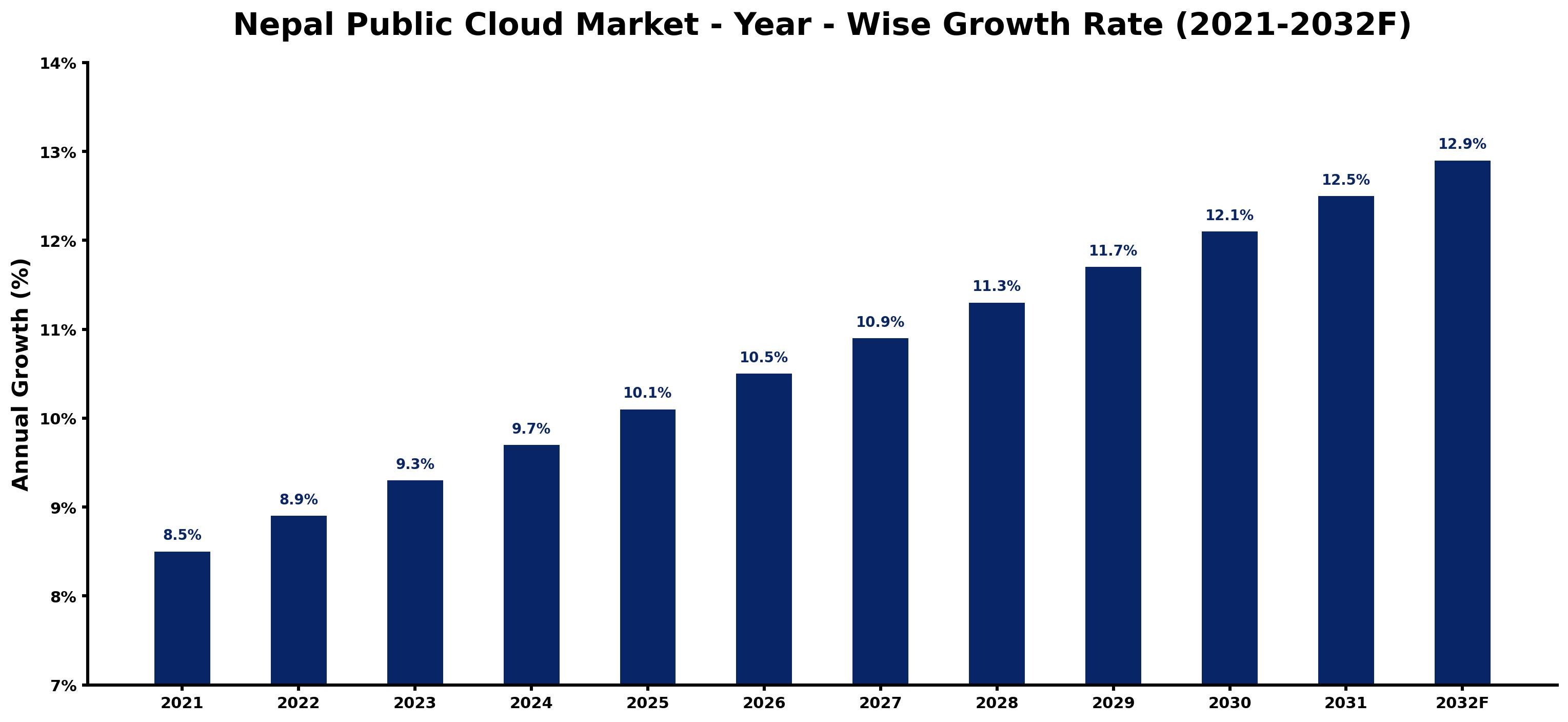
The table below presents the year‑wise growth rates along with the key drivers influencing the market
| Year | Growth Rate | Major Drivers |
| 2021 | 8.5% | Growing adoption of digital payment systems in Nepal |
| 2022 | 8.9% | Government support for ICT innovation and infrastructure development |
| 2023 | 9.3% | Increased remote work driving cloud service demands |
| 2024 | 9.7% | Local startups adopting cloud solutions for scalability |
| 2025 | 10.1% | E-learning initiatives boosting demand for online resources |
| 2026 | 10.5% | Enhanced internet penetration supporting cloud service accessibility |
| 2027 | 10.9% | Emergence of SMEs migrating to cloud-based solutions |
| 2028 | 11.3% | Cybersecurity regulations driving investments in cloud security |
| 2029 | 11.7% | Increased focus on data sovereignty influencing local cloud adoption |
| 2030 | 12.1% | Major telecommunications upgrades facilitating better cloud connectivity |
| 2031 | 12.5% | Public sector cloud initiatives streamlining government services |
| 2032 | 12.9% | Collaboration between tech companies and educational institutions |
Note: Market size estimations and growth projections presented in this report are based on 6Wresearch's proprietary forecasting methodology, utilizing the latest available industry data, government publications, and primary research inputs.
Nepal Public Cloud Market Key Takeaways
Below are some of the specific key takeaways from the market, including:
- Demand for Software as a Service (SaaS) solutions is rapidly increasing, particularly in areas like customer relationship management.
- Infrastructure as a Service (IaaS) is becoming essential as organizations seek to offload IT management.
- Cloud-based data storage services are gaining traction, driven by the need for secure data management.
- Local cloud service providers are emerging to meet specific market demands, enhancing competition.
- Government policies are actively promoting cloud adoption, which supports market growth.
Evaluation of Restraints in Nepal Public Cloud Market
Despite the promising outlook, several factors are holding back the Nepal Public Cloud Market. Limited internet connectivity poses a major challenge, particularly in rural areas where high-speed access remains scarce. Security and privacy concerns are also significant, as businesses hesitate to fully migrate to cloud solutions without robust data protection measures in place. Additionally, a lack of awareness about the benefits of cloud computing hampers widespread adoption. Addressing these issues will be crucial for the market to unlock its full potential.
Nepal Public Cloud Market Trends
A notable trend is the increasing demand for cloud-based collaboration tools as remote work becomes more normalized. Businesses are shifting towards SaaS applications not just for efficiency, but also for enhanced collaboration among teams scattered across different locations. on top of that, organizations are beginning to prioritize data security, leading to a rise in solutions that integrate advanced security features into their cloud offerings. These trends indicate a shift towards more sophisticated and user-friendly cloud solutions.
Nepal Public Cloud Market Opportunities
Investment opportunities abound in the Nepal Public Cloud Market, particularly in sectors looking to modernize their IT frameworks. The growing trend of e-commerce is creating a demand for reliable cloud services to support online transactions and customer management. Local data centers are also in high demand as companies seek to comply with data localization policies. Investors can capitalize on these opportunities by focusing on infrastructure upgrades and developing innovative cloud solutions tailored to the Nepali market.
Government Initiatives in the Nepal Public Cloud Market
The Nepalese government has recognized the potential of the public cloud market and is implementing policies to foster its growth. These initiatives aim to improve service delivery in both public and private sectors while ensuring data security and compliance. The government's proactive approach is essential for creating a conducive environment for cloud adoption.
- A recently launched "National Cloud Policy" encourages cloud service use across sectors while emphasizing data localization.
- Currently underway is a national digital infrastructure upgrade program aimed at enhancing internet connectivity nationwide.
- Upcoming plans include tax incentives for cloud service providers to stimulate investment in local technology infrastructure.
- A public-private initiative focusing on enhancing cybersecurity measures is expected to roll out in the next two years.
- Ongoing awareness campaigns are being conducted to educate businesses about the benefits of cloud computing.
Future Insights of the Nepal Public Cloud Market
Looking ahead, the Nepal Public Cloud Market is set for substantial growth. As internet penetration continues to improve and more businesses recognize the advantages of cloud technologies, demand will likely increase. The focus on operational efficiency and cost-effectiveness will drive further adoption of cloud services. In addition, evolving consumer behaviors and preferences towards digital solutions will create new opportunities for cloud service providers.
Nepal Public Cloud Market Latest Developments
Recent developments in the Nepal Public Cloud Market highlight a dynamic shift towards enhanced cloud services and infrastructure. Companies are actively adapting to the changing demands of businesses, with new offerings and partnerships emerging to meet local needs.
- A major technology vendor launched a new cloud-based data management service in Q1 2025, enhancing data storage options for local businesses.
- An ongoing partnership between regional providers is focusing on developing integrated cloud solutions for SMEs, expected to enhance service delivery by late 2025.
- In early 2026, an initiative is set to begin that will establish a network of local data centers to support cloud service demands.
- A recent upgrade to cloud security protocols was completed in Q3 2025, improving data protection for users across various sectors.
- Upcoming in late 2026, a national awareness campaign will be launched to promote cloud adoption among businesses.
Nepal Public Cloud Market - Key Attractiveness of the Report
- 10 Years of Market Numbers
- Historical Data Starting from 2022 to 2025
- Base Year: 2025
- Forecast Data until 2032
- Key Performance Indicators Impacting the Market
- Major Upcoming Developments and Projects
Key Highlights of the Report:
- Nepal Public Cloud Market Outlook
- Market Size of Nepal Public Cloud Market, 2025
- Forecast of Nepal Public Cloud Market, 2032
- Historical Data and Forecast of Nepal Public Cloud Revenues & Volume for the Period 2022-2032F
- Nepal Public Cloud Market Trend Evolution
- Nepal Public Cloud Market Drivers and Challenges
- Nepal Public Cloud Price Trends
- Nepal Public Cloud Porter's Five Forces
- Nepal Public Cloud Industry Life Cycle
- Historical Data and Forecast of Nepal Public Cloud Market Revenues & Volume By Service Model for the Period 2022-2032F
- Historical Data and Forecast of Nepal Public Cloud Market Revenues & Volume By Infrastructure as a Service for the Period 2022-2032F
- Historical Data and Forecast of Nepal Public Cloud Market Revenues & Volume By Platform as a Service for the Period 2022-2032F
- Historical Data and Forecast of Nepal Public Cloud Market Revenues & Volume By Software as a Service for the Period 2022-2032F
- Historical Data and Forecast of Nepal Public Cloud Market Revenues & Volume By Organization Size Large enterprises for the Period 2022-2032F
- Historical Data and Forecast of Nepal Public Cloud Market Revenues & Volume By Small for the Period 2022-2032F
- Historical Data and Forecast of Nepal Public Cloud Market Revenues & Volume By Medium Enterprises SMEs for the Period 2022-2032F
- Historical Data and Forecast of Nepal Public Cloud Market Revenues & Volume By Verticals for the Period 2022-2032F
- Historical Data and Forecast of Nepal Public Cloud Market Revenues & Volume By BFSI for the Period 2022-2032F
- Historical Data and Forecast of Nepal Public Cloud Market Revenues & Volume By Telecommunication for the Period 2022-2032F
- Historical Data and Forecast of Nepal Public Cloud Market Revenues & Volume By IT & ITeS for the Period 2022-2032F
- Historical Data and Forecast of Nepal Public Cloud Market Revenues & Volume By Government & Public Sector for the Period 2022-2032F
- Historical Data and Forecast of Nepal Public Cloud Market Revenues & Volume By Retail & Consumer Goods for the Period 2022-2032F
- Historical Data and Forecast of Nepal Public Cloud Market Revenues & Volume By Manufacturing for the Period 2022-2032F
- Historical Data and Forecast of Nepal Public Cloud Market Revenues & Volume By Energy & Utility for the Period 2022-2032F
- Historical Data and Forecast of Nepal Public Cloud Market Revenues & Volume By Media & Entertainment for the Period 2022-2032F
- Nepal Public Cloud Import Export Trade Statistics
- Market Opportunity Assessment By Service Model
- Market Opportunity Assessment By Organization Size Large enterprises
- Market Opportunity Assessment By Verticals
- Nepal Public Cloud Top Companies Market Share
- Nepal Public Cloud Competitive Benchmarking By Technical and Operational Parameters
- Nepal Public Cloud Company Profiles
- Nepal Public Cloud Key Strategic Recommendations






































