Nepal Refined Petroleum Products Market Size, Share & Growth Rate
The Nepal Refined Petroleum Products Market was estimated at USD 433 Million in 2025 and is projected to reach USD 607 Million by 2032, growing at a CAGR of 4.9% from 2026 to 2032. This growth trajectory is primarily driven by rising energy demand from the transportation sector, burgeoning industrial activities, and an increasing focus on household energy needs. Additionally, the governments commitment to infrastructure expansion and energy access further solidifies the market's favorable outlook.
Nepal Refined Petroleum Products Market Year-wise Growth Rate and Key Drivers
This graph highlights how the Nepal Refined Petroleum Products Market has steadily grown over the years, supported by major growth factors.
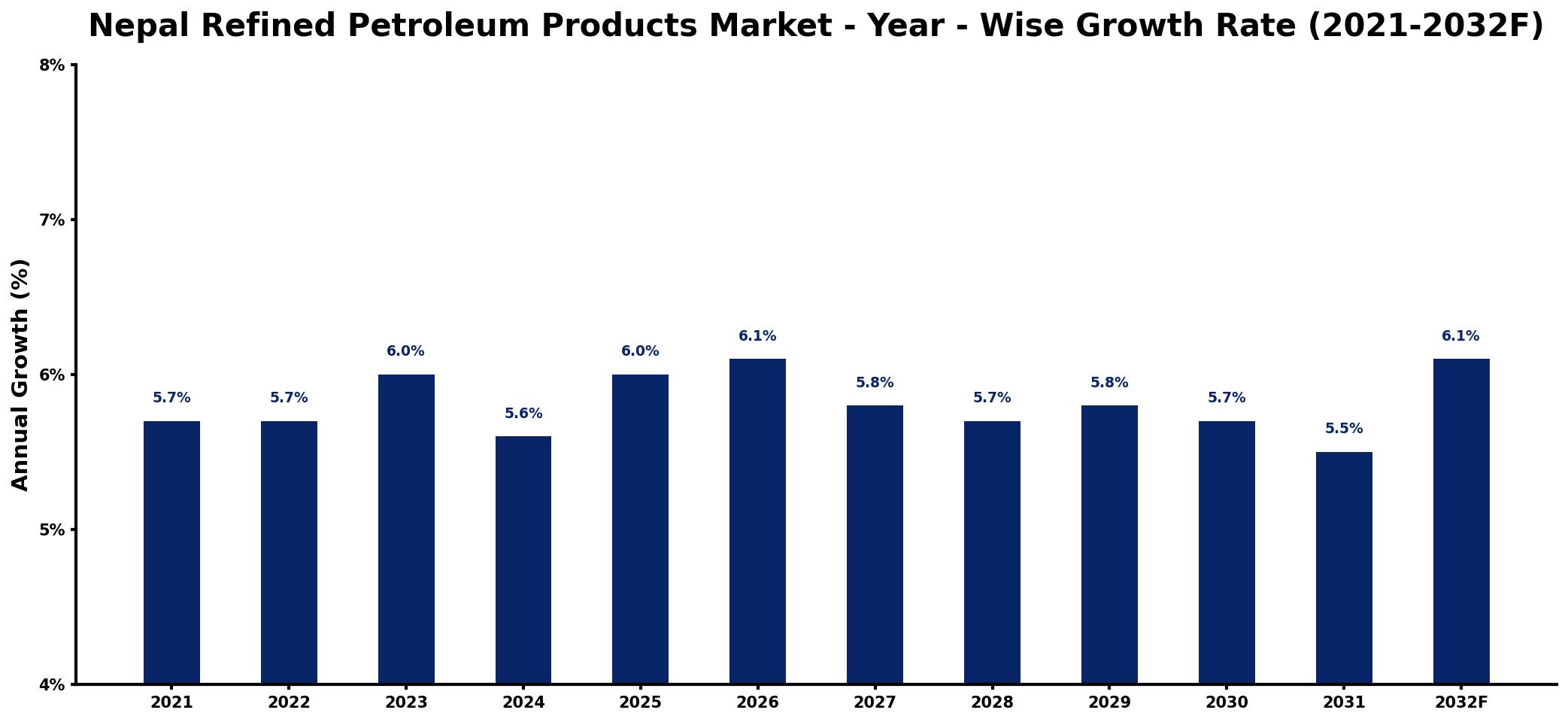
The table below presents the year‑wise growth rates along with the key drivers influencing the market
| Year | Growth Rate | Major Drivers |
| 2021 | 5.7% | Rising transportation sector investments |
| 2022 | 5.7% | Increased industrial production activities |
| 2023 | 6.0% | Enhanced infrastructure development projects |
| 2024 | 5.6% | Growing energy consumption patterns |
| 2025 | 6.0% | Expansion of transportation networks |
| 2026 | 6.1% | Development of new industrial facilities |
| 2027 | 5.8% | Boost in tourism and travel |
| 2028 | 5.7% | Rising urban population demands |
| 2029 | 5.8% | Increased agricultural machinery usage |
| 2030 | 5.7% | Strengthened regional trade agreements |
| 2031 | 5.5% | Growing demand for logistics services |
| 2032 | 6.1% | Investment in renewable energy initiatives |
Note: Market size estimations and growth projections presented in this report are based on 6Wresearch's proprietary forecasting methodology, utilizing the latest available industry data, government publications, and primary research inputs.
Nepal Refined Petroleum Products Market Synopsis
The strongest force shaping the Nepal Refined Petroleum Products Market is the state-owned Nepal Oil Corporation (NOC), which controls the import, storage, and distribution of refined petroleum products. This centralized approach not only ensures a stable supply but also influences pricing and availability across the nation.
As fuel consumption rises, particularly for diesel and gasoline, the market is adapting to meet the growing energy demands of both urban and rural populations. Enhanced infrastructure and regulatory policies aimed at promoting cleaner fuels are also significant factors influencing market dynamics.
Nepal Refined Petroleum Products Market Key Takeaways
- The market is primarily driven by increasing demand for gasoline and diesel fuel across various sectors.
- Government initiatives are facilitating the transition towards cleaner fuel options like LPG and CNG.
- The centralization of petroleum distribution by NOC plays a crucial role in market stability.
- Infrastructure development is essential for addressing supply chain inefficiencies.
- Investments in alternative energy sources are emerging as competitive threats to traditional petroleum products.
Evaluation of Restraints in Nepal Refined Petroleum Products Market
Several significant restraints currently challenge the growth of the Nepal Refined Petroleum Products Market. Fluctuating global oil prices contribute to inconsistent local fuel pricing, complicating budget management for consumers and businesses alike. Furthermore, inadequate infrastructure for storage and distribution systems results in inefficiencies that impact the supply chain. Nepal's dependency on imports due to limited domestic refining capacity also presents a vulnerability, particularly in times of geopolitical tension or global market disruptions. Coupled with political instability and changing government regulations, these factors create a complex operating environment for stakeholders in the market.
Nepal Refined Petroleum Products Market Trends
The market is witnessing a notable shift towards cleaner fuel alternatives, such as liquefied petroleum gas (LPG) and compressed natural gas (CNG), driven by government initiatives aimed at reducing air pollution and fostering sustainable energy solutions. Additionally, consumers are increasingly interested in energy-efficient technologies and vehicles, contributing to a growing market for low-emission options. Investments are also being channeled into infrastructure upgrades, ensuring enhanced storage capabilities and distribution networks that meet the evolving demands of the market.
Nepal Refined Petroleum Products Market Opportunities
Opportunities for investment in the Nepal Refined Petroleum Products Market are abundant. The expansion of refining capacities stands out as a critical area to meet rising domestic demand. Additionally, the development of retail and distribution networks presents lucrative prospects, particularly as consumer bases continue to grow. Investing in infrastructure improvements, such as efficient storage facilities and advanced logistics systems, can significantly enhance supply chain effectiveness, while also opening new revenue streams. The potential for exploring and trading imported refined petroleum products aligns well with Nepal's consumption needs, marking another avenue for investment.
Government Initiatives in the Nepal Refined Petroleum Products Market
The government of Nepal regulates the refined petroleum products market through various measures aimed at ensuring stable pricing, maintaining quality standards, and facilitating a steady supply of fuel. The Nepal Oil Corporation plays a pivotal role in managing these processes, regularly adjusting fuel prices in response to global market fluctuations. Moreover, initiatives promoting renewable energy sources are being implemented as part of the country's broader commitment to sustainable development and environmental conservation.
Future Insights of the Nepal Refined Petroleum Products Market
Looking ahead to 2026-2032, the Nepal Refined Petroleum Products Market is positioned for notable growth. Urbanization and rising disposable incomes will likely increase demand for various petroleum products, particularly gasoline and diesel. Government strategies focused on infrastructure development and energy security will further bolster market growth. While the shift towards alternative energy sources poses challenges, it also opens avenues for innovation, suggesting a dynamic future for stakeholders willing to adapt to changing consumer preferences and technological advancements.
Nepal Refined Petroleum Products Market Latest Developments (2025 - 2026)
Recent trends in the Nepal Refined Petroleum Products Market indicate a continued emphasis on enhancing the countrys petroleum infrastructure. Government and private sector collaborations are emerging to invest in advanced storage and distribution facilities. Moreover, the demand for cleaner fuels is prompting retailers to diversify their offerings to include more environmentally friendly options. Regulatory updates aimed at promoting sustainable energy sources are expected to create an evolving competitive landscape in the months ahead.
Nepal Refined Petroleum Products Market - Key Attractiveness of the Report
- 10 Years of Market Numbers
- Historical Data Starting from 2022 to 2025
- Base Year: 2025
- Forecast Data until 2032
- Key Performance Indicators Impacting the Market
- Major Upcoming Developments and Projects
Key Highlights of the Report:
- Nepal Refined Petroleum Products Market Outlook
- Market Size of Nepal Refined Petroleum Products Market, 2025
- Forecast of Nepal Refined Petroleum Products Market, 2032
- Historical Data and Forecast of Nepal Refined Petroleum Products Revenues & Volume for the Period 2022-2032F
- Nepal Refined Petroleum Products Market Trend Evolution
- Nepal Refined Petroleum Products Market Drivers and Challenges
- Nepal Refined Petroleum Products Price Trends
- Nepal Refined Petroleum Products Porter's Five Forces
- Nepal Refined Petroleum Products Industry Life Cycle
- Historical Data and Forecast of Nepal Refined Petroleum Products Market Revenues & Volume By Product Type for the Period 2022-2032F
- Historical Data and Forecast of Nepal Refined Petroleum Products Market Revenues & Volume By Diesel for the Period 2022-2032F
- Historical Data and Forecast of Nepal Refined Petroleum Products Market Revenues & Volume By Gasoline for the Period 2022-2032F
- Historical Data and Forecast of Nepal Refined Petroleum Products Market Revenues & Volume By Fuel Oils for the Period 2022-2032F
- Historical Data and Forecast of Nepal Refined Petroleum Products Market Revenues & Volume By Kerosene for the Period 2022-2032F
- Historical Data and Forecast of Nepal Refined Petroleum Products Market Revenues & Volume By Others for the Period 2022-2032F
- Historical Data and Forecast of Nepal Refined Petroleum Products Market Revenues & Volume By Application for the Period 2022-2032F
- Historical Data and Forecast of Nepal Refined Petroleum Products Market Revenues & Volume By Fuel for the Period 2022-2032F
- Historical Data and Forecast of Nepal Refined Petroleum Products Market Revenues & Volume By Chemical for the Period 2022-2032F
- Historical Data and Forecast of Nepal Refined Petroleum Products Market Revenues & Volume By Others for the Period 2022-2032F
- Historical Data and Forecast of Nepal Refined Petroleum Products Market Revenues & Volume By Fraction for the Period 2022-2032F
- Historical Data and Forecast of Nepal Refined Petroleum Products Market Revenues & Volume By Light Distillates for the Period 2022-2032F
- Historical Data and Forecast of Nepal Refined Petroleum Products Market Revenues & Volume By Middle Distillates for the Period 2022-2032F
- Historical Data and Forecast of Nepal Refined Petroleum Products Market Revenues & Volume By Heavy Oils for the Period 2022-2032F
- Nepal Refined Petroleum Products Import Export Trade Statistics
- Market Opportunity Assessment By Product Type
- Market Opportunity Assessment By Application
- Market Opportunity Assessment By Fraction
- Nepal Refined Petroleum Products Top Companies Market Share
- Nepal Refined Petroleum Products Competitive Benchmarking By Technical and Operational Parameters
- Nepal Refined Petroleum Products Company Profiles
- Nepal Refined Petroleum Products Key Strategic Recommendations






































