Nepal Sanitary Paper Market Summary
The nepal sanitary paper market was estimated at USD 1016 Million in 2025 and is projected to reach USD 1465 Million by 2032, growing at a CAGR of 6.5% from 2026 to 2032.
Nepal Sanitary Paper Market Year-wise Growth Rate and Key Drivers
This graph highlights how the Nepal Sanitary Paper Market has steadily grown over the past five years, supported by major growth factors.
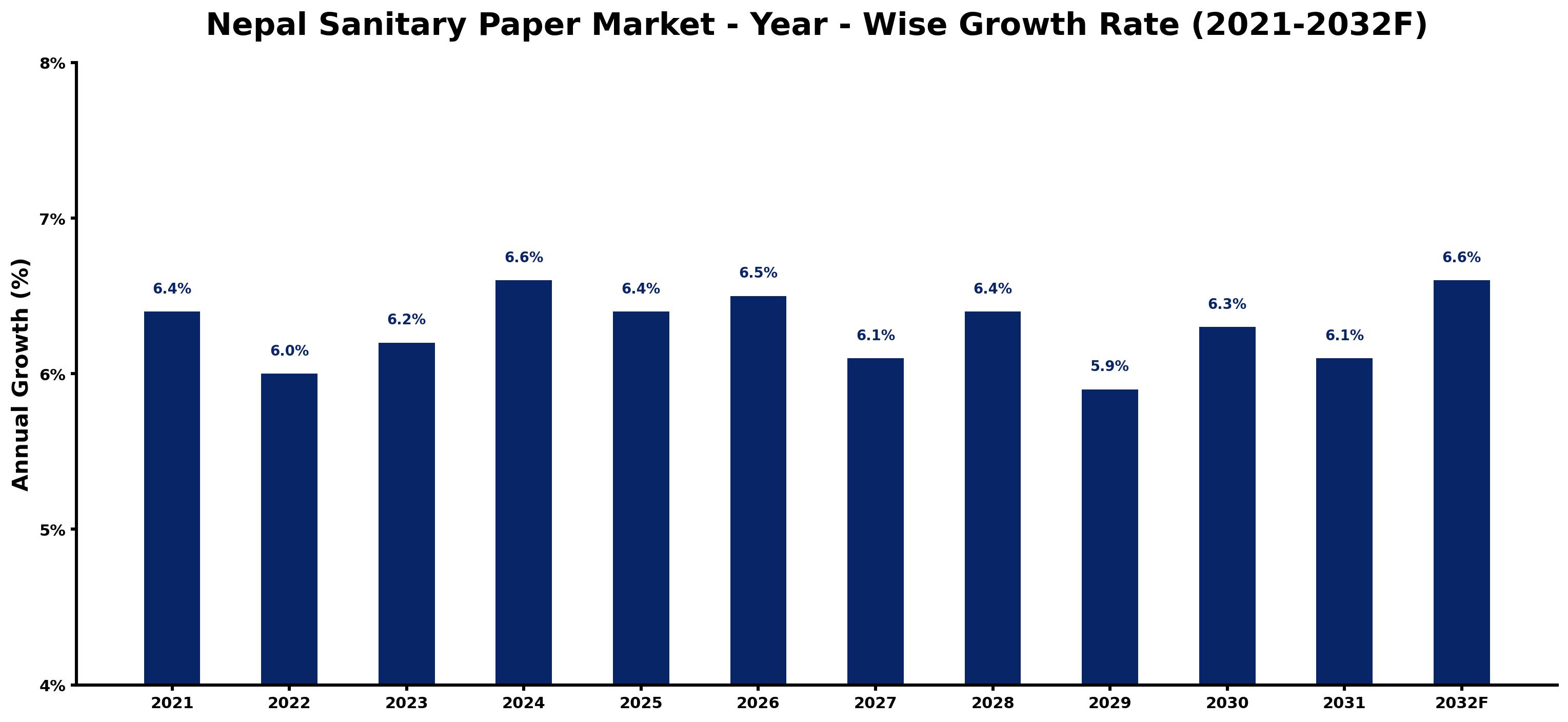
The table below presents the year wise growth rates along with the key drivers influencing the market
| Year | Growth Rate | Major Drivers |
| 2021 | 6.4% | Consumer awareness about hygiene elevates preferences for high-quality sanitary paper products. |
| 2022 | 6.0% | Emerging e-commerce platforms reshape distribution channels for sanitary paper in Nepal. |
| 2023 | 6.2% | Urbanization trends create a higher demand for household sanitary paper products. |
| 2024 | 6.6% | Local manufacturers invest in sustainable materials, appealing to environmentally conscious consumers. |
| 2025 | 6.4% | Rural electrification projects lead to increased purchasing power for sanitary items. |
| 2026 | 6.5% | Integration of local brands into global supply chains enhances product availability. |
| 2027 | 6.1% | Brand loyalty strengthens as consumers prioritize quality over cost in sanitary products. |
| 2028 | 6.4% | New packaging innovations capture consumer interest, promoting brand differentiation. |
| 2029 | 5.9% | Health campaigns amplify the importance of hygienic practices, boosting paper usage. |
| 2030 | 6.3% | Expansion of retail outlets provides better access to sanitary products across regions. |
| 2031 | 6.1% | Technological improvements streamline production, reducing costs for manufacturers. |
| 2032 | 6.6% | Sustainable practices gain traction, transforming consumer preferences towards eco-friendly options. |
Note - Market size estimations and growth projections presented in this report are based on 6Wresearch's advanced forecasting approach, validated with industry datasets as of June 2026.
Nepal Sanitary Paper Market Synopsis
The Nepal Sanitary Paper Market is projected to reach 6.5% and witness significant growth during the forecast period (2026-2032). The anticipated growth rate of 8.4% CAGR is driven by an increasing consumer awareness surrounding hygiene and sanitation, alongside a rise in disposable incomes. This market is further supported by government initiatives aimed at promoting hygienic products to mitigate diseases such as cholera, dysentery, typhoid fever, and hepatitis A. Efforts geared towards enhancing the availability of sanitary papers in rural regions also play a crucial role in bolstering market expansion. Sanitary papers, including toilet paper, facial tissues, and napkins, are essential for personal hygiene, predominantly utilized across households and healthcare facilities due to their absorbent qualities and softness.
Nepal Sanitary Paper Market Growth Drivers
The Nepal Sanitary Paper Market's growth can be attributed to several key factors:
- The rising consumer awareness regarding hygiene has become a significant motivator, leading to increased demand for sanitary products across various demographics.
- Increasing disposable incomes among the middle class enable consumers to invest in quality hygiene products, thus expanding market reach.
- Government initiatives that advocate for improved sanitation practices create a favorable environment for the growth of sanitary paper consumption.
- The expansion of distribution networks into rural areas facilitates access to these products, enabling enhanced penetration into previously underserved markets.
- Innovative packaging and product variations, including scented and unscented options, attract a broader customer base, thus enhancing market appeal.
Nepal Sanitary Paper Market Trends and Opportunities
The evolving landscape of the Nepal Sanitary Paper Market reveals several emerging trends and opportunities that could shape the future of the industry:
- Growing urbanization contributes significantly to the demand for sanitary papers as urban areas stress hygiene and sanitation more than rural environments.
- Sustainability trends are gaining traction, leading to potential market opportunities in eco-friendly and biodegradable sanitary paper products.
- Rising health awareness regarding sanitary products' impact on personal health opens avenues for manufacturers to introduce specialized products.
- Digital marketing strategies and e-commerce platforms facilitate improved accessibility and shopping convenience for consumers.
- Collaborative partnerships between manufacturers and governmental bodies could result in the introduction of subsidized sanitary products for lower-income families.
Nepal Sanitary Paper Market Challenges and Restraints
While the Nepal Sanitary Paper Market presents numerous growth opportunities, certain challenges may hinder its potential:
- The relatively high cost of sanitary products poses a barrier for lower-income segments, potentially limiting market penetration and revenue generation.
- Lack of awareness in remote areas about the importance of hygiene and sanitation may affect product consumption rates.
- Competition from locally produced, lower-cost alternatives might impact the sales of premium offerings.
- Supply chain disruptions due to external factors, such as natural disasters or economic fluctuations, can adversely affect product availability.
- Limited infrastructure for waste disposal and recycling can lead to negative perceptions regarding product sustainability.
Nepal Sanitary Paper Market Government Investment and Initiatives
The government of Nepal is actively investing in initiatives aimed at enhancing sanitation standards across the country. These policies are designed to promote hygienic practices that can lead to a decrease in disease transmission rates. Key government measures include:
- Implementation of public health campaigns that educate citizens about the importance of sanitation and the role of sanitary products in maintaining hygiene.
- Allocation of budgetary resources to improve sanitation infrastructure, especially in rural areas, thus facilitating access to sanitary products.
- Collaboration with non-governmental organizations to provide training programs on hygiene practices, targeting both adults and children.
- Initiatives to subsidize sanitary products for low-income families, increasing affordability and encouraging usage.
- Development of regulatory frameworks that encourage manufacturers to adhere to quality standards for sanitary products.
Nepal Sanitary Paper Market Latest Developments (May 2025 - June 2026)
Recent developments in the Nepal Sanitary Paper Market from May 2025 to June 2026 indicate a shift towards increased innovation and sustainability. Industry players are focusing on the introduction of environmentally friendly products while enhancing distribution networks to reach consumers more effectively. There has also been a marked increase in collaborations aimed at improving public awareness about hygiene and sanitation. Strategic marketing initiatives are being employed to promote newly launched product lines, ensuring they are tailored to the preferences of different demographic groups. Overall, the emphasis on health, sanitation, and sustainability continues to drive market dynamics.
Nepal Sanitary Paper Market - Key Attractiveness of the Report
- 10 Years of Market Numbers
- Historical Data Starting from 2022 to 2025
- Base Year: 2025
- Forecast Data until 2032
- Key Performance Indicators Impacting the Market
- Major Upcoming Developments and Projects
Key Highlights of the Report:
- Nepal Sanitary Paper Market Outlook
- Market Size of Nepal Sanitary Paper Market, 2025
- Forecast of Nepal Sanitary Paper Market, 2032F
- Historical Data and Forecast of Nepal Sanitary Paper Revenues & Volume for the Period 2022-2032F
- Nepal Sanitary Paper Market Trend Evolution
- Nepal Sanitary Paper Market Drivers and Challenges
- Nepal Sanitary Paper Price Trends
- Nepal Sanitary Paper Porter's Five Forces
- Nepal Sanitary Paper Industry Life Cycle
- Historical Data and Forecast of Nepal Sanitary Paper Market Revenues & Volume By Product Types for the Period 2022-2032F
- Historical Data and Forecast of Nepal Sanitary Paper Market Revenues & Volume By Tissues And Handkerchiefs for the Period 2022-2032F
- Historical Data and Forecast of Nepal Sanitary Paper Market Revenues & Volume By Table Napkins for the Period 2022-2032F
- Historical Data and Forecast of Nepal Sanitary Paper Market Revenues & Volume By Toilet Paper for the Period 2022-2032F
- Historical Data and Forecast of Nepal Sanitary Paper Market Revenues & Volume By Towels for the Period 2022-2032F
- Historical Data and Forecast of Nepal Sanitary Paper Market Revenues & Volume By Sanitary Napkins And Tampons for the Period 2022-2032F
- Historical Data and Forecast of Nepal Sanitary Paper Market Revenues & Volume By Disposable Diapers for the Period 2022-2032F
- Historical Data and Forecast of Nepal Sanitary Paper Market Revenues & Volume By Application? for the Period 2022-2032F
- Historical Data and Forecast of Nepal Sanitary Paper Market Revenues & Volume By Residential for the Period 2022-2032F
- Historical Data and Forecast of Nepal Sanitary Paper Market Revenues & Volume By Commercial for the Period 2022-2032F
- Nepal Sanitary Paper Import Export Trade Statistics
- Market Opportunity Assessment By Product Types
- Market Opportunity Assessment By Application?
- Nepal Sanitary Paper Top Companies Market Share
- Nepal Sanitary Paper Competitive Benchmarking By Technical and Operational Parameters
- Nepal Sanitary Paper Company Profiles
- Nepal Sanitary Paper Key Strategic Recommendations






































