Nepal Scissors and Shears Market Summary
The nepal scissors and shears market was estimated at USD 405 Million in 2025 and is projected to reach USD 537 Million by 2032, growing at a CAGR of 4.7% from 2026 to 2032.
Nepal Scissors and Shears Market Year-wise Growth Rate and Key Drivers
This graph highlights how the Nepal Scissors and Shears Market has steadily grown over the past five years, supported by major growth factors.
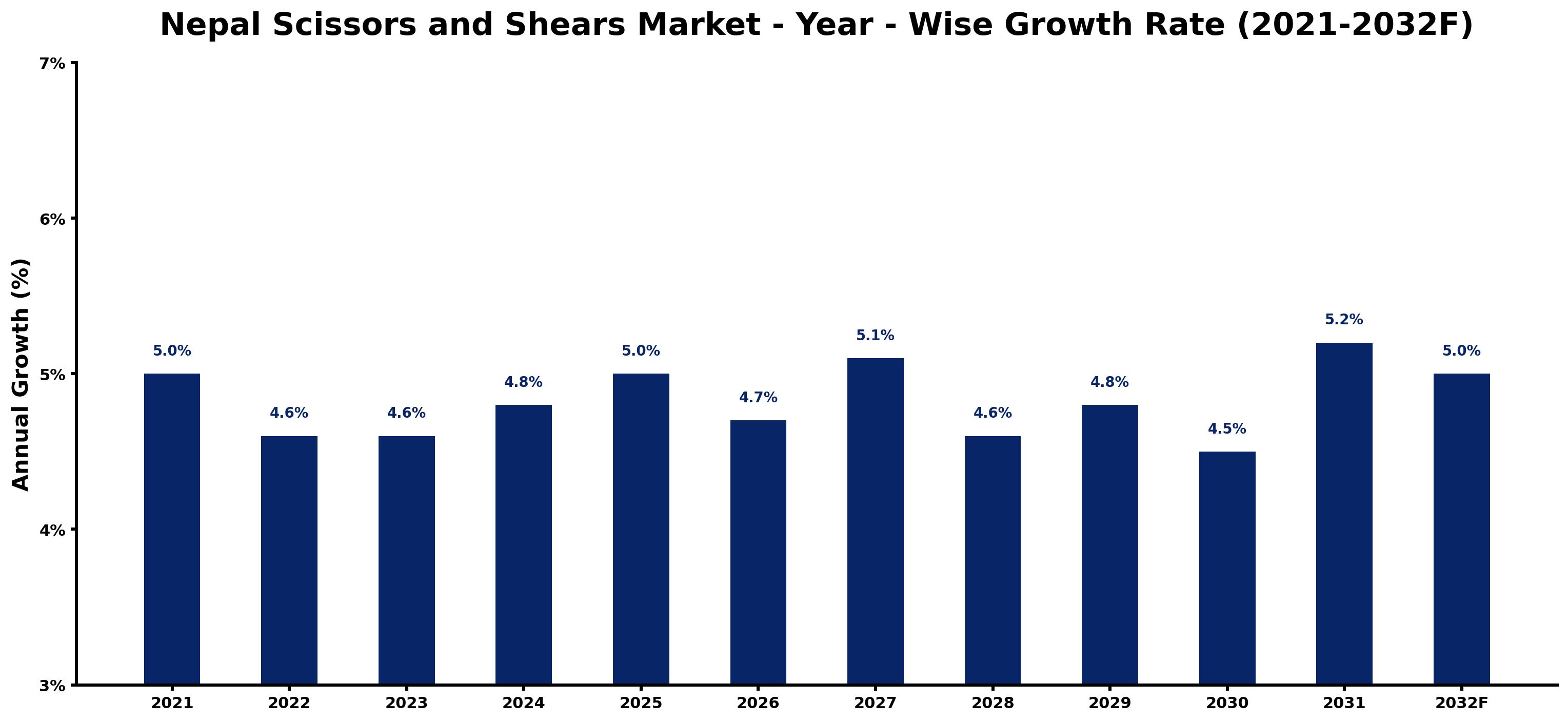
The table below presents the year wise growth rates along with the key drivers influencing the market
| Year | Growth Rate | Major Drivers |
| 2021 | 5.0% | Local artisans increasingly value quality, elevating demand for premium scissors and shears. |
| 2022 | 4.6% | Urbanization trends fuel interest in home gardening, boosting kitchen and garden tool sales. |
| 2023 | 4.6% | E-commerce platforms offer greater accessibility, transforming purchasing habits for scissors and shears. |
| 2024 | 4.8% | Manufacturers focus on sustainability, introducing eco-friendly materials into product lines. |
| 2025 | 5.0% | Education programs on crafts and trades grow, leading to increased tool usage among students. |
| 2026 | 4.7% | Export opportunities expand with improved logistics, introducing Nepalese scissors to international markets. |
| 2027 | 5.1% | Regional fashion and textile industries flourish, enhancing the need for specialized cutting tools. |
| 2028 | 4.6% | Cultural events celebrating craftsmanship spark interest in locally made scissors and shears. |
| 2029 | 4.8% | Technological integrations support precision cutting, attracting professionals and hobbyists alike. |
| 2030 | 4.5% | Partnerships between local artists and manufacturers promote innovation in design and functionality. |
| 2031 | 5.2% | Health and wellness trends encourage DIY grooming, increasing demand for high-quality personal care shears. |
| 2032 | 5.0% | Consumer awareness about tool maintenance grows, fostering a culture of quality over quantity. |
Note - Market size estimations and growth projections presented in this report are based on 6Wresearch's advanced forecasting approach, validated with industry datasets as of June 2026.
Nepal Scissors and Shears Market Synopsis
The Nepal Scissors and Shears Market is projected to reach 4.7% and witness significant growth during the forecast period (2026-2032). This market is poised to grow at a compound annual growth rate (CAGR) of 8.6%, driven by several key factors including an increasing demand for stationery items, rising disposable incomes, and the expansion of organized retailing throughout the country. Furthermore, a burgeoning e-commerce sector coupled with favorable government policies is expected to provide a robust foundation for growth in the Nepal scissors and shears market.
Nepal Scissors and Shears Market Growth Drivers
The growth of the Nepal scissors and shears market can be attributed to several interrelated drivers. Firstly, the surge in demand for stationery items is a cornerstone for market expansion, as schools, offices, and households increasingly require these tools. Secondly, the rising disposable incomes in Nepal allow consumers to invest in higher quality products, which often includes premium scissors and shears that boast better craftsmanship and durability.
Additionally, the shift towards organized retailing has made these products more accessible to consumers. With the growth of shopping malls and retail chains, consumers are exposed to a wider range of options, further stimulating demand. The digital transformation brought on by e-commerce platforms is another significant driver, facilitating convenient purchasing experiences and expanding market reach.
Lastly, innovation in product design, including various blade shapes and sizes, along with the ongoing promotional activities by manufacturers, is expected to enhance consumer interest and ultimately stimulate market growth. These factors combined paint a promising picture for the future of the Nepal scissors and shears market.
Nepal Scissors and Shears Market Challenges and Restraints
While the Nepal scissors and shears market shows promising growth potential, there are challenges and restraints that could impact its trajectory. One major issue is the heavy dependence on imports, particularly from countries like China. While these imports are often cost-effective, they can pose risks to local production and employment rates. Additionally, fluctuations in global supply chains may affect availability and pricing, challenging local retailers.
Another restraint is the competition between low-cost imported products and domestic manufacturing. Local manufacturers may struggle to compete on price, which could limit their market share. Furthermore, a lack of awareness among consumers regarding quality metrics and product differentiation can hinder the acceptance of locally produced items.
Furthermore, economic fluctuations or downturns can impact disposable income levels, subsequently affecting consumer spending on non-essential items like scissors and shears. Finally, potential regulatory challenges and changes in import duties could impose additional barriers for businesses operating within this space.
Nepal Scissors and Shears Market Government Investment and Initiatives
The Nepalese government plays a critical role in shaping the landscape of the scissors and shears market through various investment initiatives and policies. Existing government policies are designed to boost local manufacturing, thereby encouraging the production of high-quality scissors and shears domestically. By implementing favorable import duties, the government aims to support local manufacturers while still allowing room for competitive pricing from foreign imports.
Additionally, government initiatives focused on improving e-commerce infrastructure are expected to enhance online retail opportunities for local businesses. By facilitating better access to digital platforms, the government actively promotes the growth of organized retailing, thereby enabling local manufacturers to reach broader consumer bases.
Investment in public infrastructure, such as transportation and logistics, will also play a pivotal role in improving supply chain efficiency, thereby benefiting market players. These initiatives serve not only to stimulate growth in the scissors and shears market but also contribute to the overall economic development of the region, creating job opportunities and supporting the local economy.
Nepal Scissors and Shears Market Latest Developments (May 2025 - June 2026)
In the period from May 2025 to June 2026, the Nepal scissors and shears market has seen several notable developments that have influenced its direction. A key trend has been the increased focus on sustainability, with a growing emphasis on creating eco-friendly tools using biodegradable materials. This shift aligns with global consumer preferences for sustainable products and could open new market avenues.
Moreover, there has been a marked rise in digital marketing efforts by various firms trying to capture the burgeoning online market, leading to enhanced consumer engagement. As the e-commerce landscape continues to mature, more players are investing in digital strategies to improve their visibility and consumer reach.
Additionally, product innovation has gained momentum, with manufacturers experimenting with ergonomic designs to enhance usability and appeal to a broader audience. This focus on user-centered design is likely to enhance product differentiation in an increasingly competitive market.
Nepal Scissors and Shears Market - Key Attractiveness of the Report
- 10 Years of Market Numbers
- Historical Data Starting from 2022 to 2025
- Base Year: 2025
- Forecast Data until 2032
- Key Performance Indicators Impacting the Market
- Major Upcoming Developments and Projects
Key Highlights of the Report:
- Nepal Scissors and Shears Market Outlook
- Market Size of Nepal Scissors and Shears Market, 2025
- Forecast of Nepal Scissors and Shears Market, 2032F
- Historical Data and Forecast of Nepal Scissors and Shears Revenues & Volume for the Period 2022-2032F
- Nepal Scissors and Shears Market Trend Evolution
- Nepal Scissors and Shears Market Drivers and Challenges
- Nepal Scissors and Shears Price Trends
- Nepal Scissors and Shears Porter's Five Forces
- Nepal Scissors and Shears Industry Life Cycle
- Historical Data and Forecast of Nepal Scissors and Shears Market Revenues & Volume By Type for the Period 2022-2032F
- Historical Data and Forecast of Nepal Scissors and Shears Market Revenues & Volume By Scissors for the Period 2022-2032F
- Historical Data and Forecast of Nepal Scissors and Shears Market Revenues & Volume By Shears for the Period 2022-2032F
- Historical Data and Forecast of Nepal Scissors and Shears Market Revenues & Volume By Application for the Period 2022-2032F
- Historical Data and Forecast of Nepal Scissors and Shears Market Revenues & Volume By Residential for the Period 2022-2032F
- Historical Data and Forecast of Nepal Scissors and Shears Market Revenues & Volume By Non-Residential for the Period 2022-2032F
- Nepal Scissors and Shears Import Export Trade Statistics
- Market Opportunity Assessment By Type
- Market Opportunity Assessment By Application
- Nepal Scissors and Shears Top Companies Market Share
- Nepal Scissors and Shears Competitive Benchmarking By Technical and Operational Parameters
- Nepal Scissors and Shears Company Profiles
- Nepal Scissors and Shears Key Strategic Recommendations






































