Nepal Solenoid Valve Market Size, Share & Growth Rate
The Nepal Solenoid Valve Market was estimated at USD 296 Million in 2025 and is projected to reach USD 386 Million by 2032, growing at a CAGR of 3.9% from 2026 to 2032. This growth trajectory is fueled by the rapid pace of industrialization and the rising adoption of automation technologies across various sectors in Nepal, including manufacturing and agriculture. Furthermore, government investments in infrastructure and water management systems are acting as catalysts for increased demand, ensuring a robust future for solenoid valve applications.
Nepal Solenoid Valve Market Year-wise Growth Rate and Key Drivers
This graph highlights how the Nepal Solenoid Valve Market has steadily grown over the years, supported by major growth factors.
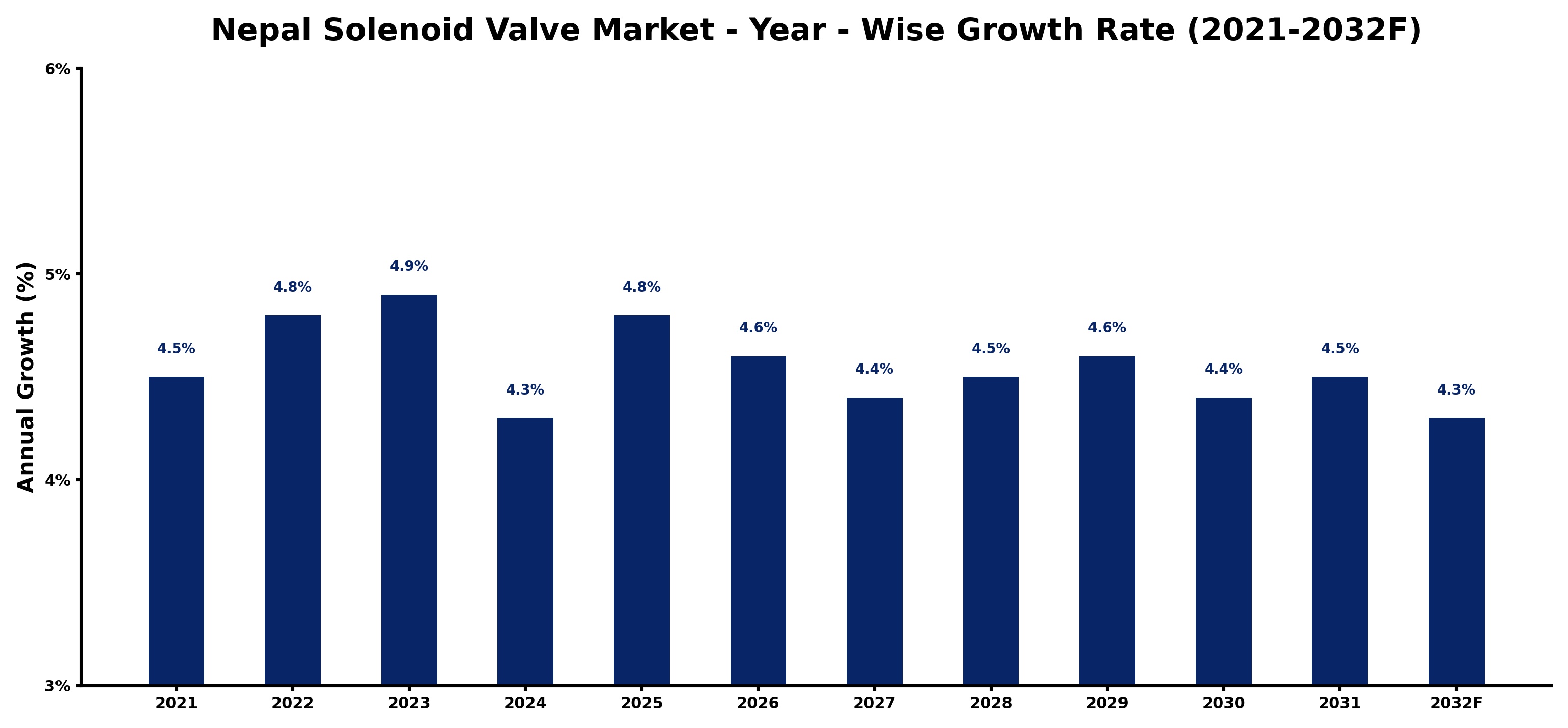
The table below presents the year‑wise growth rates along with the key drivers influencing the market
| Year | Growth Rate | Major Drivers |
| 2021 | 4.5% | Growing urbanization and commercial development |
| 2022 | 4.8% | Increasing industrial automation investments |
| 2023 | 4.9% | Increasing smart city development projects |
| 2024 | 4.3% | Increasing industrial infrastructure investments |
| 2025 | 4.8% | Growing renewable energy integration projects |
| 2026 | 4.6% | Increasing adoption of advanced technologies |
| 2027 | 4.4% | Rapid growth in telecom and data center sectors |
| 2028 | 4.5% | Increasing smart city development projects |
| 2029 | 4.6% | Growing urbanization and commercial development |
| 2030 | 4.4% | Expansion of manufacturing activities |
| 2031 | 4.5% | Growing renewable energy integration projects |
| 2032 | 4.3% | Growing urbanization and commercial development |
Note - Market size estimations and growth projections presented in this report are based on 6Wresearch's advanced forecasting approach, validated with industry datasets as of June 2026.
Nepal Solenoid Valve Market Synopsis
Recently, the Nepal Solenoid Valve Market has witnessed a momentum shift, driven primarily by the surge in automation across diverse industries. As sectors like water treatment and healthcare continue to evolve, the demand for efficient flow control solutions is set to amplify.
Looking ahead, the market is expected to embrace innovations in technology and increasing focus on sustainability. These developments will not only enhance operational efficiencies but also align with global environmental standards, thus solidifying the market's growth potential.
Nepal Solenoid Valve Market Key Takeaways
- Industrial automation is a key growth driver for the solenoid valve market in Nepal.
- Government initiatives in infrastructure development significantly boost demand.
- Technological advancements, including IoT integration, are shaping the market landscape.
- Energy efficiency remains a focal point for industries opting for solenoid valves.
- Investment opportunities abound in customized solutions for local industrial requirements.
Evaluation of Restraints in Nepal Solenoid Valve Market
Despite the promising outlook, several challenges persist in the Nepal Solenoid Valve Market. A noticeable gap exists in the awareness and understanding of solenoid valves among potential end-users, particularly in less industrialized sectors like agriculture. Additionally, the quality of available products varies, often raising concerns about their durability under harsh environmental conditions. The absence of standardized regulations can lead to inconsistent product performance, which poses risks for widespread adoption. Addressing these issues is essential for fostering market growth and ensuring consumer trust in solenoid valve solutions.
Nepal Solenoid Valve Market Trends
Current trends in the Nepal Solenoid Valve Market highlight a strong inclination toward energy efficiency and automation. Companies are increasingly integrating advanced technologies such as remote monitoring and digital controls to meet the evolving needs of various industries. Furthermore, an emphasis on sustainable practices is encouraging manufacturers and end-users alike to adopt solenoid valves over traditional valve systems, as they offer reliable performance while consuming less power.
Nepal Solenoid Valve Market Opportunities
The Nepal Solenoid Valve Market presents substantial investment opportunities, particularly as the government prioritizes infrastructure projects in sectors like water treatment and industrial automation. Companies entering this market can benefit significantly by supplying high-quality solenoid valves tailored to local requirements. Moreover, partnerships with local manufacturers and distributors can facilitate market entry and enhance competitiveness. Investing in R&D to create customized solutions for unique applications will also be crucial for capturing emerging market segments.
Government Initiatives in the Nepal Solenoid Valve Market
The Nepalese government plays a vital role in shaping the solenoid valve market through policies aimed at promoting local manufacturing and ensuring product quality. Import regulations and tariffs are implemented to protect domestic industries while maintaining competitive pricing. Quality standards established by regulatory bodies further enhance consumer safety and product integrity. Such initiatives underscore the government's commitment to fostering a conducive environment for industry growth and development in the solenoid valve sector.
Future Insights of the Nepal Solenoid Valve Market
Looking forward, the Nepal Solenoid Valve Market is well-positioned for growth through 2026 and beyond. The increasing need for effective water and wastewater management solutions will drive further adoption across multiple sectors, including agriculture and healthcare. Technological innovations, alongside a greater emphasis on operational efficiency and sustainability, are expected to create a dynamic market landscape. As various industries in Nepal modernize, the demand for solenoid valves will likely see significant escalation, offering opportunities for both local and international players.
Nepal Solenoid Valve Market Latest Developments (May 2025 - June 2026)
In recent months, the Nepal Solenoid Valve Market has seen increased interest in smart valve technologies that integrate IoT capabilities for real-time monitoring and control. Industry stakeholders are exploring collaborations to enhance product offerings, aiming to address the rising expectations for energy-efficient and durable solutions. Moreover, various local manufacturers are ramping up their production capacities to meet the expected demand from infrastructure projects, signaling a robust outlook for the market.
Nepal Solenoid Valve Market - Key Attractiveness of the Report
- 10 Years of Market Numbers
- Historical Data Starting from 2022 to 2025
- Base Year: 2025
- Forecast Data until 2032
- Key Performance Indicators Impacting the Market
- Major Upcoming Developments and Projects
Key Highlights of the Report:
- Nepal Solenoid Valve Market Outlook
- Market Size of Nepal Solenoid Valve Market, 2025
- Forecast of Nepal Solenoid Valve Market, 2032
- Historical Data and Forecast of Nepal Solenoid Valve Revenues & Volume for the Period 2022-2032F
- Nepal Solenoid Valve Market Trend Evolution
- Nepal Solenoid Valve Market Drivers and Challenges
- Nepal Solenoid Valve Price Trends
- Nepal Solenoid Valve Porter's Five Forces
- Nepal Solenoid Valve Industry Life Cycle
- Historical Data and Forecast of Nepal Solenoid Valve Market Revenues & Volume By Body Material for the Period 2022-2032F
- Historical Data and Forecast of Nepal Solenoid Valve Market Revenues & Volume By Stainless Steel for the Period 2022-2032F
- Historical Data and Forecast of Nepal Solenoid Valve Market Revenues & Volume By Brass for the Period 2022-2032F
- Historical Data and Forecast of Nepal Solenoid Valve Market Revenues & Volume By Aluminium for the Period 2022-2032F
- Historical Data and Forecast of Nepal Solenoid Valve Market Revenues & Volume By Plastic for the Period 2022-2032F
- Historical Data and Forecast of Nepal Solenoid Valve Market Revenues & Volume By Valve Design Type for the Period 2022-2032F
- Historical Data and Forecast of Nepal Solenoid Valve Market Revenues & Volume By 2-way for the Period 2022-2032F
- Historical Data and Forecast of Nepal Solenoid Valve Market Revenues & Volume By 3-way for the Period 2022-2032F
- Historical Data and Forecast of Nepal Solenoid Valve Market Revenues & Volume By 4-way for the Period 2022-2032F
- Historical Data and Forecast of Nepal Solenoid Valve Market Revenues & Volume By 5-way for the Period 2022-2032F
- Historical Data and Forecast of Nepal Solenoid Valve Market Revenues & Volume By Industry for the Period 2022-2032F
- Historical Data and Forecast of Nepal Solenoid Valve Market Revenues & Volume By Oil & Gas for the Period 2022-2032F
- Historical Data and Forecast of Nepal Solenoid Valve Market Revenues & Volume By Chemical & Petrochemical for the Period 2022-2032F
- Historical Data and Forecast of Nepal Solenoid Valve Market Revenues & Volume By Water & Wastewater for the Period 2022-2032F
- Historical Data and Forecast of Nepal Solenoid Valve Market Revenues & Volume By Food & Beverages for the Period 2022-2032F
- Historical Data and Forecast of Nepal Solenoid Valve Market Revenues & Volume By Power Generation for the Period 2022-2032F
- Historical Data and Forecast of Nepal Solenoid Valve Market Revenues & Volume By Pharmaceuticals for the Period 2022-2032F
- Historical Data and Forecast of Nepal Solenoid Valve Market Revenues & Volume By Automotive for the Period 2022-2032F
- Historical Data and Forecast of Nepal Solenoid Valve Market Revenues & Volume By Others for the Period 2022-2032F
- Nepal Solenoid Valve Import Export Trade Statistics
- Market Opportunity Assessment By Body Material
- Market Opportunity Assessment By Valve Design Type
- Market Opportunity Assessment By Industry
- Nepal Solenoid Valve Top Companies Market Share
- Nepal Solenoid Valve Competitive Benchmarking By Technical and Operational Parameters
- Nepal Solenoid Valve Company Profiles
- Nepal Solenoid Valve Key Strategic Recommendations






































