Nepal Sports Flooring Market Summary
The nepal sports flooring market was estimated at USD 219 Million in 2025 and is projected to reach USD 287 Million by 2032, growing at a CAGR of 4.9% from 2026 to 2032.
Nepal Sports Flooring Market Year-wise Growth Rate and Key Drivers
This graph highlights how the Nepal Sports Flooring Market has steadily grown over the past five years, supported by major growth factors.
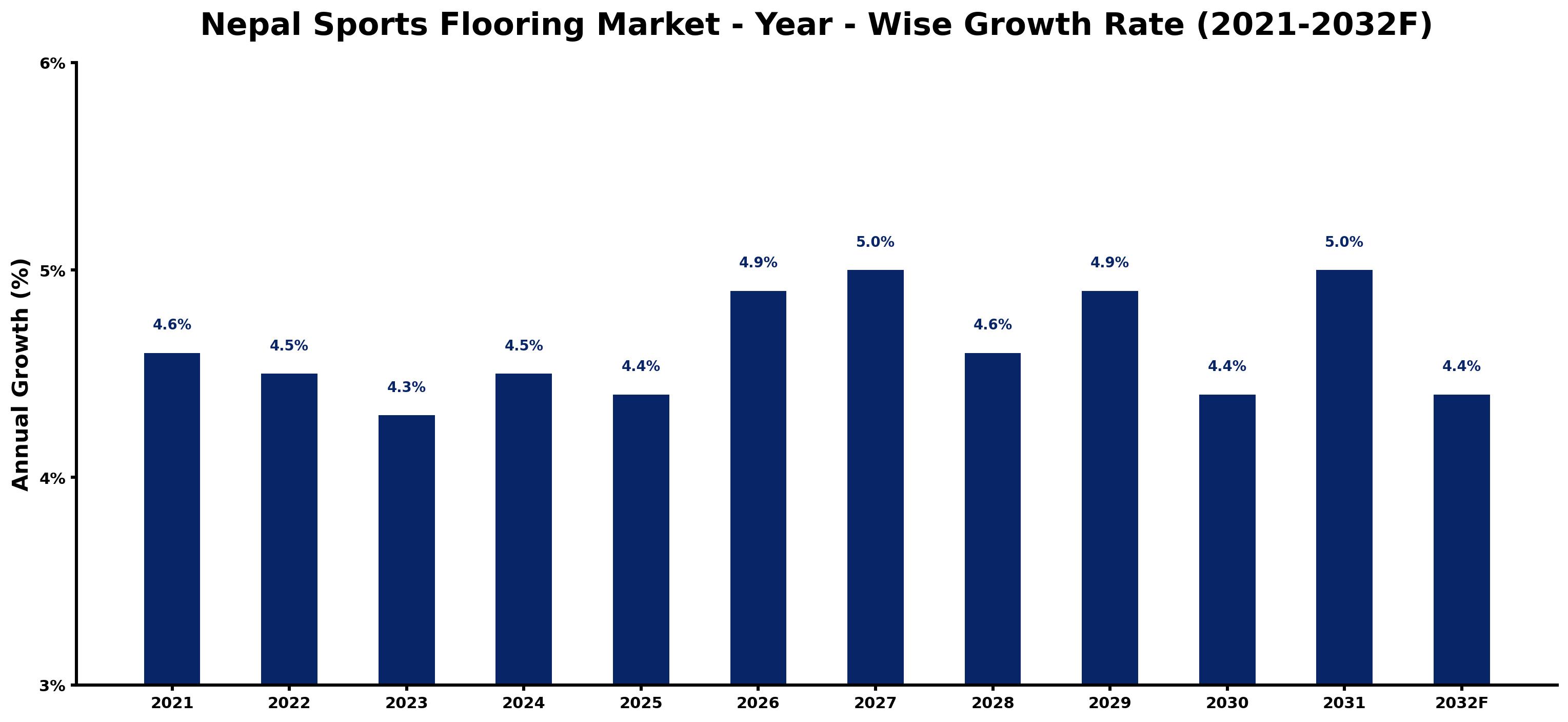
The table below presents the year wise growth rates along with the key drivers influencing the market
| Year | Growth Rate | Major Drivers |
| 2021 | 4.6% | Local sports facilities undergo renovations, enhancing the need for quality flooring solutions. |
| 2022 | 4.5% | Increased youth engagement in sports leads to more indoor sports facility constructions. |
| 2023 | 4.3% | International events hosted in Nepal spark interest in professional-grade sports flooring options. |
| 2024 | 4.5% | Urbanization trends influence the development of multi-purpose sports complexes in cities. |
| 2025 | 4.4% | Educational institutions prioritize sports programs, requiring upgraded flooring in gyms and auditoriums. |
| 2026 | 4.9% | Health and wellness awareness prompts fitness centers to invest in durable sports flooring. |
| 2027 | 5.0% | Technological advancements facilitate the production of eco-friendly sports flooring materials. |
| 2028 | 4.6% | Partnerships with global flooring brands introduce high standards in local manufacturing practices. |
| 2029 | 4.9% | Infrastructure development projects create demand for specialized flooring in athletic venues. |
| 2030 | 4.4% | Local manufacturers adopt innovative solutions to cater to diverse sporting activities. |
| 2031 | 5.0% | Increased disposable income encourages home gyms, influencing demand for versatile flooring options. |
| 2032 | 4.4% | Government support for sports initiatives boosts investments in community recreational facilities. |
Note - Market size estimations and growth projections presented in this report are based on 6Wresearch's advanced forecasting approach, validated with industry datasets as of June 2026.
Nepal Sports Flooring Market Synopsis
The Nepal Sports Flooring Market is projected to reach 4.9% and witness significant growth during the forecast period (2026-2032). The increasing investments in sports infrastructure and a surge in sports participation have created a demand for high-quality flooring solutions in the region. This demand spans across various facilities, including gyms, stadiums, sports halls, and fitness centers, which necessitates durable and safe flooring options.
Nepal Sports Flooring Market Growth Drivers
A variety of factors contribute to the growth of the Nepal Sports Flooring Market. Key growth drivers include:
- The rise in government spending devoted to the development and upgrade of sports infrastructure enhances the need for effective flooring solutions. Investments in new sports complexes and gymnasiums are pivotal.
- Increased public awareness regarding the benefits of fitness and sports is leading to higher participation rates. As more individuals engage in sporting activities, the demand for quality flooring options becomes paramount.
- The focus on safety in sports practices drives the need for anti-slip and shock-absorbing flooring technologies that enhance athlete performance and minimize injuries.
- The growing popularity of various sports, including football, basketball, and badminton, necessitates tailored flooring solutions to accommodate a wide range of sporting activities.
- Technological advancements in flooring materials, such as sustainable and eco-friendly options, are attracting investment and driving demand among environmentally-conscious consumers.
Nepal Sports Flooring Market Trends and Opportunities
The current trends in the Nepal Sports Flooring Market illustrate a shift towards more sustainable and multifunctional flooring solutions. Key trends include:
- A marked increase in the demand for eco-friendly materials that align with global sustainability goals. This trend reflects a growing consciousness among customers regarding environmental implications.
- The popularity of customizable and modular flooring options is on the rise, with facilities seeking solutions that allow easy installation and maintenance, catering to specific sports requirements.
- Investors are exploring innovative flooring solutions that incorporate advanced technologies for improved safety and performance, further enhancing the athletic experience.
- The combination of fitness spaces and community hubs is leading to diverse flooring applications, catering to varying sporting needs and enhancing the utilization of shared spaces.
- There is an observable shift towards integrating aesthetic factors into flooring designs, as facilities aim to create visually appealing environments that attract participation.
Nepal Sports Flooring Market Challenges and Restraints
Despite the promising outlook, the Nepal Sports Flooring Market faces several challenges that could impact its growth:
- Limited awareness of the benefits of high-quality sports flooring among potential customers can hinder market expansion, as many stakeholders may opt for cheaper alternatives.
- The lack of skilled labor for the installation and maintenance of specialized flooring systems poses a barrier to the market, as it affects the quality assurance of installations.
- Insufficient regulatory frameworks tailored specifically to sports flooring can result in inconsistencies in quality and safety standards across the market.
- The relatively small market size can lead to intense competition among providers, particularly from low-cost alternatives that may not meet quality expectations.
- Supply chain disruptions and material shortages can impact the availability and pricing of premium flooring solutions, making it challenging for companies to fulfill demand.
Nepal Sports Flooring Market Investment Opportunities
As interest in sports and fitness continues to grow, the Nepal Sports Flooring Market holds significant investment opportunities. Potential areas for investment include:
- Developing and supplying environmentally-friendly flooring solutions such as rubber and synthetic turf that meet the increasing demand for performance and sustainability.
- Establishing contracts for installation and maintenance services can create recurring revenue streams while ensuring quality service delivery.
- Collaborating with local governments and educational institutions to supply flooring solutions for schools and community sports facilities can help tap into the grassroots market.
- Investing in marketing and awareness campaigns to educate stakeholders on the importance of high-quality flooring can stimulate demand and drive growth.
- Optimizing distribution channels to enhance the reach and availability of sports flooring materials can help capture a larger share of the market.
Nepal Sports Flooring Market Government Investment and Initiatives
The Nepal government has implemented a variety of policies aimed at fostering the growth of the sports infrastructure, which directly impacts the sports flooring market. Key initiatives include:
- The introduction of funding programs designed to enhance the development of sports centers and infrastructure, thereby increasing demand for quality flooring solutions.
- Regulations that encourage the use of internationally-approved flooring products in public sports facilities to ensure athlete safety and improved performance.
- Support for eco-friendly construction practices, which promotes the adoption of sustainable materials in sports flooring projects, aligning with broader environmental goals.
- Incentives for private sector investments in sports infrastructure, allowing for enhanced public-private partnerships to develop new recreational spaces.
- Campaigns aimed at elevating community engagement in sports activities, promoting facilities where high-quality flooring plays a crucial role in athlete and audience experience.
Nepal Sports Flooring Market Latest Developments (May 2025 - June 2026)
Recent developments in the Nepal Sports Flooring Market indicate a continued focus on sustainability, quality, and safety. Over the period from May 2025 to June 2026, there has been an observable push towards the adoption of advanced flooring technologies that enhance player performance and safety. Interest in eco-friendly materials has surged, reflecting a broader trend towards sustainability in the construction sector.
There has also been an increase in government-led initiatives aimed at improving sports facilities nationwide, further driving the demand for specialized flooring solutions. As sports participation becomes an essential part of community life, the market dynamics are shifting, fostering innovation and collaboration between various stakeholders.
Nepal Sports Flooring Market - Key Attractiveness of the Report
- 10 Years of Market Numbers
- Historical Data Starting from 2022 to 2025
- Base Year: 2025
- Forecast Data until 2032
- Key Performance Indicators Impacting the Market
- Major Upcoming Developments and Projects
Key Highlights of the Report:
- Nepal Sports Flooring Market Outlook
- Market Size of Nepal Sports Flooring Market, 2025
- Forecast of Nepal Sports Flooring Market, 2032F
- Historical Data and Forecast of Nepal Sports Flooring Revenues & Volume for the Period 2022-2032F
- Nepal Sports Flooring Market Trend Evolution
- Nepal Sports Flooring Market Drivers and Challenges
- Nepal Sports Flooring Price Trends
- Nepal Sports Flooring Porter's Five Forces
- Nepal Sports Flooring Industry Life Cycle
- Historical Data and Forecast of Nepal Sports Flooring Market Revenues & Volume By Product Type for the Period 2022-2032F
- Historical Data and Forecast of Nepal Sports Flooring Market Revenues & Volume By Outdoor for the Period 2022-2032F
- Historical Data and Forecast of Nepal Sports Flooring Market Revenues & Volume By Indoor for the Period 2022-2032F
- Historical Data and Forecast of Nepal Sports Flooring Market Revenues & Volume By Material Type for the Period 2022-2032F
- Historical Data and Forecast of Nepal Sports Flooring Market Revenues & Volume By Wood for the Period 2022-2032F
- Historical Data and Forecast of Nepal Sports Flooring Market Revenues & Volume By Rubber for the Period 2022-2032F
- Historical Data and Forecast of Nepal Sports Flooring Market Revenues & Volume By Polymeric for the Period 2022-2032F
- Historical Data and Forecast of Nepal Sports Flooring Market Revenues & Volume By Sales Channel for the Period 2022-2032F
- Historical Data and Forecast of Nepal Sports Flooring Market Revenues & Volume By Direct Sales for the Period 2022-2032F
- Historical Data and Forecast of Nepal Sports Flooring Market Revenues & Volume By Independent Sports Outlet for the Period 2022-2032F
- Historical Data and Forecast of Nepal Sports Flooring Market Revenues & Volume By Mass Merchandiser for the Period 2022-2032F
- Historical Data and Forecast of Nepal Sports Flooring Market Revenues & Volume By Value Added Resellers for the Period 2022-2032F
- Historical Data and Forecast of Nepal Sports Flooring Market Revenues & Volume By End-users for the Period 2022-2032F
- Historical Data and Forecast of Nepal Sports Flooring Market Revenues & Volume By Commercial for the Period 2022-2032F
- Historical Data and Forecast of Nepal Sports Flooring Market Revenues & Volume By Residential for the Period 2022-2032F
- Nepal Sports Flooring Import Export Trade Statistics
- Market Opportunity Assessment By Product Type
- Market Opportunity Assessment By Material Type
- Market Opportunity Assessment By Sales Channel
- Market Opportunity Assessment By End-users
- Nepal Sports Flooring Top Companies Market Share
- Nepal Sports Flooring Competitive Benchmarking By Technical and Operational Parameters
- Nepal Sports Flooring Company Profiles
- Nepal Sports Flooring Key Strategic Recommendations






































