Nepal Three Wheeler Market Size, Share & Growth Rate
The Nepal Three Wheeler Market was estimated at USD 152 Million in 2025 and is projected to reach USD 204 Million by 2032, growing at a CAGR of 4.3% from 2026 to 2032. This growth trajectory is fueled by an increasing urban population and a rising demand for affordable, efficient transportation solutions across both urban and rural landscapes. Additionally, government initiatives promoting electric vehicles are likely to catalyze market expansion, making three-wheelers a more attractive option for consumers.
Nepal Three Wheeler Market Year-wise Growth Rate and Key Drivers
This graph highlights how the Nepal Three Wheeler Market has steadily grown over the years, supported by major growth factors.
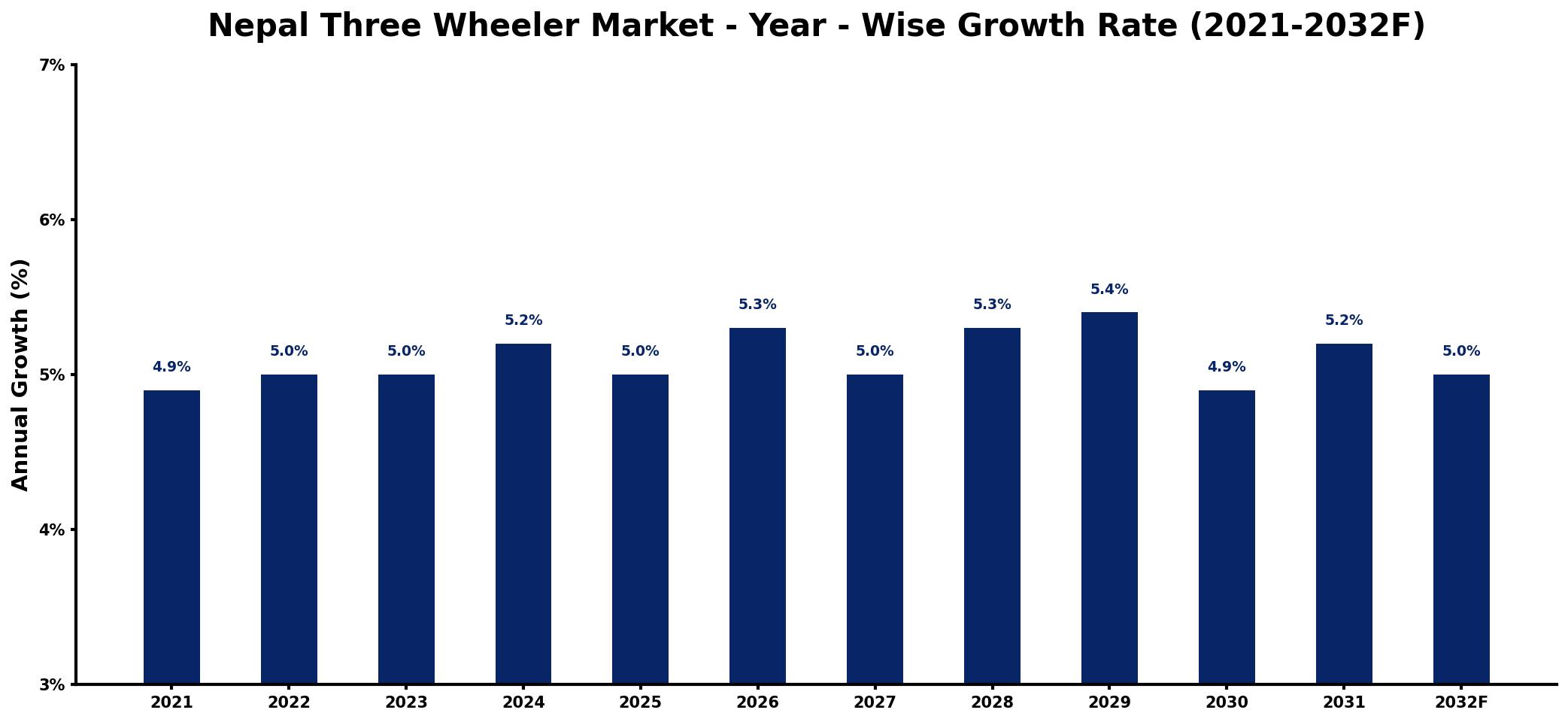
The table below presents the year‑wise growth rates along with the key drivers influencing the market
| Year | Growth Rate | Major Drivers |
| 2021 | 4.9% | Rising urban transportation demand |
| 2022 | 5.0% | Increased investment in infrastructure |
| 2023 | 5.0% | Expansion of ride-sharing services |
| 2024 | 5.2% | Growing fuel efficiency regulations |
| 2025 | 5.0% | Enhanced financing options available |
| 2026 | 5.3% | Development of electric alternatives |
| 2027 | 5.0% | Boost in tourism activities |
| 2028 | 5.3% | Strengthened logistics and delivery networks |
| 2029 | 5.4% | Emergence of new business models |
| 2030 | 4.9% | Advancements in technology adoption |
| 2031 | 5.2% | Higher disposable income levels |
| 2032 | 5.0% | Improved public transportation options |
Note: Market size estimations and growth projections presented in this report are based on 6Wresearch's proprietary forecasting methodology, utilizing the latest available industry data, government publications, and primary research inputs.
Nepal Three Wheeler Market Synopsis
The demand for three-wheelers in Nepal is underscored by their versatility and ability to navigate congested urban areas and narrow rural roads. As a result, they are increasingly utilized for passenger transport as well as cargo delivery, fulfilling a crucial role in the countrys transportation ecosystem.
Amidst the growing popularity of eco-friendly options, electric three-wheelers are gaining traction due to their reduced operating costs and lower environmental impact. This shift toward electrification reflects the broader trends in sustainable transportation solutions, appealing to environmentally conscious consumers.
Nepal Three Wheeler Market Key Takeaways
- Electric three-wheelers are becoming increasingly popular, offering significant environmental and cost benefits.
- Customization and technological advancements are driving consumer preferences toward modern, feature-rich three-wheelers.
- The governments support for electric vehicles enhances the markets growth potential through subsidies and infrastructure improvements.
- Infrastructure limitations and regulatory constraints remain critical considerations for market participants.
- Opportunities exist in financing, manufacturing, and distribution to meet the rising demand for three-wheelers.
Evaluation of Restraints in Nepal Three Wheeler Market
The Nepal Three Wheeler Market faces several restraints that could impede its growth. Regulatory constraints pose challenges as changing government policies affect the import and operation of three-wheelers. Moreover, competition from alternative transportation modes like motorcycles and public buses can limit the market's potential. Infrastructure limitations, particularly in remote areas, can hinder the efficiency of operations and lead to higher maintenance costs. Furthermore, access to financing options remains limited for potential buyers, posing additional barriers to market expansion.
Nepal Three Wheeler Market Trends
Notable trends in the Nepal Three Wheeler Market include the rising popularity of electric three-wheelers, which are positioned as a sustainable alternative to traditional fuel-powered vehicles. There is a growing consumer demand for modern three-wheelers equipped with advanced safety features and enhanced comfort, reflecting a shift towards more sophisticated mobility solutions. Additionally, customization options are becoming more prevalent, allowing users to personalize their vehicles according to specific needs.
Nepal Three Wheeler Market Opportunities
The market offers numerous investment opportunities, particularly in the electric three-wheeler segment, which aligns with global sustainability trends. Manufacturers and investors can capitalize on the rising demand for efficient and cost-effective transportation solutions. There is also significant potential for innovation in design and technology, catering to local preferences and requirements. Collaborating with local stakeholders to enhance financing options and infrastructure can further stimulate growth.
Government Initiatives in the Nepal Three Wheeler Market
The Nepalese government is actively promoting the three-wheeler market through policies aimed at regulating emissions and enhancing vehicle safety. Incentives such as tax breaks and subsidies for electric three-wheelers are designed to encourage the adoption of environmentally friendly transportation solutions. Furthermore, ongoing reviews of regulatory frameworks aim to adapt to technological advancements and changing market dynamics, ensuring the sustainable development of the three-wheeler sector.
Future Insights of the Nepal Three Wheeler Market
Looking ahead, the Nepal Three Wheeler Market is poised for steady growth driven by urbanization and an increasing demand for affordable transportation. The government's commitment to enhancing infrastructure and promoting electric vehicles will further bolster market expansion. Emerging trends such as ride-sharing and delivery services are expected to open new avenues for three-wheelers, adapting to consumer needs in a changing economic landscape. However, market participants must remain vigilant regarding regulatory changes and competition to fully leverage these opportunities.
Nepal Three Wheeler Market Latest Developments (2025 - 2026)
Recent developments in the Nepal Three Wheeler Market indicate a notable shift toward electric models, spurred by consumer interest in sustainability. Government incentives are encouraging investments in electric three-wheeler infrastructure, while manufacturers are innovating to meet evolving consumer expectations. Additionally, collaboration with local partners is becoming crucial for navigating regulatory frameworks and enhancing financing options, fostering a more robust market environment.
Nepal Three Wheeler Market - Key Attractiveness of the Report
- 10 Years of Market Numbers
- Historical Data Starting from 2022 to 2025
- Base Year: 2025
- Forecast Data until 2032
- Key Performance Indicators Impacting the Market
- Major Upcoming Developments and Projects
Key Highlights of the Report:
- Nepal Three Wheeler Market Outlook
- Market Size of Nepal Three Wheeler Market, 2025
- Forecast of Nepal Three Wheeler Market, 2032
- Historical Data and Forecast of Nepal Three Wheeler Revenues & Volume for the Period 2022-2032F
- Nepal Three Wheeler Market Trend Evolution
- Nepal Three Wheeler Market Drivers and Challenges
- Nepal Three Wheeler Price Trends
- Nepal Three Wheeler Porter's Five Forces
- Nepal Three Wheeler Industry Life Cycle
- Historical Data and Forecast of Nepal Three Wheeler Market Revenues & Volume By Fuel Type for the Period 2022-2032F
- Historical Data and Forecast of Nepal Three Wheeler Market Revenues & Volume By Petrol/CNG for the Period 2022-2032F
- Historical Data and Forecast of Nepal Three Wheeler Market Revenues & Volume By Diesel for the Period 2022-2032F
- Historical Data and Forecast of Nepal Three Wheeler Market Revenues & Volume By Electric for the Period 2022-2032F
- Historical Data and Forecast of Nepal Three Wheeler Market Revenues & Volume By Vehicle Type for the Period 2022-2032F
- Historical Data and Forecast of Nepal Three Wheeler Market Revenues & Volume By Passenger Carrier for the Period 2022-2032F
- Historical Data and Forecast of Nepal Three Wheeler Market Revenues & Volume By Load Carrier for the Period 2022-2032F
- Nepal Three Wheeler Import Export Trade Statistics
- Market Opportunity Assessment By Fuel Type
- Market Opportunity Assessment By Vehicle Type
- Nepal Three Wheeler Top Companies Market Share
- Nepal Three Wheeler Competitive Benchmarking By Technical and Operational Parameters
- Nepal Three Wheeler Company Profiles
- Nepal Three Wheeler Key Strategic Recommendations






































