Nepal Toys and Hobby Goods Market Summary
The nepal toys and hobby goods market was estimated at USD 215 Million in 2025 and is projected to reach USD 302 Million by 2032, growing at a CAGR of 5.8% from 2026 to 2032.
Nepal Toys and Hobby Goods Market Year-wise Growth Rate and Key Drivers
This graph highlights how the Nepal Toys and Hobby Goods Market has steadily grown over the past five years, supported by major growth factors.
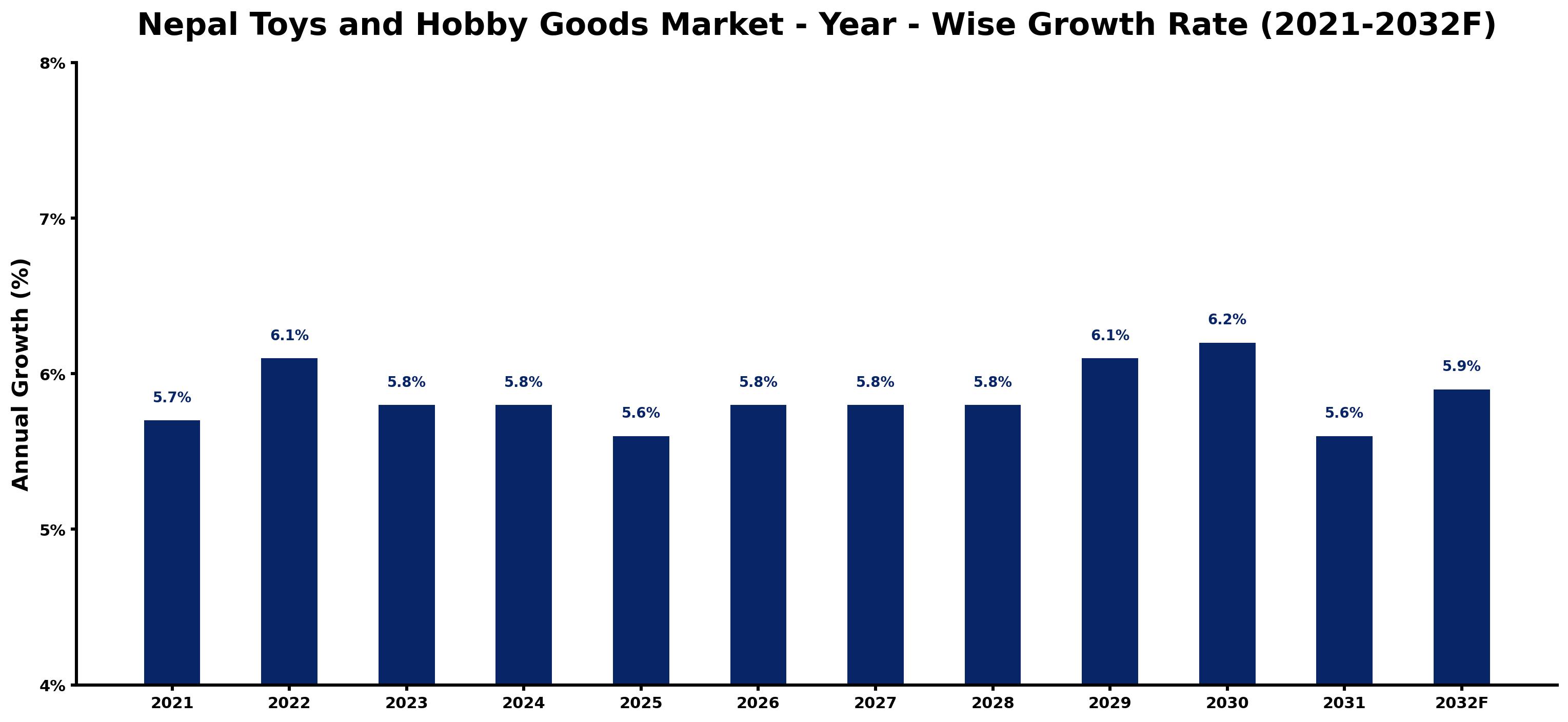
The table below presents the year wise growth rates along with the key drivers influencing the market
| Year | Growth Rate | Major Drivers |
| 2021 | 5.7% | Post-lockdown retail recovery showcased a rebound in consumer spending on toys. |
| 2022 | 6.1% | Urban families increasingly prioritize educational toys, enhancing cognitive development for children. |
| 2023 | 5.8% | The introduction of eco-friendly materials in toy manufacturing captured consumer attention significantly. |
| 2024 | 5.8% | Local artisans began creating handmade toys, fostering cultural identity and uniqueness. |
| 2025 | 5.6% | Digital gaming trends influenced physical toy designs, blending virtual and real experiences. |
| 2026 | 5.8% | Rural areas witnessed emerging markets for affordable toys, broadening access and choice. |
| 2027 | 5.8% | Collaborations between brands and educational institutions sparked innovative learning-based toy products. |
| 2028 | 5.8% | Increased interest in STEM education led to a surge in science-themed hobby kits. |
| 2029 | 6.1% | Online marketplaces expanded distribution channels, reaching previously untapped demographics efficiently. |
| 2030 | 6.2% | Social media campaigns effectively engaged parents, amplifying brand visibility and product interest. |
| 2031 | 5.6% | Cultural festivals and events promoted local toy brands, boosting community support and sales. |
| 2032 | 5.9% | Sustainability trends accelerated, as consumers favored brands prioritizing environmental responsibility in toys. |
Note - Market size estimations and growth projections presented in this report are based on 6Wresearch's advanced forecasting approach, validated with industry datasets as of June 2026.
Nepal Toys and Hobby Goods Market Synopsis
The Nepal Toys and Hobby Goods Market is projected to reach 5.8% and witness significant growth during the forecast period (2026-2032). This growth trajectory is primarily fueled by an increase in disposable incomes, evolving lifestyle habits among children, heightened awareness surrounding educational toys, and advancements in manufacturing technologies that enhance production capacities. Furthermore, the rising demand for electronic toys and digital gaming consoles is contributing positively to the overall market dynamics.
Nepal Toys and Hobby Goods Market Growth Drivers
The growth of the Nepal Toys and Hobby Goods Market can be attributed to several key factors:
- Increasing disposable income levels among consumers, particularly in urban centers, are enabling more families to invest in quality toys and hobby goods for their children.
- Changing lifestyle habits have led parents to seek toys that promote both fun and learning, thus boosting the market for educational toys.
- The popularity of electronic toys and games, including video games and digital gaming consoles, resonates well with the tech-savvy younger generation, further driving market demand.
- Advancements in manufacturing technology allow for more innovative product designs and features, catering to evolving consumer preferences.
- Growing retail networks and online sales platforms are making toys and hobby goods more accessible across various regions of Nepal, including remote areas.
Nepal Toys and Hobby Goods Market Trends and Opportunities
The Nepal Toys and Hobby Goods Market is undergoing several notable trends that present opportunities for growth:
- The trend towards sustainable and eco-friendly toys is gaining momentum, with consumers increasingly favoring products made from organic materials.
- Interactive and smart toys that incorporate technology are becoming more popular, engaging children in novel and educational ways.
- There is a significant rise in the online shopping sector, allowing consumers to easily access a wide range of toys without geographical constraints.
- Collaborative play and multi-user games are being promoted, encouraging social interaction and teamwork among children.
- As parents prioritize child development, there is a growing market for toys that emphasize STEM (Science, Technology, Engineering, and Mathematics) learning.
Nepal Toys and Hobby Goods Market Challenges and Restraints
Despite the growth potential, the Nepal Toys and Hobby Goods Market faces several challenges:
- The high cost of import duties and logistics can make certain toys unaffordable for many consumers, limiting market reach.
- A lack of awareness regarding international standards for toy safety poses a risk, which can deter some consumers from purchasing toys.
- The market still has limited local manufacturing capabilities, making it heavily reliant on imports for a majority of products.
- Counterfeit products and substandard toys present a significant challenge, undermining consumer trust and safety.
- Economic fluctuations and the impact of global events can impact consumer spending patterns and investment in non-essential items such as toys.
Nepal Toys and Hobby Goods Market Government Investment and Initiatives
The government of Nepal plays a pivotal role in fostering the development of the toys and hobby goods market through various initiatives:
- Public spending on education has increased, encouraging the purchase of educational toys that align with government priorities for enhancing learning outcomes.
- Incentives for local manufacturing, such as tax breaks or subsidies, are being considered to stimulate domestic production and reduce dependency on imports.
- Regulatory frameworks are being established to ensure higher safety standards for toys, protecting children and building consumer confidence.
- Support for small and medium enterprises (SMEs) in the toy sector is part of broader economic development plans aimed at creating jobs and encouraging entrepreneurship.
- Efforts to improve transportation infrastructure are underway, which will enhance accessibility to remote areas, enabling better distribution of toys and hobby goods.
Nepal Toys and Hobby Goods Market Latest Developments (May 2025 - June 2026)
Recent developments in the Nepal Toys and Hobby Goods Market indicate a dynamic shift towards modernization and consumer engagement:
- Innovative product launches featuring interactive toys have gained popularity, engaging children in more immersive play experiences.
- Retailers have expanded their online platforms, catering to an increasingly digital-savvy population while improving convenience for customers.
- Collaborations between local artisans and toy manufacturers have emerged, resulting in unique, culturally relevant products that resonate with consumers.
- The introduction of community-based sales events has helped local producers showcase their offerings, promoting regional goods.
- Awareness campaigns focusing on the importance of educational toys are being implemented, leading to a more informed consumer base.
Nepal Toys and Hobby Goods Market - Key Attractiveness of the Report
- 10 Years of Market Numbers
- Historical Data Starting from 2022 to 2025
- Base Year: 2025
- Forecast Data until 2032
- Key Performance Indicators Impacting the Market
- Major Upcoming Developments and Projects
Key Highlights of the Report:
- Nepal Toys and Hobby Goods Market Outlook
- Market Size of Nepal Toys and Hobby Goods Market, 2025
- Forecast of Nepal Toys and Hobby Goods Market, 2032F
- Historical Data and Forecast of Nepal Toys and Hobby Goods Revenues & Volume for the Period 2022-2032F
- Nepal Toys and Hobby Goods Market Trend Evolution
- Nepal Toys and Hobby Goods Market Drivers and Challenges
- Nepal Toys and Hobby Goods Price Trends
- Nepal Toys and Hobby Goods Porter's Five Forces
- Nepal Toys and Hobby Goods Industry Life Cycle
- Historical Data and Forecast of Nepal Toys and Hobby Goods Market Revenues & Volume By Type for the Period 2022-2032F
- Historical Data and Forecast of Nepal Toys and Hobby Goods Market Revenues & Volume By Sports Toys for the Period 2022-2032F
- Historical Data and Forecast of Nepal Toys and Hobby Goods Market Revenues & Volume By Intellectual Toys for the Period 2022-2032F
- Historical Data and Forecast of Nepal Toys and Hobby Goods Market Revenues & Volume By Education Toys for the Period 2022-2032F
- Historical Data and Forecast of Nepal Toys and Hobby Goods Market Revenues & Volume By Decorative Toys for the Period 2022-2032F
- Historical Data and Forecast of Nepal Toys and Hobby Goods Market Revenues & Volume By Other for the Period 2022-2032F
- Historical Data and Forecast of Nepal Toys and Hobby Goods Market Revenues & Volume By Application for the Period 2022-2032F
- Historical Data and Forecast of Nepal Toys and Hobby Goods Market Revenues & Volume By Online Sales for the Period 2022-2032F
- Historical Data and Forecast of Nepal Toys and Hobby Goods Market Revenues & Volume By Offline Sales for the Period 2022-2032F
- Historical Data and Forecast of Nepal Toys and Hobby Goods Market Revenues & Volume By Others for the Period 2022-2032F
- Nepal Toys and Hobby Goods Import Export Trade Statistics
- Market Opportunity Assessment By Type
- Market Opportunity Assessment By Application
- Nepal Toys and Hobby Goods Top Companies Market Share
- Nepal Toys and Hobby Goods Competitive Benchmarking By Technical and Operational Parameters
- Nepal Toys and Hobby Goods Company Profiles
- Nepal Toys and Hobby Goods Key Strategic Recommendations






































