Nepal Trolley Market Size, Share & Growth Rate
The Nepal Trolley Market was estimated at USD 432 Million in 2025 and is projected to reach USD 576 Million by 2032, growing at a CAGR of 4.2% from 2026 to 2032. This growth trajectory is primarily driven by increasing urbanization and infrastructure development, which have heightened the demand for efficient transportation solutions. Moreover, the rise of e-commerce and consumer awareness surrounding the benefits of trolleys for various applications are critical factors propelling this market forward.
Nepal Trolley Market Year-wise Growth Rate and Key Drivers
This graph highlights how the Nepal Trolley Market has steadily grown over the years, supported by major growth factors.
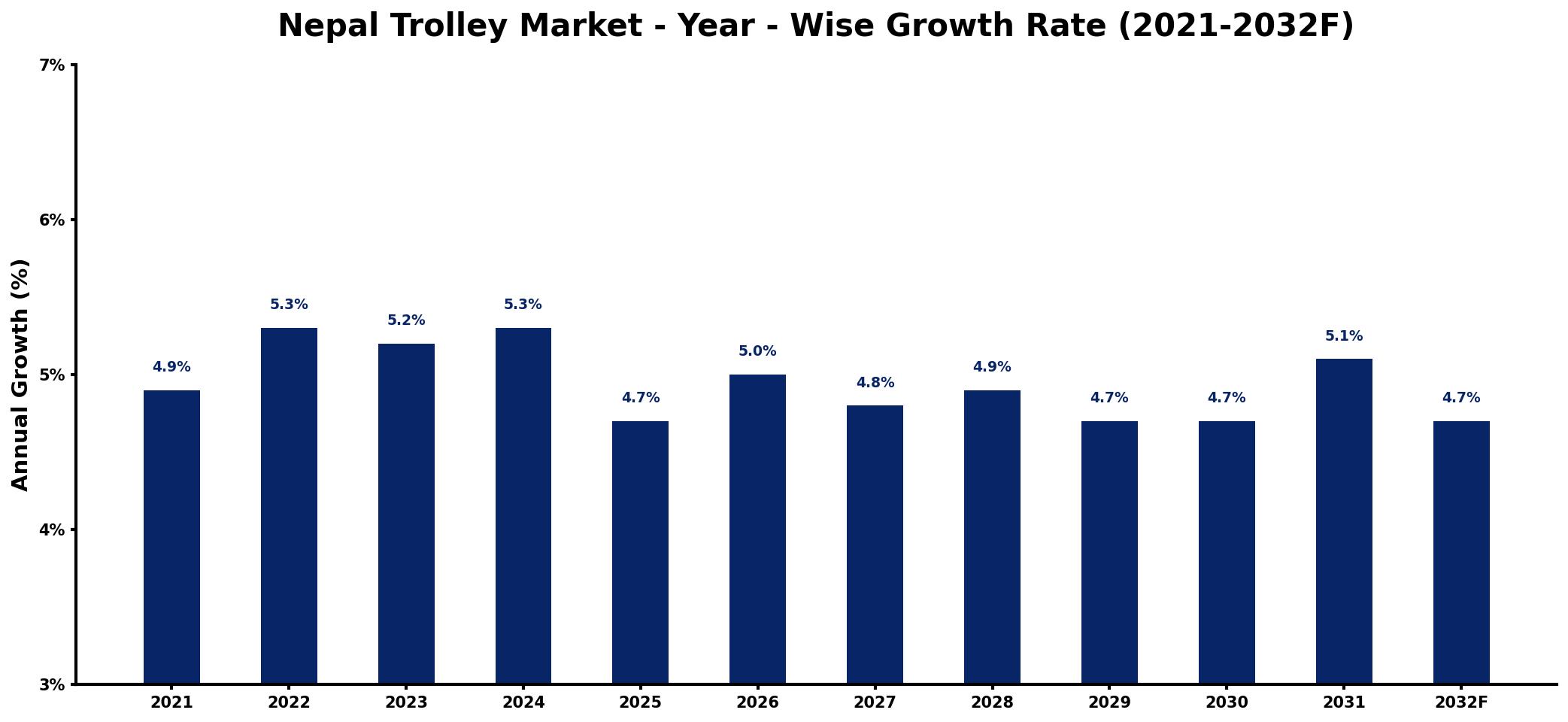
The table below presents the year‑wise growth rates along with the key drivers influencing the market
| Year | Growth Rate | Major Drivers |
| 2021 | 4.9% | Rising urbanization driving demand |
| 2022 | 5.3% | Increased infrastructure investments nationwide |
| 2023 | 5.2% | Growth in e-commerce logistics sector |
| 2024 | 5.3% | Expansion of retail distribution networks |
| 2025 | 4.7% | Emerging trends in sustainable transport |
| 2026 | 5.0% | Higher consumer spending on mobility |
| 2027 | 4.8% | Surge in online shopping habits |
| 2028 | 4.9% | Government initiatives promoting efficiency |
| 2029 | 4.7% | Growing demand for last-mile solutions |
| 2030 | 4.7% | Strengthening regional trade partnerships |
| 2031 | 5.1% | Technological advancements in logistics |
| 2032 | 4.7% | Rising consumer preference for convenience |
Note: Market size estimations and growth projections presented in this report are based on 6Wresearch's proprietary forecasting methodology, utilizing the latest available industry data, government publications, and primary research inputs.
Nepal Trolley Market Synopsis
Recent momentum in the Nepal trolley market highlights a surge in demand across multiple sectors, notably hospitality, retail, and healthcare. As businesses increasingly recognize the importance of efficient goods transportation, the market is anticipated to expand further in the coming years.
With a diverse product range that includes luggage, service, platform, and utility trolleys, the market is evolving to meet specialized needs. Factors such as enhanced product features, like lightweight materials and ergonomic designs, are becoming essential in catering to a broader customer base.
Nepal Trolley Market Key Takeaways
- The market is growing steadily, driven by urbanization, infrastructure development, and e-commerce expansion.
- Innovation in product design is crucial, with a focus on lightweight, durable, and ergonomic trolleys.
- Environmental sustainability is becoming a priority, spurring interest in eco-friendly trolley materials.
- Customizable trolleys tailored to specific industry needs are gaining traction in the market.
- Investment in manufacturing and distribution channels presents significant opportunities for stakeholders.
Evaluation of Restraints in Nepal Trolley Market
The Nepal trolley market faces notable challenges that hinder its growth potential. The absence of standardized regulations results in a mixed quality of products available to consumers, leading to safety concerns and decreased trust in local offerings. Additionally, competition from low-cost imported trolleys places pressure on local manufacturers, who struggle to maintain competitive pricing while ensuring high standards. Addressing these issues is crucial for building a more reliable market environment and fostering consumer confidence.
Nepal Trolley Market Trends
Currently, the market is trending towards lightweight and durable trolleys that facilitate easy maneuverability. Eco-conscious consumerism is driving the shift toward sustainable materials, prompting manufacturers to rethink their production methods. Furthermore, the demand for customizable trolleys tailored for specific sectors, such as logistics and healthcare, is on the rise, reflecting businesses diverse requirements. The evolving landscape of e-commerce is also emphasizing the necessity for trolleys equipped with security features to ensure safe delivery processes.
Nepal Trolley Market Opportunities
The Nepal trolley market presents various avenues for growth, particularly in manufacturing innovative and environmentally friendly trolleys. Investment in research and development to create advanced trolleys that incorporate foldable designs and improved materials is ripe with potential. Additionally, establishing e-commerce channels can facilitate direct-to-consumer sales, capturing a broader audience. Collaborating with local suppliers and manufacturers will also streamline production and potentially reduce costs, enhancing competitiveness.
Government Initiatives in the Nepal Trolley Market
The Nepalese government has introduced several policies to regulate the trolley market, focusing on safety and efficiency. These regulations establish construction and operational standards, ensuring both passengers and pedestrians are protected. Licensing requirements for operators further enhance safety protocols. The government also monitors trolley routes to alleviate traffic congestion and mitigate environmental impact, all contributing to a more organized market landscape.
Future Insights of the Nepal Trolley Market
Looking ahead to the period between 2026 and 2032, the Nepal trolley market is expected to flourish, propelled by rising disposable incomes and an increasing emphasis on the convenience of trolley usage in various sectors. The anticipated surge in demand across retail, logistics, and hospitality sectors, along with expanding consumer bases for household applications, indicates a vibrant future. Manufacturers will likely concentrate on innovative designs and enhanced functionality to align with shifting consumer preferences, particularly driven by the e-commerce boom.
Nepal Trolley Market Latest Developments (2025 - 2026)
In recent months, the Nepal trolley market has seen a shift towards greater product innovation and sustainability. Manufacturers are increasingly exploring eco-friendly materials in their trolley designs and enhancing features to improve maneuverability. The rise of e-commerce has sparked interest in trolleys that prioritize security features, reflecting the growing demand for safe delivery solutions. As competition intensifies, local manufacturers are adapting their strategies to cater to evolving consumer needs.
Nepal Trolley Market - Key Attractiveness of the Report
- 10 Years of Market Numbers
- Historical Data Starting from 2022 to 2025
- Base Year: 2025
- Forecast Data until 2032
- Key Performance Indicators Impacting the Market
- Major Upcoming Developments and Projects
Key Highlights of the Report:
- Nepal Trolley Market Outlook
- Market Size of Nepal Trolley Market, 2025
- Forecast of Nepal Trolley Market, 2032
- Historical Data and Forecast of Nepal Trolley Revenues & Volume for the Period 2022-2032F
- Nepal Trolley Market Trend Evolution
- Nepal Trolley Market Drivers and Challenges
- Nepal Trolley Price Trends
- Nepal Trolley Porter's Five Forces
- Nepal Trolley Industry Life Cycle
- Historical Data and Forecast of Nepal Trolley Market Revenues & Volume By Product for the Period 2022-2032F
- Historical Data and Forecast of Nepal Trolley Market Revenues & Volume By Manual for the Period 2022-2032F
- Historical Data and Forecast of Nepal Trolley Market Revenues & Volume By Electric for the Period 2022-2032F
- Historical Data and Forecast of Nepal Trolley Market Revenues & Volume By Application for the Period 2022-2032F
- Historical Data and Forecast of Nepal Trolley Market Revenues & Volume By Commercial for the Period 2022-2032F
- Historical Data and Forecast of Nepal Trolley Market Revenues & Volume By Non-commercial for the Period 2022-2032F
- Historical Data and Forecast of Nepal Trolley Market Revenues & Volume By Distribution for the Period 2022-2032F
- Historical Data and Forecast of Nepal Trolley Market Revenues & Volume By Offline for the Period 2022-2032F
- Historical Data and Forecast of Nepal Trolley Market Revenues & Volume By Online for the Period 2022-2032F
- Nepal Trolley Import Export Trade Statistics
- Market Opportunity Assessment By Product
- Market Opportunity Assessment By Application
- Market Opportunity Assessment By Distribution
- Nepal Trolley Top Companies Market Share
- Nepal Trolley Competitive Benchmarking By Technical and Operational Parameters
- Nepal Trolley Company Profiles
- Nepal Trolley Key Strategic Recommendations






































