Nepal Vacuum Pumps Market Summary
The nepal vacuum pumps market was estimated at USD 379 Million in 2025 and is projected to reach USD 543 Million by 2032, growing at a CAGR of 6.5% from 2026 to 2032.
Nepal Vacuum Pumps Market Year-wise Growth Rate and Key Drivers
This graph highlights how the Nepal Vacuum Pumps Market has steadily grown over the past five years, supported by major growth factors.
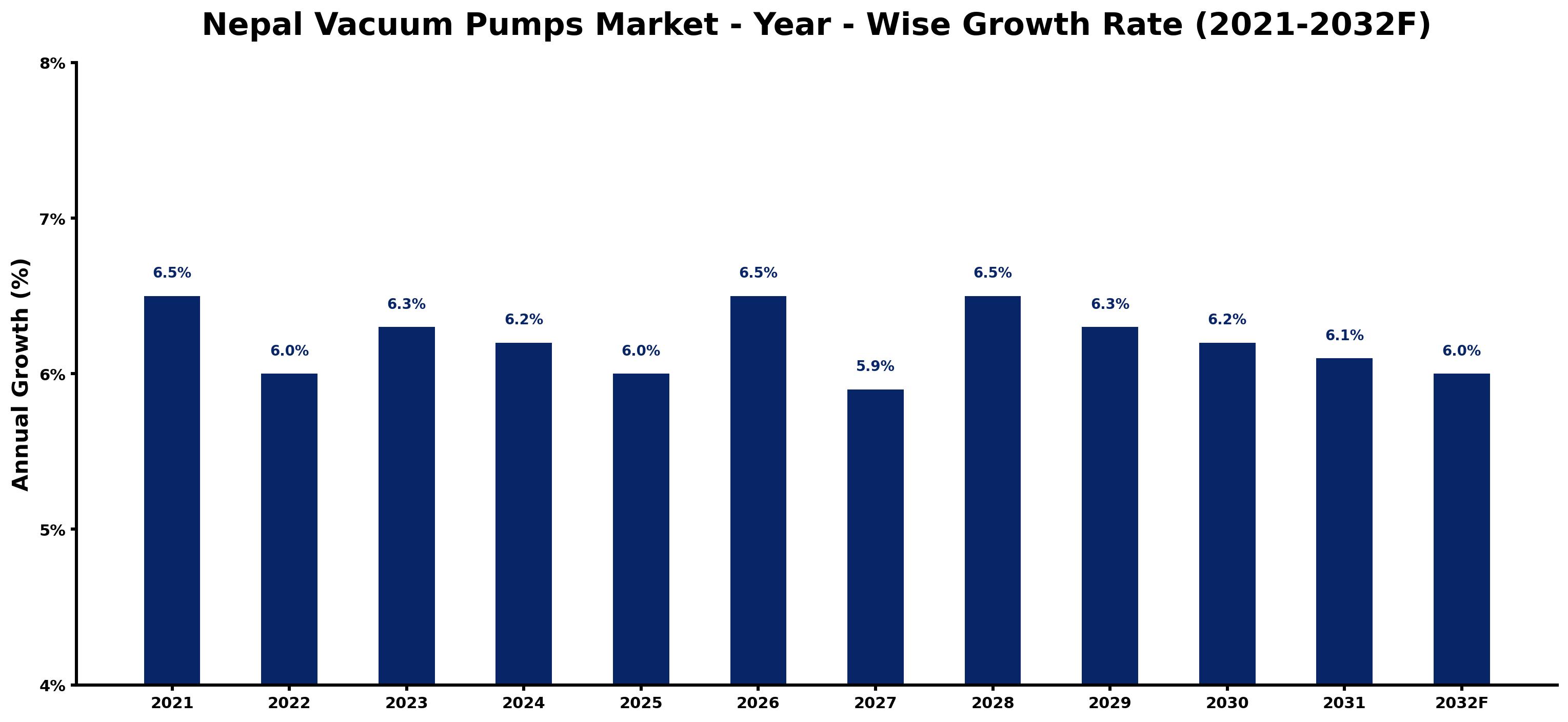
The table below presents the year wise growth rates along with the key drivers influencing the market
| Year | Growth Rate | Major Drivers |
| 2021 | 6.5% | Economic recovery initiatives post-pandemic fueled industrial projects requiring reliable vacuum solutions. |
| 2022 | 6.0% | Emergence of green technology mandates increased demand for energy-efficient vacuum pumps. |
| 2023 | 6.3% | Infrastructure development in urban areas highlighted the need for advanced vacuum systems. |
| 2024 | 6.2% | Growing awareness about contamination risks drove sectors to invest in quality vacuum pumps. |
| 2025 | 6.0% | Partnerships between local manufacturers and global brands enhanced product offerings and accessibility. |
| 2026 | 6.5% | Increased focus on sustainability attracted investments in eco-friendly vacuum pump technologies. |
| 2027 | 5.9% | Technological innovations in materials improved the durability and efficiency of vacuum pumps. |
| 2028 | 6.5% | Expansion of the pharmaceutical sector emphasized the critical role of vacuum systems for compliance. |
| 2029 | 6.3% | The rise in food processing industries necessitated precise vacuum solutions for preservation. |
| 2030 | 6.2% | Investment in renewable energy projects amplified the demand for specialized vacuum equipment. |
| 2031 | 6.1% | Enhanced logistics networks improved supply chain efficiency for vacuum pump distribution. |
| 2032 | 6.0% | Growing manufacturing needs in electronics and aerospace sectors further expanded market potential. |
Note - Market size estimations and growth projections presented in this report are based on 6Wresearch's advanced forecasting approach, validated with industry datasets as of June 2026.
Nepal Vacuum Pumps Market Synopsis
The Nepal Vacuum Pumps Market is projected to reach 6.5% and witness significant growth during the forecast period (2026-2032). This growth trajectory is primarily fueled by the surge in industrial activities across various sectors such as pharmaceuticals, food processing, and automotive. As manufacturing processes evolve, the demand for efficient and reliable vacuum pumping solutions is becoming increasingly critical. Furthermore, technological advancements and product innovations are at the forefront of the market, as stakeholders adapt to the specific requirements of diverse industries.
Nepal Vacuum Pumps Market Growth Drivers
Several key drivers are contributing to the expansion of the Nepal Vacuum Pumps Market. Foremost among these is the rising industrial activity, particularly in the pharmaceutical sector, where vacuum pumps are essential for processes such as packaging and quality control. Additionally, the food processing industry is embracing advanced vacuum technology to ensure product safety and extend shelf life. The automotive sector is integrating vacuum pumps into various manufacturing processes, further fueling demand.
- The increasing focus on energy efficiency is compelling companies to adopt vacuum pump technologies that minimize energy consumption and operational costs.
- Growing environmental awareness is driving industries to shift towards eco-friendly vacuum pump solutions, such as dry vacuum pumps, which offer lower maintenance and a reduced environmental footprint.
- As industries modernize their operations, the demand for smart vacuum pumps, equipped with remote monitoring features, is gaining traction.
- Government initiatives aimed at modernizing industrial processes are expected to further support market growth as companies invest in advanced pumping solutions.
- The emphasis on productivity enhancements in manufacturing processes is also a pivotal factor, as vacuum pumps are critical for maintaining efficiency.
Nepal Vacuum Pumps Market Challenges and Restraints
Despite the positive outlook, the Nepal Vacuum Pumps Market faces several challenges that could hinder growth. A primary concern is the limited awareness and understanding of vacuum pump technology among potential customers, which may result in slower adoption rates. The market's relatively small and fragmented nature complicates competition, making it challenging for companies to achieve economies of scale.
- Moreover, infrastructure issues such as inadequate power supply and transportation logistics can disrupt the efficient distribution of vacuum pumps.
- The lack of local manufacturing capabilities compels reliance on imported vacuum pumps, which can be costly due to tariffs and currency fluctuations.
- Market education and training programs are necessary to improve awareness and understanding of vacuum pump technology.
- Competition from alternative pumping solutions may also pose challenges, as industries weigh their options against emerging technologies.
- Lastly, economic fluctuations could affect investment in new technologies, impacting market growth.
Nepal Vacuum Pumps Market Investment Opportunities
The Nepal Vacuum Pumps Market presents numerous investment opportunities driven by the burgeoning industrial sector. Specializing in the distribution and servicing of high-quality vacuum pumps tailored specifically to sectors such as pharmaceuticals, food processing, and electronics can yield promising returns.
- Establishing maintenance and repair services for existing vacuum pump users in the market can create a steady revenue stream.
- Collaborating with local manufacturers to deliver customized vacuum pump solutions is another lucrative investment pathway.
- Investors can explore the potential of developing energy-efficient vacuum pump technologies suited for the local market.
- Expanding educational initiatives that promote understanding of vacuum technology may also present investment opportunities in training and support services.
- As industries continue to modernize, there is an opening for investments focused on data-driven solutions, such as IoT-enabled vacuum pumps that enhance operational efficiency.
Nepal Vacuum Pumps Market Government Investment and Initiatives
The Nepal government has shown a proactive stance in supporting the vacuum pumps market through various policies and initiatives. These measures include incentives aimed at promoting the manufacturing and import of energy-efficient vacuum pumps, thus encouraging sustainability and reducing energy consumption across industrial sectors. Furthermore, regulations are in place to uphold quality and safety standards for vacuum pumps available in the market, which serve to protect both consumers and the environment.
In addition, the government actively promotes research and development in the vacuum pump industry through funding initiatives, aiming to stimulate innovation and technological advancement. These efforts seek to foster a competitive and sustainable vacuum pumps market in Nepal while ensuring adherence to consumer protection standards and environmental sustainability.
Nepal Vacuum Pumps Market Latest Developments (May 2025 - June 2026)
Between May 2025 and June 2026, the Nepal Vacuum Pumps Market has begun to evolve significantly, with a noticeable shift towards adopting more energy-efficient and environmentally friendly technologies. The industry has witnessed an increased focus on smart vacuum pump systems, which are equipped with capabilities for remote monitoring and diagnostics, thus enhancing operational efficiency.
- Companies are increasingly investing in R&D initiatives to create innovative vacuum pump solutions that align with global sustainability trends.
- The market has seen a rise in partnerships and collaborations focused on developing customized pumping solutions tailored to local industrial needs.
- Training and educational programs have gained traction, aimed at improving user understanding of vacuum pump technology and maintenance.
- There is a growing trend towards integrating advanced digital solutions within vacuum systems, promising to improve overall productivity.
- Governmental support for environmentally friendly initiatives has prompted manufacturers to prioritize the development of sustainable vacuum pump technologies.
Nepal Vacuum Pumps Market - Key Attractiveness of the Report
- 10 Years of Market Numbers
- Historical Data Starting from 2022 to 2025
- Base Year: 2025
- Forecast Data until 2032
- Key Performance Indicators Impacting the Market
- Major Upcoming Developments and Projects
Key Highlights of the Report:
- Nepal Vacuum Pumps Market Outlook
- Market Size of Nepal Vacuum Pumps Market, 2025
- Forecast of Nepal Vacuum Pumps Market, 2032F
- Historical Data and Forecast of Nepal Vacuum Pumps Revenues & Volume for the Period 2022-2032F
- Nepal Vacuum Pumps Market Trend Evolution
- Nepal Vacuum Pumps Market Drivers and Challenges
- Nepal Vacuum Pumps Price Trends
- Nepal Vacuum Pumps Porter's Five Forces
- Nepal Vacuum Pumps Industry Life Cycle
- Historical Data and Forecast of Nepal Vacuum Pumps Market Revenues & Volume By Lubrication for the Period 2022-2032F
- Historical Data and Forecast of Nepal Vacuum Pumps Market Revenues & Volume By Dry for the Period 2022-2032F
- Historical Data and Forecast of Nepal Vacuum Pumps Market Revenues & Volume By Wet for the Period 2022-2032F
- Historical Data and Forecast of Nepal Vacuum Pumps Market Revenues & Volume By Technology for the Period 2022-2032F
- Historical Data and Forecast of Nepal Vacuum Pumps Market Revenues & Volume By Gas Capture/Binding Pumps for the Period 2022-2032F
- Historical Data and Forecast of Nepal Vacuum Pumps Market Revenues & Volume By Gas Transfer Pumps for the Period 2022-2032F
- Historical Data and Forecast of Nepal Vacuum Pumps Market Revenues & Volume By Product Type for the Period 2022-2032F
- Historical Data and Forecast of Nepal Vacuum Pumps Market Revenues & Volume By Low vacuum pumps for the Period 2022-2032F
- Historical Data and Forecast of Nepal Vacuum Pumps Market Revenues & Volume By Medium vacuum pumps for the Period 2022-2032F
- Historical Data and Forecast of Nepal Vacuum Pumps Market Revenues & Volume By High vacuum pumps for the Period 2022-2032F
- Historical Data and Forecast of Nepal Vacuum Pumps Market Revenues & Volume By End-Users for the Period 2022-2032F
- Historical Data and Forecast of Nepal Vacuum Pumps Market Revenues & Volume By Chemical & pharmaceutical for the Period 2022-2032F
- Historical Data and Forecast of Nepal Vacuum Pumps Market Revenues & Volume By Semiconductor & electronics for the Period 2022-2032F
- Historical Data and Forecast of Nepal Vacuum Pumps Market Revenues & Volume By Oil & gas for the Period 2022-2032F
- Historical Data and Forecast of Nepal Vacuum Pumps Market Revenues & Volume By Food & beverages for the Period 2022-2032F
- Historical Data and Forecast of Nepal Vacuum Pumps Market Revenues & Volume By Wood, paper & pulp for the Period 2022-2032F
- Historical Data and Forecast of Nepal Vacuum Pumps Market Revenues & Volume By Other for the Period 2022-2032F
- Nepal Vacuum Pumps Import Export Trade Statistics
- Market Opportunity Assessment By Lubrication
- Market Opportunity Assessment By Technology
- Market Opportunity Assessment By Product Type
- Market Opportunity Assessment By End-Users
- Nepal Vacuum Pumps Top Companies Market Share
- Nepal Vacuum Pumps Competitive Benchmarking By Technical and Operational Parameters
- Nepal Vacuum Pumps Company Profiles
- Nepal Vacuum Pumps Key Strategic Recommendations






































