Nepal Vision Screeners Market Size, Share & Growth Rate
The Nepal Vision Screeners Market was estimated at USD 177 Million in 2025 and is projected to reach USD 234 Million by 2032, growing at a CAGR of 4.1% from 2026 to 2032. This growth is propelled by increasing health awareness among the population, coupled with the rising incidence of vision disorders, particularly among children. Additionally, government initiatives aimed at enhancing eye care services further support this positive trajectory.
Nepal Vision Screeners Market Year-wise Growth Rate and Key Drivers
This graph highlights how the Nepal Vision Screeners Market has steadily grown over the years, supported by major growth factors.
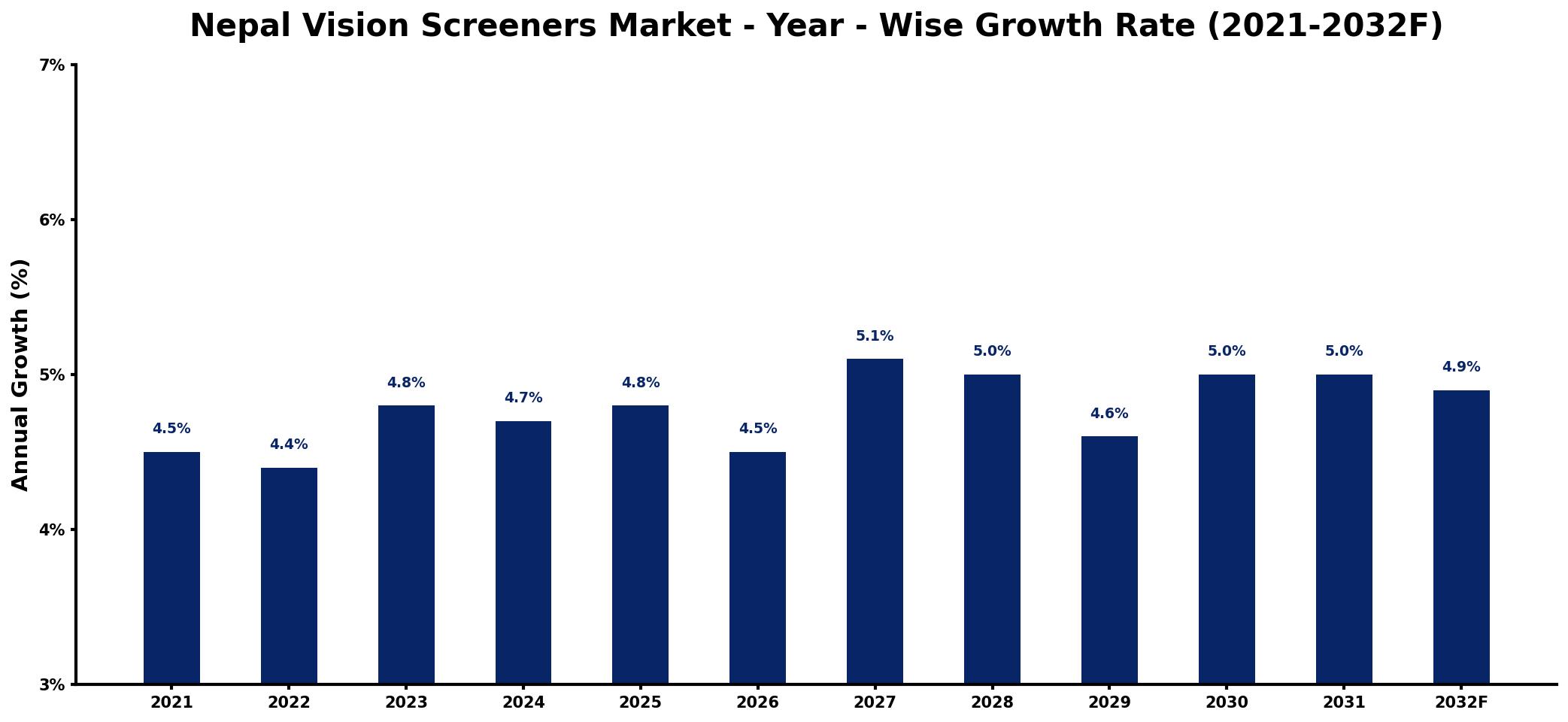
The table below presents the year‑wise growth rates along with the key drivers influencing the market
| Year | Growth Rate | Major Drivers |
| 2021 | 4.5% | increased healthcare investments nationwide |
| 2022 | 4.4% | rising awareness of eye health |
| 2023 | 4.8% | expansion of telemedicine services |
| 2024 | 4.7% | growing population with eye issues |
| 2025 | 4.8% | enhanced government health initiatives |
| 2026 | 4.5% | increased funding for healthcare programs |
| 2027 | 5.1% | surge in private sector involvement |
| 2028 | 5.0% | improved access to healthcare facilities |
| 2029 | 4.6% | greater emphasis on preventive care |
| 2030 | 5.0% | rising demand for diagnostic services |
| 2031 | 5.0% | expanding international healthcare partnerships |
| 2032 | 4.9% | advancements in healthcare technology |
Note: Market size estimations and growth projections presented in this report are based on 6Wresearch's proprietary forecasting methodology, utilizing the latest available industry data, government publications, and primary research inputs.
Nepal Vision Screeners Market Synopsis
In Nepal, vision screeners play a vital role in early detection of eye conditions, particularly in educational settings where school children are the primary focus. As a result, both local and international manufacturers are increasingly providing a diverse range of screening devices to meet the demands of healthcare facilities across urban and rural areas.
The market landscape is also evolving, driven by the demand for more innovative, user-friendly screening solutions. Portable and handheld devices are gaining traction, particularly in hard-to-reach areas, thereby making eye care more accessible to underserved populations. This shift aligns with the broader trend toward preventive healthcare within the country.
Nepal Vision Screeners Market Key Takeaways
- The market is experiencing robust growth due to heightened awareness of eye health.
- Technological advancements are reshaping the landscape with the introduction of portable devices.
- Government initiatives are crucial in promoting the accessibility of vision screening services.
- Investment opportunities are ripe for innovative solutions addressing rural healthcare gaps.
- Challenges persist, including training shortages for healthcare professionals in utilizing screening technology.
Evaluation of Restraints in Nepal Vision Screeners Market
Despite the promising growth trajectory of the Nepal Vision Screeners Market, several significant restraints hinder its potential. Access to healthcare services in rural areas remains limited, which affects the reach of vision screening programs. Additionally, the high costs associated with acquiring and maintaining advanced vision screening equipment can deter healthcare providers, especially in underfunded regions. Cultural beliefs around eye health and insufficient public awareness of the importance of regular screenings further exacerbate these challenges, highlighting a need for targeted educational initiatives and resource allocation.
Nepal Vision Screeners Market Trends
Current trends indicate a growing preference for portable and handheld vision screening devices, enhancing accessibility for both urban and rural populations. Additionally, the integration of advanced technologies—such as cloud-based data management and artificial intelligence—into vision screening practices is set to improve accuracy and efficiency. The emphasis on early detection and management of vision disorders has also led to increased public campaigns promoting regular screenings, particularly in schools and community health centers.
Nepal Vision Screeners Market Opportunities
The Nepal Vision Screeners Market offers substantial investment opportunities, especially with a rising focus on affordable and accessible screening solutions. Companies that can innovate and introduce cost-effective screening devices are well-positioned to meet the needs of underserved populations. Furthermore, collaborating with local healthcare providers to implement vision screening programs can address unmet healthcare needs while enhancing the overall efficacy of eye health services in the country.
Government Initiatives in the Nepal Vision Screeners Market
The Nepalese government has introduced several policies aimed at enhancing the quality and reach of vision care services. These initiatives focus on setting standards for vision screening equipment, ensuring accuracy and reliability, and raising public awareness about the importance of early detection. Collaborative efforts between government bodies and healthcare providers are also underway to target underserved populations, thus promoting comprehensive eye health services throughout the country.
Future Insights of the Nepal Vision Screeners Market
Looking ahead to the period from 2026 to 2032, the Nepal Vision Screeners Market is expected to undergo transformative changes. Continued advancements in technology, coupled with a growing elderly population and rising incidence of eye diseases, will drive demand for efficient screening devices. Government initiatives focused on improving healthcare access in rural areas will further bolster market growth, creating opportunities for enhanced innovation and the introduction of more effective screening solutions to address Nepal's evolving healthcare landscape.
Nepal Vision Screeners Market Latest Developments (2025 - 2026)
In recent months, the market has seen an influx of developments aimed at improving the availability and efficiency of vision screening tools. Manufacturers are increasingly focusing on the integration of digital health solutions and telemedicine capabilities to expand reach and enhance service delivery. Additionally, partnerships between local healthcare entities and international organizations are becoming more common, aimed at fostering awareness and access to vision screenings across diverse communities.
Nepal Vision Screeners Market - Key Attractiveness of the Report
- 10 Years of Market Numbers
- Historical Data Starting from 2022 to 2025
- Base Year: 2025
- Forecast Data until 2032
- Key Performance Indicators Impacting the Market
- Major Upcoming Developments and Projects
Key Highlights of the Report:
- Nepal Vision Screeners Market Outlook
- Market Size of Nepal Vision Screeners Market, 2025
- Forecast of Nepal Vision Screeners Market, 2032
- Historical Data and Forecast of Nepal Vision Screeners Revenues & Volume for the Period 2022-2032F
- Nepal Vision Screeners Market Trend Evolution
- Nepal Vision Screeners Market Drivers and Challenges
- Nepal Vision Screeners Price Trends
- Nepal Vision Screeners Porter's Five Forces
- Nepal Vision Screeners Industry Life Cycle
- Historical Data and Forecast of Nepal Vision Screeners Market Revenues & Volume By Product for the Period 2022-2032F
- Historical Data and Forecast of Nepal Vision Screeners Market Revenues & Volume By Table-Top Vision Screeners for the Period 2022-2032F
- Historical Data and Forecast of Nepal Vision Screeners Market Revenues & Volume By Portable/Handheld Vision Screeners for the Period 2022-2032F
- Historical Data and Forecast of Nepal Vision Screeners Market Revenues & Volume By Vision Screening Software for the Period 2022-2032F
- Historical Data and Forecast of Nepal Vision Screeners Market Revenues & Volume By Technology for the Period 2022-2032F
- Historical Data and Forecast of Nepal Vision Screeners Market Revenues & Volume By Digital Vision Screeners for the Period 2022-2032F
- Historical Data and Forecast of Nepal Vision Screeners Market Revenues & Volume By Computer-Based Vision Screeners for the Period 2022-2032F
- Historical Data and Forecast of Nepal Vision Screeners Market Revenues & Volume By Application for the Period 2022-2032F
- Historical Data and Forecast of Nepal Vision Screeners Market Revenues & Volume By Vision Screening Tests for the Period 2022-2032F
- Historical Data and Forecast of Nepal Vision Screeners Market Revenues & Volume By Color Vision Test for the Period 2022-2032F
- Historical Data and Forecast of Nepal Vision Screeners Market Revenues & Volume By Binocular Testing for the Period 2022-2032F
- Historical Data and Forecast of Nepal Vision Screeners Market Revenues & Volume By Others for the Period 2022-2032F
- Historical Data and Forecast of Nepal Vision Screeners Market Revenues & Volume By End Users for the Period 2022-2032F
- Historical Data and Forecast of Nepal Vision Screeners Market Revenues & Volume By Hospitals for the Period 2022-2032F
- Historical Data and Forecast of Nepal Vision Screeners Market Revenues & Volume By Homecare Settings for the Period 2022-2032F
- Historical Data and Forecast of Nepal Vision Screeners Market Revenues & Volume By Specialized Clinics for the Period 2022-2032F
- Historical Data and Forecast of Nepal Vision Screeners Market Revenues & Volume By Rehabilitation Centers for the Period 2022-2032F
- Historical Data and Forecast of Nepal Vision Screeners Market Revenues & Volume By Ambulatory Surgical Centers for the Period 2022-2032F
- Nepal Vision Screeners Import Export Trade Statistics
- Market Opportunity Assessment By Product
- Market Opportunity Assessment By Technology
- Market Opportunity Assessment By Application
- Market Opportunity Assessment By End Users
- Nepal Vision Screeners Top Companies Market Share
- Nepal Vision Screeners Competitive Benchmarking By Technical and Operational Parameters
- Nepal Vision Screeners Company Profiles
- Nepal Vision Screeners Key Strategic Recommendations






































