Nepal Water Desalination Equipment Market Size, Share & Growth Rate
The Nepal Water Desalination Equipment Market was estimated at USD 466 Million in 2025 and is projected to reach USD 614 Million by 2032, growing at a CAGR of 4.0% from 2026 to 2032. This trajectory reflects a strong response to the nation's pressing water scarcity challenges, driven by urbanization, industrial growth, and climate change. With increasing demand for safe drinking water, there is a clear emphasis on advanced desalination technologies, particularly reverse osmosis systems, which are preferred for their efficiency and reliability.
Nepal Water Desalination Equipment Market Year-wise Growth Rate and Key Drivers
This graph highlights how the Nepal Water Desalination Equipment Market has steadily grown over the years, supported by major growth factors.
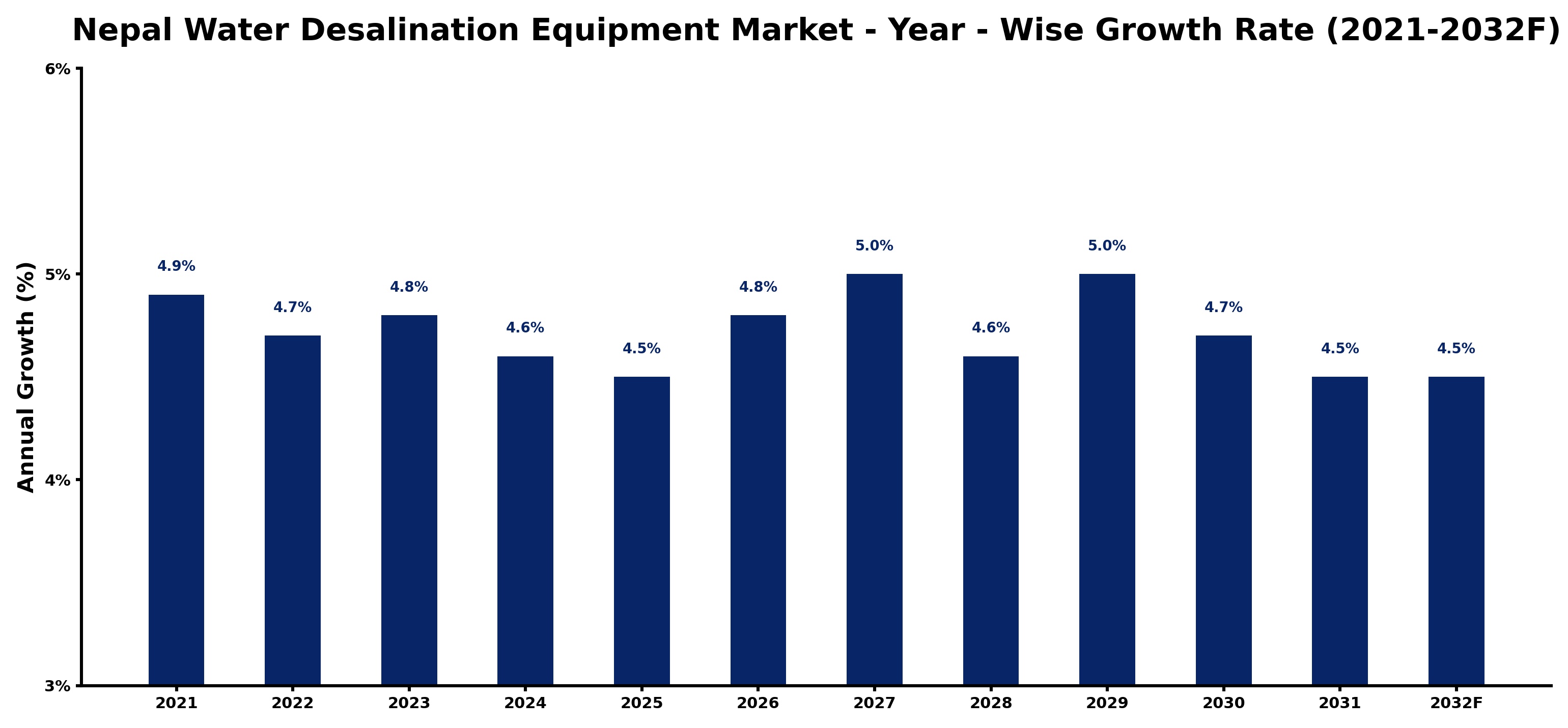
The table below presents the year‑wise growth rates along with the key drivers influencing the market
| Year | Growth Rate | Major Drivers |
| 2021 | 4.9% | Increasing adoption of advanced technologies |
| 2022 | 4.7% | Growing renewable energy integration projects |
| 2023 | 4.8% | Increasing industrial automation investments |
| 2024 | 4.6% | Expansion of transportation and logistics networks |
| 2025 | 4.5% | Rising electricity demand across industries |
| 2026 | 4.8% | Increasing adoption of advanced technologies |
| 2027 | 5.0% | Rising electricity demand across industries |
| 2028 | 4.6% | Increasing adoption of advanced technologies |
| 2029 | 5.0% | Growing renewable energy integration projects |
| 2030 | 4.7% | Government infrastructure modernization initiatives |
| 2031 | 4.5% | Increasing industrial automation investments |
| 2032 | 4.5% | Expansion of transportation and logistics networks |
Note - Market size estimations and growth projections presented in this report are based on 6Wresearch's advanced forecasting approach, validated with industry datasets as of June 2026.
Nepal Water Desalination Equipment Market Synopsis
Recently, the Nepal Water Desalination Equipment Market has gained momentum as local stakeholders increasingly recognize the significance of sustainable water management solutions. As the government and private sectors prioritize clean water accessibility, the market is poised for progressive expansion. However, the future holds even more promise, with anticipated advancements in technology and infrastructure investments driving further adoption of desalination systems.
Moreover, the focus on energy-efficient solutions and environmental sustainability is shaping the market landscape. Collaborations between local and international entities are emerging, promoting the introduction of tailored desalination technologies that cater to Nepal's unique challenges. This evolving scenario is a testament to the resilience and adaptability of the market as it strives to overcome water-related issues.
Nepal Water Desalination Equipment Market Key Takeaways
- The market is heavily influenced by increasing water scarcity and demand for clean drinking water.
- Reverse osmosis systems are the dominant technology due to their effectiveness in purifying water.
- Investments in infrastructure and technology are crucial for market growth and accessibility.
- Government initiatives are likely to focus on sustainable water management and technology adoption.
- Collaborative efforts between local and international firms are fostering innovation in the sector.
Evaluation of Restraints in Nepal Water Desalination Equipment Market
Despite the promising outlook, the Nepal Water Desalination Equipment Market faces substantial challenges that limit its potential. A key restraint is the limited availability of skilled labor required to operate and maintain desalination plants, which can hinder efficiency and sustainability. Additionally, high initial investment costs deter some stakeholders from adopting desalination technologies, particularly in rural areas where infrastructure is lacking. Furthermore, concerns regarding the environmental impact of desalination processes add another layer of complexity that stakeholders must navigate to create a balanced approach to water management.
Nepal Water Desalination Equipment Market Trends
The market is currently witnessing a shift toward more energy-efficient and cost-effective desalination solutions, particularly among reverse osmosis systems, which dominate the landscape. There is a growing emphasis on sustainable practices, with stakeholders increasingly looking to minimize the environmental footprint of desalination technologies. Additionally, the focus on research and development is gaining traction, with local and international collaborations aimed at enhancing the technology tailored for Nepal's specific water needs.
Nepal Water Desalination Equipment Market Opportunities
Investment opportunities abound in the Nepal Water Desalination Equipment Market, primarily driven by the escalating demand for clean drinking water and the urgency to address water scarcity. Opportunities for capital investment exist in desalination equipment manufacturing and technology provision, reflecting a strong market need. Furthermore, establishing partnerships for desalination plant construction and operation can yield substantial returns, particularly as the government seeks to implement sustainable water management solutions.
Government Initiatives in the Nepal Water Desalination Equipment Market
Currently, there are no specific government policies targeting the water desalination equipment sector in Nepal. However, the government is demonstrating interest in promoting sustainable water management practices. Initiatives are underway to enhance water infrastructure, improve access to clean water, and promote conservation measures. In the future, it is anticipated that the government will consider implementing policies or incentives to facilitate the adoption of desalination technologies, thereby reinforcing the importance of water security in Nepal.
Future Insights of the Nepal Water Desalination Equipment Market
The outlook for the Nepal Water Desalination Equipment Market between 2026 and 2032 is optimistic, driven by the continued rise in population and the intensifying impacts of climate change on water availability. The projected market growth will be supported by government investments in water quality and infrastructure, as well as increased private sector interest in addressing water supply issues. Additionally, advancements in desalination technology aimed at boosting efficiency and reducing costs will make these solutions more accessible, thus ensuring the market's significant expansion in the coming years.
Nepal Water Desalination Equipment Market Latest Developments (May 2025 - June 2026)
In recent months, the Nepal Water Desalination Equipment Market has witnessed an increased focus on developing partnerships aimed at enhancing technology and infrastructure. Stakeholders are looking to leverage innovative approaches in desalination processes, focusing on sustainability and efficiency. Furthermore, there have been discussions around potential governmental incentives to spur investment in desalination technologies, signaling a progressive shift towards comprehensive water management strategies in Nepal.
Nepal Water Desalination Equipment Market - Key Attractiveness of the Report
- 10 Years of Market Numbers
- Historical Data Starting from 2022 to 2025
- Base Year: 2025
- Forecast Data until 2032
- Key Performance Indicators Impacting the Market
- Major Upcoming Developments and Projects
Key Highlights of the Report:
- Nepal Water Desalination Equipment Market Outlook
- Market Size of Nepal Water Desalination Equipment Market, 2025
- Forecast of Nepal Water Desalination Equipment Market, 2032
- Historical Data and Forecast of Nepal Water Desalination Equipment Revenues & Volume for the Period 2022-2032F
- Nepal Water Desalination Equipment Market Trend Evolution
- Nepal Water Desalination Equipment Market Drivers and Challenges
- Nepal Water Desalination Equipment Price Trends
- Nepal Water Desalination Equipment Porter's Five Forces
- Nepal Water Desalination Equipment Industry Life Cycle
- Historical Data and Forecast of Nepal Water Desalination Equipment Market Revenues & Volume By Technology for the Period 2022-2032F
- Historical Data and Forecast of Nepal Water Desalination Equipment Market Revenues & Volume By Reverse Osmosis for the Period 2022-2032F
- Historical Data and Forecast of Nepal Water Desalination Equipment Market Revenues & Volume By Multi-Stage Flash (MSF) Distillation for the Period 2022-2032F
- Historical Data and Forecast of Nepal Water Desalination Equipment Market Revenues & Volume By Multi-Effect Distillation (MED) for the Period 2022-2032F
- Historical Data and Forecast of Nepal Water Desalination Equipment Market Revenues & Volume By Others for the Period 2022-2032F
- Historical Data and Forecast of Nepal Water Desalination Equipment Market Revenues & Volume By Source for the Period 2022-2032F
- Historical Data and Forecast of Nepal Water Desalination Equipment Market Revenues & Volume By Seawater for the Period 2022-2032F
- Historical Data and Forecast of Nepal Water Desalination Equipment Market Revenues & Volume By Brackish water for the Period 2022-2032F
- Historical Data and Forecast of Nepal Water Desalination Equipment Market Revenues & Volume By River water for the Period 2022-2032F
- Historical Data and Forecast of Nepal Water Desalination Equipment Market Revenues & Volume By Others for the Period 2022-2032F
- Historical Data and Forecast of Nepal Water Desalination Equipment Market Revenues & Volume By Application for the Period 2022-2032F
- Historical Data and Forecast of Nepal Water Desalination Equipment Market Revenues & Volume By Municipal for the Period 2022-2032F
- Historical Data and Forecast of Nepal Water Desalination Equipment Market Revenues & Volume By Industrial for the Period 2022-2032F
- Historical Data and Forecast of Nepal Water Desalination Equipment Market Revenues & Volume By Others for the Period 2022-2032F
- Nepal Water Desalination Equipment Import Export Trade Statistics
- Market Opportunity Assessment By Technology
- Market Opportunity Assessment By Source
- Market Opportunity Assessment By Application
- Nepal Water Desalination Equipment Top Companies Market Share
- Nepal Water Desalination Equipment Competitive Benchmarking By Technical and Operational Parameters
- Nepal Water Desalination Equipment Company Profiles
- Nepal Water Desalination Equipment Key Strategic Recommendations






































