Nepal Water Purifier Market Size, Share & Growth Rate
The Nepal Water Purifier Market was estimated at USD 330 Million in 2025 and is projected to reach USD 442 Million by 2032, growing at a CAGR of 4.3% from 2026 to 2032. This trajectory is fueled by heightened consumer awareness regarding health risks associated with contaminated water and government initiatives aimed at promoting safe drinking water access. As urbanization continues to escalate and incomes rise, the demand for effective water purification solutions is anticipated to further increase.
Nepal Water Purifier Market Year-wise Growth Rate and Key Drivers
This graph highlights how the Nepal Water Purifier Market has steadily grown over the years, supported by major growth factors.
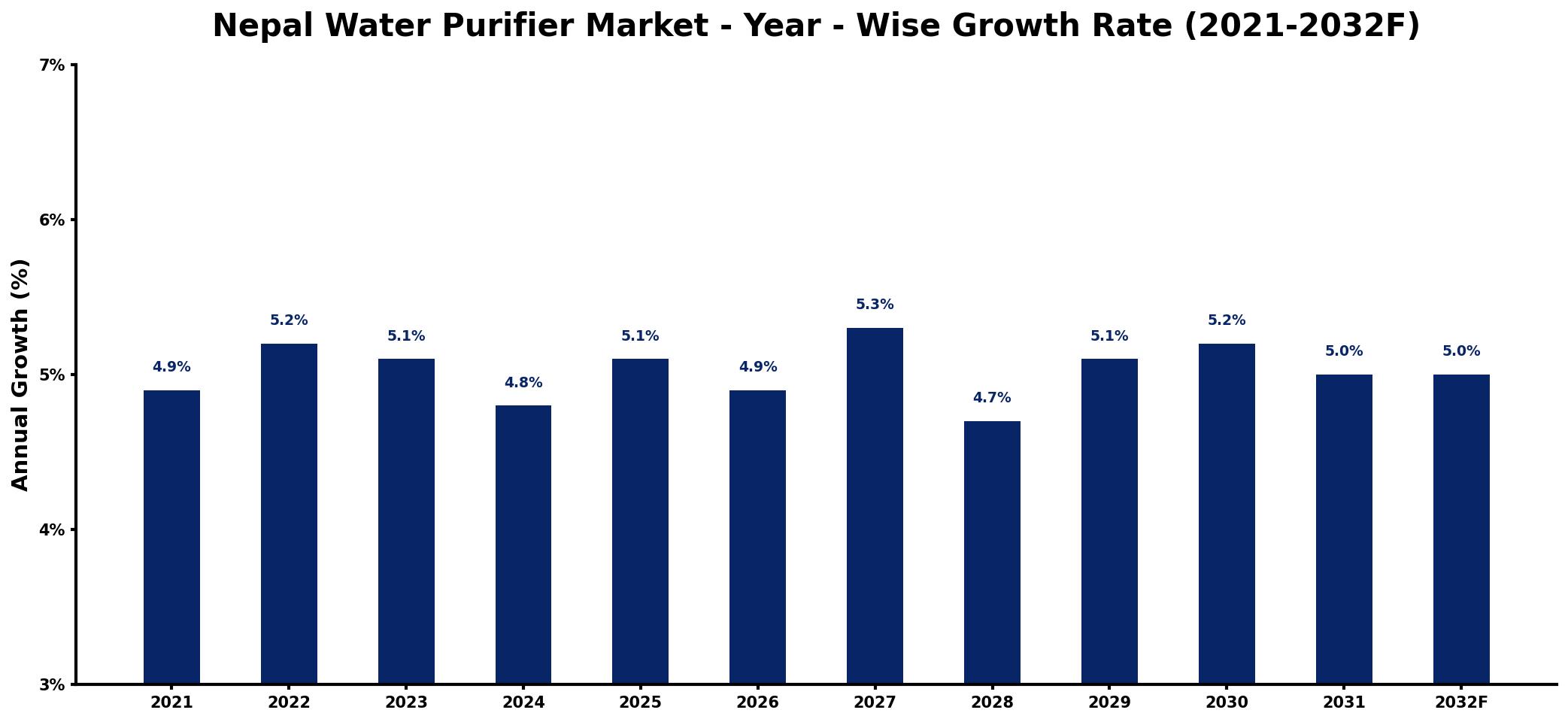
The table below presents the year‑wise growth rates along with the key drivers influencing the market
| Year | Growth Rate | Major Drivers |
| 2021 | 4.9% | Rising health awareness among consumers |
| 2022 | 5.2% | Increased urbanization driving demand |
| 2023 | 5.1% | Growing investments in infrastructure |
| 2024 | 4.8% | Expansion of distribution networks |
| 2025 | 5.1% | Surge in household spending capacity |
| 2026 | 4.9% | Adoption of advanced technologies |
| 2027 | 5.3% | Regulatory support for clean solutions |
| 2028 | 4.7% | Focus on sustainability initiatives |
| 2029 | 5.1% | Emerging trends in eco-friendly options |
| 2030 | 5.2% | improved raw material availability |
| 2031 | 5.0% | Increased availability of financing options |
| 2032 | 5.0% | Rising concerns over environmental impact |
Note: Market size estimations and growth projections presented in this report are based on 6Wresearch's proprietary forecasting methodology, utilizing the latest available industry data, government publications, and primary research inputs.
Nepal Water Purifier Market Synopsis
In Nepal, the increasing prevalence of waterborne diseases has heightened the urgency for effective water purification solutions. Consumers are becoming more discerning, seeking products that ensure not only safe drinking water but also enhanced taste and mineral content. Urban households, in particular, are leading the charge in adopting advanced purification technologies.
While urban areas dominate the demand landscape, rural regions are also showing significant interest as awareness spreads. This expanding market features a diverse array of products, from UV and RO purifiers to portable filters, catering to various consumer preferences and budgets. Companies are strategically innovating to balance quality and affordability.
Nepal Water Purifier Market Key Takeaways
- Urbanization and rising disposable incomes are propelling the demand for advanced water purification technologies.
- Government initiatives are bolstering efforts to enhance access to clean drinking water across the nation.
- Consumers are prioritizing compact, energy-efficient purifiers that fit urban living spaces.
- Market players are innovating to create cost-effective solutions to address affordability concerns.
- Growing awareness of waterborne diseases is driving demand for high-quality filtration systems.
Evaluation of Restraints in Nepal Water Purifier Market
Despite its growth potential, the Nepal Water Purifier Market faces significant hurdles. A notable challenge is the pervasive lack of awareness surrounding water purification and its benefits, especially in rural areas where educational campaigns are limited. Additionally, many households view high-quality purifiers as financially out of reach, limiting widespread adoption. Distribution inefficiencies in remote regions further complicate access to these essential products, while traditional purification methods, such as boiling, continue to compete with modern solutions. Addressing these constraints requires a multi-faceted approach that encompasses education, innovative pricing strategies, and improved logistics.
Nepal Water Purifier Market Trends
The Nepal Water Purifier Market is witnessing noteworthy trends that shape consumer preferences and technological advancements. There is a marked shift toward advanced purification technologies, with consumers increasingly opting for features such as UV sterilization and mineral enhancement. Additionally, a growing inclination towards eco-friendly products has led to the popularity of energy-efficient purifiers that align with sustainability goals. Furthermore, the convenience of portable purifiers is gaining traction as more consumers seek flexible solutions for their drinking water needs.
Nepal Water Purifier Market Opportunities
Investors and stakeholders are presented with numerous opportunities in the burgeoning Nepal Water Purifier Market. The increasing urgency for clean drinking water, driven by urbanization and pollution, opens doors for innovative solutions that cater to both residential and commercial sectors. Sustainable products that align with eco-conscious consumer trends are particularly promising. Partnerships with local entities, government bodies, and NGOs focused on health initiatives can amplify efforts to improve water access in underserved areas, enhancing market penetration.
Government Initiatives in the Nepal Water Purifier Market
The government of Nepal has implemented several policies aimed at enhancing the quality and accessibility of drinking water. The Safe Drinking Water Act establishes essential guidelines for water treatment and quality standards. To facilitate the adoption of water purifiers, the government offers incentives and subsidies, particularly targeting rural communities. Oversight from the Department of Water Supply and Sewerage ensures compliance with these standards, reinforcing public trust in the safety of drinking water.
Future Insights of the Nepal Water Purifier Market
Looking ahead to the period from 2026 to 2032, the outlook for the Nepal Water Purifier Market remains bright. The convergence of rising health consciousness, urbanization, and governmental support is set to sustain market growth. As consumers prioritize their well-being and demand for clean water intensifies, the advent of cost-effective and innovative purification solutions will likely catalyze further market expansion. Advancements in technology promise to enhance efficiency and affordability, making water purification more accessible to a broader population.
Nepal Water Purifier Market Latest Developments (2025 - 2026)
The Nepal Water Purifier Market has seen several significant developments in recent months, showcasing a clear direction towards innovation and accessibility. There has been an uptick in collaboration between manufacturers and governmental bodies to improve distribution networks, particularly in rural areas. Additionally, numerous companies are actively launching new, energy-efficient models that cater to changing consumer preferences for sustainable products. The focus on enhancing after-sales services has also become a key differentiator as market competition intensifies.
Nepal Water Purifier Market - Key Attractiveness of the Report
- 10 Years of Market Numbers
- Historical Data Starting from 2022 to 2025
- Base Year: 2025
- Forecast Data until 2032
- Key Performance Indicators Impacting the Market
- Major Upcoming Developments and Projects
Key Highlights of the Report:
- Nepal Water Purifier Market Outlook
- Market Size of Nepal Water Purifier Market, 2025
- Forecast of Nepal Water Purifier Market, 2032
- Historical Data and Forecast of Nepal Water Purifier Revenues & Volume for the Period 2022-2032F
- Nepal Water Purifier Market Trend Evolution
- Nepal Water Purifier Market Drivers and Challenges
- Nepal Water Purifier Price Trends
- Nepal Water Purifier Porter's Five Forces
- Nepal Water Purifier Industry Life Cycle
- Historical Data and Forecast of Nepal Water Purifier Market Revenues & Volume By Type for the Period 2022-2032F
- Historical Data and Forecast of Nepal Water Purifier Market Revenues & Volume By Point-of-use Filters for the Period 2022-2032F
- Historical Data and Forecast of Nepal Water Purifier Market Revenues & Volume By Under The Counter Filters for the Period 2022-2032F
- Historical Data and Forecast of Nepal Water Purifier Market Revenues & Volume By Counter Top Filters for the Period 2022-2032F
- Historical Data and Forecast of Nepal Water Purifier Market Revenues & Volume By Pitcher Filters for the Period 2022-2032F
- Historical Data and Forecast of Nepal Water Purifier Market Revenues & Volume By Faucet-mounted Filters for the Period 2022-2032F
- Historical Data and Forecast of Nepal Water Purifier Market Revenues & Volume By Others for the Period 2022-2032F
- Historical Data and Forecast of Nepal Water Purifier Market Revenues & Volume By Point-of-entry Filters for the Period 2022-2032F
- Historical Data and Forecast of Nepal Water Purifier Market Revenues & Volume By Category for the Period 2022-2032F
- Historical Data and Forecast of Nepal Water Purifier Market Revenues & Volume By Ro Filters for the Period 2022-2032F
- Historical Data and Forecast of Nepal Water Purifier Market Revenues & Volume By Uv Filters for the Period 2022-2032F
- Historical Data and Forecast of Nepal Water Purifier Market Revenues & Volume By Gravity Filters for the Period 2022-2032F
- Historical Data and Forecast of Nepal Water Purifier Market Revenues & Volume By Others for the Period 2022-2032F
- Historical Data and Forecast of Nepal Water Purifier Market Revenues & Volume By Application for the Period 2022-2032F
- Historical Data and Forecast of Nepal Water Purifier Market Revenues & Volume By Residential for the Period 2022-2032F
- Historical Data and Forecast of Nepal Water Purifier Market Revenues & Volume By Light Commercial for the Period 2022-2032F
- Nepal Water Purifier Import Export Trade Statistics
- Market Opportunity Assessment By Type
- Market Opportunity Assessment By Category
- Market Opportunity Assessment By Application
- Nepal Water Purifier Top Companies Market Share
- Nepal Water Purifier Competitive Benchmarking By Technical and Operational Parameters
- Nepal Water Purifier Company Profiles
- Nepal Water Purifier Key Strategic Recommendations






































