Nepal Winding Wire Market Size, Share & Growth Rate
The Nepal Winding Wire Market was estimated at USD 1202 Million in 2025 and is projected to reach USD 1717 Million by 2032, growing at a CAGR of 5.2% from 2026 to 2032. This growth is primarily fueled by escalating investments in infrastructure development, particularly in sectors like power generation and urbanization. Furthermore, the rising focus on renewable energy initiatives is significantly driving the demand for high-quality winding wires across various applications.
Nepal Winding Wire Market Year-wise Growth Rate and Key Drivers
This graph highlights how the Nepal Winding Wire Market has steadily grown over the years, supported by major growth factors.
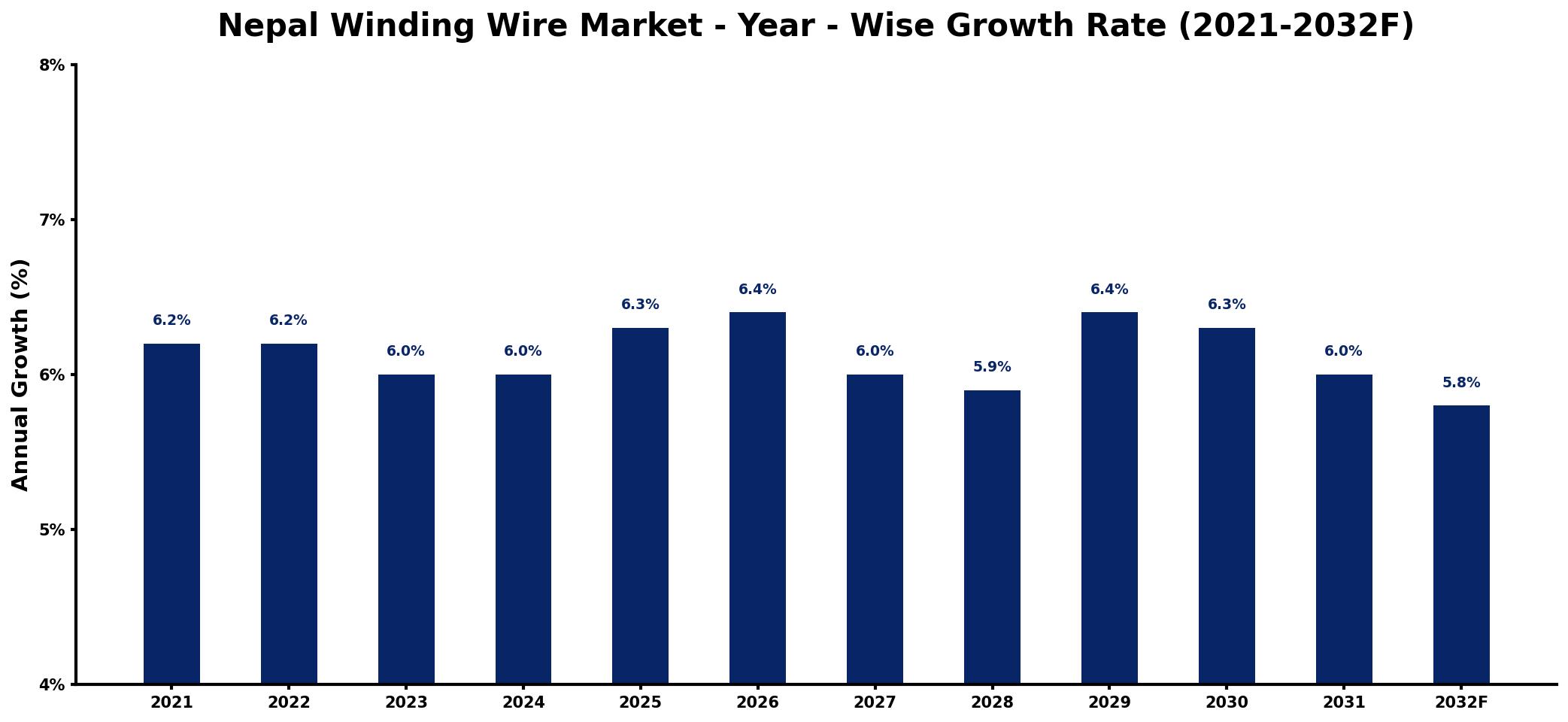
The table below presents the year‑wise growth rates along with the key drivers influencing the market
| Year | Growth Rate | Major Drivers |
| 2021 | 6.2% | Increased demand from construction sector |
| 2022 | 6.2% | Expansion of renewable energy projects |
| 2023 | 6.0% | Growth in automotive manufacturing industry |
| 2024 | 6.0% | Rise in electrical infrastructure investments |
| 2025 | 6.3% | Surge in telecommunications network expansion |
| 2026 | 6.4% | Increase in residential housing developments |
| 2027 | 6.0% | rising procurement volume requirements |
| 2028 | 5.9% | Demand from consumer electronics market |
| 2029 | 6.4% | growing downstream application demand |
| 2030 | 6.3% | increased capital investment inflows |
| 2031 | 6.0% | expanding manufacturing base activity |
| 2032 | 5.8% | Rising investments in smart technologies |
Note: Market size estimations and growth projections presented in this report are based on 6Wresearch's proprietary forecasting methodology, utilizing the latest available industry data, government publications, and primary research inputs.
Nepal Winding Wire Market Synopsis
The demand for winding wires in Nepal is increasingly influenced by the growth of the construction and automotive industries. As infrastructure projects expand, the need for efficient electrical equipment, including transformers and motors, continues to surge. This is leading manufacturers to innovate and offer advanced winding wire solutions that align with evolving industry needs.
Additionally, there is a significant shift towards eco-friendly and energy-efficient technologies in Nepal. The government's initiatives to promote renewable energy sources, such as hydro and solar power, are contributing to heightened demand for winding wires, as these applications require reliable and durable electrical components.
Nepal Winding Wire Market Key Takeaways
- Strong growth trajectory driven by infrastructure development and urbanization.
- Increasing focus on renewable energy is propelling demand for winding wires.
- Shift towards advanced and high-quality wire solutions enhances market competition.
- Government policies are fostering a conducive environment for domestic production.
- Technological advancements are critical to meeting the evolving market needs.
Evaluation of Restraints in Nepal Winding Wire Market
The Nepal Winding Wire Market encounters a few notable restraints that affect its overall growth. One significant challenge is the inconsistency in quality standards, which often results in substandard products that compromise the performance and safety of electrical equipment. Additionally, the market is characterized by numerous small and unorganized players, which leads to intense competition and price wars, making it difficult for established manufacturers to sustain profitability. The limited awareness regarding the benefits of using high-quality winding wires further hinders market expansion.
Nepal Winding Wire Market Trends
The market is currently experiencing a trend towards energy-efficient winding wire solutions, particularly in applications related to renewable energy technologies. This is encouraging manufacturers to develop products that not only meet performance standards but also cater to sustainability goals. Furthermore, there is an increasing adoption of technologically advanced materials, which are designed to enhance the durability and efficiency of electrical components.
Nepal Winding Wire Market Opportunities
Investment opportunities in the Nepal Winding Wire Market are substantial, particularly in the context of the growing demand for electrical products as the country continues to urbanize. The government's emphasis on expanding its renewable energy infrastructure offers promising avenues for growth, especially in the manufacturing of winding wires for applications such as transformers, motors, and generators. Investors can leverage these trends by focusing on high-quality production and distribution channels.
Government Initiatives in the Nepal Winding Wire Market
The Nepalese government has enacted several policies aimed at regulating the winding wire market to ensure quality and safety standards. These include guidelines for manufacturing processes and compliance with environmental regulations. Furthermore, the government has introduced import duties on specific types of winding wires to encourage local production and reduce dependence on foreign imports, thereby fostering innovation and enhancing the competitiveness of the domestic market.
Future Insights of the Nepal Winding Wire Market
Looking ahead to 2026-2032, the Nepal Winding Wire Market is set for a promising future, bolstered by an uptick in investments in infrastructure and renewable energy projects. The anticipated expansion in the industrial sector will further drive demand for reliable winding wires in various applications. Additionally, advancements in manufacturing technologies are expected to play a crucial role in shaping the competitive landscape, ensuring that the market remains dynamic and responsive to evolving customer needs.
Nepal Winding Wire Market Latest Developments (2025 - 2026)
Recently, the Nepal Winding Wire Market has seen a trend towards increased collaboration between manufacturers and technology developers to enhance product offerings. This includes the adoption of innovative manufacturing processes aimed at improving the quality and efficiency of winding wires. Additionally, there has been a notable push from government bodies towards promoting sustainable practices in electrical manufacturing, which has encouraged investments in environmentally friendly technologies.
Nepal Winding Wire Market - Key Attractiveness of the Report
- 10 Years of Market Numbers
- Historical Data Starting from 2022 to 2025
- Base Year: 2025
- Forecast Data until 2032
- Key Performance Indicators Impacting the Market
- Major Upcoming Developments and Projects
Key Highlights of the Report:
- Nepal Winding Wire Market Outlook
- Market Size of Nepal Winding Wire Market, 2025
- Forecast of Nepal Winding Wire Market, 2032
- Historical Data and Forecast of Nepal Winding Wire Revenues & Volume for the Period 2022-2032F
- Nepal Winding Wire Market Trend Evolution
- Nepal Winding Wire Market Drivers and Challenges
- Nepal Winding Wire Price Trends
- Nepal Winding Wire Porter's Five Forces
- Nepal Winding Wire Industry Life Cycle
- Historical Data and Forecast of Nepal Winding Wire Market Revenues & Volume By Product for the Period 2022-2032F
- Historical Data and Forecast of Nepal Winding Wire Market Revenues & Volume By Copper Winding Wire for the Period 2022-2032F
- Historical Data and Forecast of Nepal Winding Wire Market Revenues & Volume By Aluminum Winding Wire for the Period 2022-2032F
- Nepal Winding Wire Import Export Trade Statistics
- Market Opportunity Assessment By Product
- Nepal Winding Wire Top Companies Market Share
- Nepal Winding Wire Competitive Benchmarking By Technical and Operational Parameters
- Nepal Winding Wire Company Profiles
- Nepal Winding Wire Key Strategic Recommendations






































