Nepal Wound Dressings Market Size, Share & Growth Rate
The Nepal Wound Dressings Market was estimated at USD 258 Million in 2025 and is projected to reach USD 360 Million by 2032, growing at a CAGR of 4.9% from 2026 to 2032. This growth trajectory is underpinned by several factors, including an increasing prevalence of chronic wounds, particularly among the aging population, and an uptick in healthcare infrastructure investments. Furthermore, the rising awareness and acceptance of advanced wound care products among healthcare professionals and patients are pivotal in accelerating the shift from traditional dressings to more innovative solutions.
Nepal Wound Dressings Market Year-wise Growth Rate and Key Drivers
This graph highlights how the Nepal Wound Dressings Market has steadily grown over the years, supported by major growth factors.
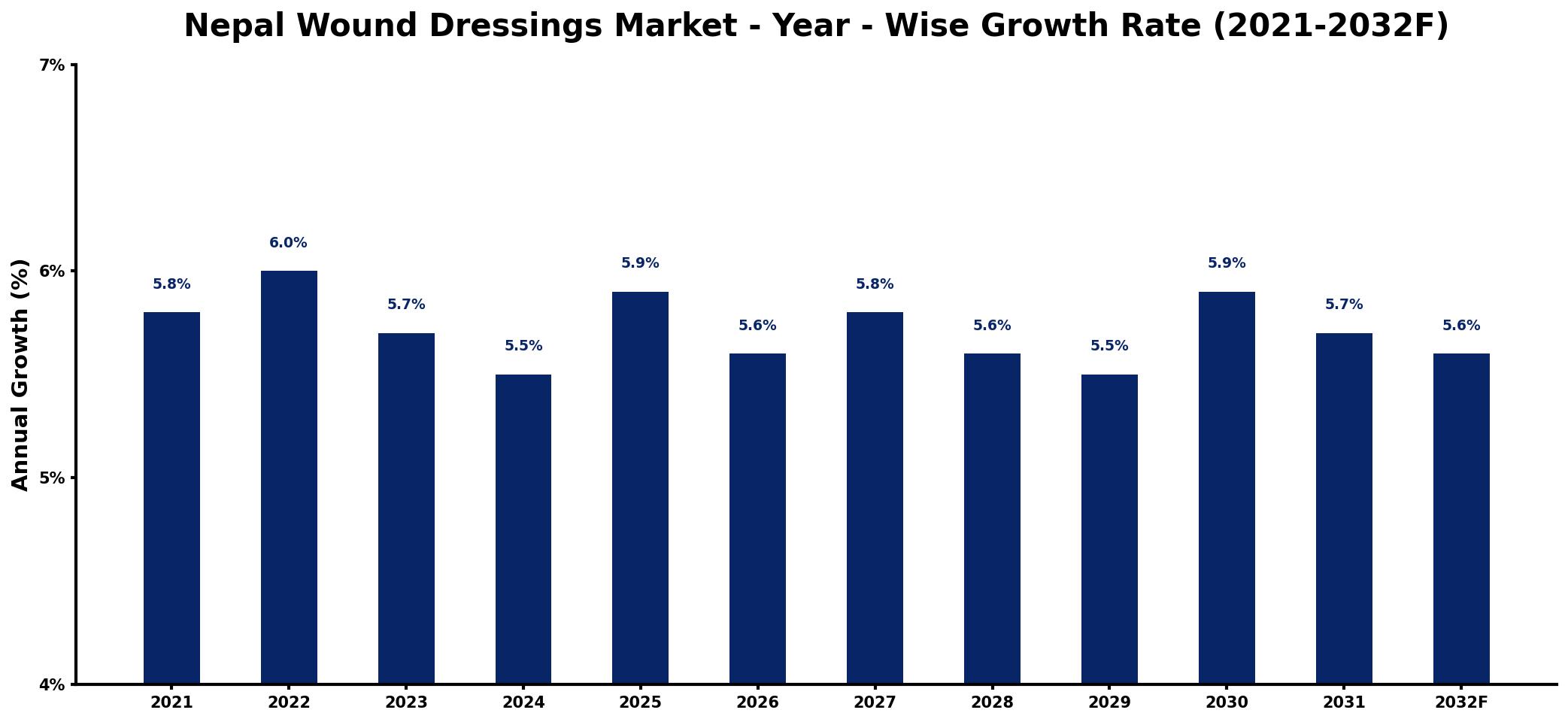
The table below presents the year‑wise growth rates along with the key drivers influencing the market
| Year | Growth Rate | Major Drivers |
| 2021 | 5.8% | Rising healthcare expenditure and investments |
| 2022 | 6.0% | Growing awareness of chronic conditions |
| 2023 | 5.7% | Expansion of healthcare infrastructure initiatives |
| 2024 | 5.5% | Increase in surgical procedures performed |
| 2025 | 5.9% | Advancements in medical technology adoption |
| 2026 | 5.6% | Surge in aging population demographics |
| 2027 | 5.8% | Growth in health insurance coverage |
| 2028 | 5.6% | Emergence of innovative treatment solutions |
| 2029 | 5.5% | increased domestic production output |
| 2030 | 5.9% | Rising prevalence of lifestyle diseases |
| 2031 | 5.7% | Focus on preventive healthcare measures |
| 2032 | 5.6% | increased capital investment inflows |
Note: Market size estimations and growth projections presented in this report are based on 6Wresearch's proprietary forecasting methodology, utilizing the latest available industry data, government publications, and primary research inputs.
Nepal Wound Dressings Market Synopsis
The Nepal wound dressings market is currently navigating a transformative phase, primarily driven by the escalating incidence of chronic wounds and surgical complications. As the healthcare landscape evolves, there is a marked shift toward advanced dressings that enhance healing and minimize infection risks.
Traditional wound dressings such as gauze and bandages still dominate the market; however, the demand for advanced products like hydrocolloids, alginates, and foam dressings is steadily gaining ground. This change reflects a growing understanding of their benefits, leading healthcare providers to adopt solutions that improve patient outcomes.
Nepal Wound Dressings Market Key Takeaways
- The market is experiencing a transition from traditional to advanced wound dressings.
- Healthcare facilities are the primary end-users, reflecting the essential role of hospitals and clinics.
- Investment in healthcare infrastructure is expected to further enhance market accessibility.
- Research and development are vital for introducing innovative products tailored to local needs.
- Pricing pressures and accessibility in remote areas pose challenges for market penetration.
Evaluation of Restraints in Nepal Wound Dressings Market
Despite the promising growth outlook, the Nepal wound dressings market faces significant restraints. Limited access to advanced wound care products, especially in remote and rural areas, remains a critical barrier. Furthermore, the inadequacies in healthcare infrastructure and resources can hinder effective distribution and utilization of these essential products. Inconsistent quality standards and a general lack of awareness regarding proper wound care practices among healthcare providers and the general population also pose considerable challenges. Addressing these issues is essential for unlocking the markets full potential.
Nepal Wound Dressings Market Trends
The market is witnessing an increasing shift towards advanced wound care products such as hydrocolloids, foams, and alginates. This trend is fueled by the rising incidence of chronic conditions like diabetes and the associated complications such as foot ulcers. In addition, the adoption of bioactive and antimicrobial dressings is gaining traction, driven by the imperative to combat antibiotic resistance. Healthcare providers are increasingly implementing innovative solutions that not only expedite healing but also enhance patient comfort.
Nepal Wound Dressings Market Opportunities
The growing awareness about advanced wound care solutions opens various investment opportunities within the Nepal wound dressings market. Products that offer superior healing properties and antimicrobial features are particularly poised for growth. Collaboration with local healthcare providers and distributors can significantly enhance market reach, while investments in R&D to develop customized solutions for the Nepalese population will drive innovation. Additionally, establishing cost-effective domestic manufacturing capabilities could improve accessibility to high-quality wound care products across the country.
Government Initiatives in the Nepal Wound Dressings Market
The government of Nepal plays a crucial role in regulating the wound dressings market through the Department of Drug Administration (DDA) under the Ministry of Health and Population. All wound dressings must undergo registration with the DDA before being imported, manufactured, or distributed, ensuring that safety and efficacy standards are met. Additionally, pricing regulations are in place to prevent unfair pricing practices, promoting affordability for consumers and ensuring that healthcare providers can access necessary materials without excessive financial burden.
Future Insights of the Nepal Wound Dressings Market
Looking ahead, the Nepal Wound Dressings Market is set for consistent growth driven by multiple factors, including the rising geriatric population and the increasing prevalence of chronic wounds. Technological advancements in wound dressing materials and delivery methods are expected to yield more effective products, addressing the evolving healthcare needs. Furthermore, the continued expansion of healthcare infrastructure and rising healthcare expenditure will further support demand, paving the way for innovative solutions that enhance patient care.
Nepal Wound Dressings Market Latest Developments (2025 - 2026)
Recent developments in the Nepal wound dressings market indicate a heightened focus on introducing technologically advanced products. There is a growing interest among manufacturers to explore innovative materials and formulations that enhance healing efficiency and reduce infection rates. Additionally, partnerships between local healthcare providers and distributors are becoming more prevalent, aimed at improving product accessibility and education regarding advanced wound care practices.
Nepal Wound Dressings Market - Key Attractiveness of the Report
- 10 Years of Market Numbers
- Historical Data Starting from 2022 to 2025
- Base Year: 2025
- Forecast Data until 2032
- Key Performance Indicators Impacting the Market
- Major Upcoming Developments and Projects
The Nepal wound dressings market was valued at approximately USD 258 Million in 2025 and is projected to reach USD 360 Million by 2032, indicating robust growth potential.
There is a notable shift towards advanced wound dressings like hydrocolloids, alginates, and foam dressings due to their enhanced healing properties and infection prevention capabilities.
The ongoing improvements in healthcare infrastructure are crucial as they facilitate better access to advanced wound care products, thereby boosting market growth.
Accessibility issues in remote areas, high costs associated with imported dressings, and limited awareness of advanced wound care practices pose significant challenges for market expansion.
Government regulations through the Department of Drug Administration ensure that all wound dressings meet safety and efficacy standards, thus shaping market dynamics positively.
Key Highlights of the Report:
- Nepal Wound Dressings Market Outlook
- Market Size of Nepal Wound Dressings Market, 2025
- Forecast of Nepal Wound Dressings Market, 2032
- Historical Data and Forecast of Nepal Wound Dressings Revenues & Volume for the Period 2022-2032F
- Nepal Wound Dressings Market Trend Evolution
- Nepal Wound Dressings Market Drivers and Challenges
- Nepal Wound Dressings Price Trends
- Nepal Wound Dressings Porter's Five Forces
- Nepal Wound Dressings Industry Life Cycle
- Historical Data and Forecast of Nepal Wound Dressings Market Revenues & Volume By Type for the Period 2022-2032F
- Historical Data and Forecast of Nepal Wound Dressings Market Revenues & Volume By Advanced Wound Dressings for the Period 2022-2032F
- Historical Data and Forecast of Nepal Wound Dressings Market Revenues & Volume By Traditional Wound Dressings for the Period 2022-2032F
- Historical Data and Forecast of Nepal Wound Dressings Market Revenues & Volume By Wound Type for the Period 2022-2032F
- Historical Data and Forecast of Nepal Wound Dressings Market Revenues & Volume By Surgical and Traumatic Wounds for the Period 2022-2032F
- Historical Data and Forecast of Nepal Wound Dressings Market Revenues & Volume By Diabetic Foot Ulcers for the Period 2022-2032F
- Historical Data and Forecast of Nepal Wound Dressings Market Revenues & Volume By Pressure Ulcers for the Period 2022-2032F
- Historical Data and Forecast of Nepal Wound Dressings Market Revenues & Volume By Venous Leg Ulcers for the Period 2022-2032F
- Historical Data and Forecast of Nepal Wound Dressings Market Revenues & Volume By Burns and Other Wounds for the Period 2022-2032F
- Historical Data and Forecast of Nepal Wound Dressings Market Revenues & Volume By End User for the Period 2022-2032F
- Historical Data and Forecast of Nepal Wound Dressings Market Revenues & Volume By Hospitals, ASCs, and Clinics for the Period 2022-2032F
- Historical Data and Forecast of Nepal Wound Dressings Market Revenues & Volume By Home Care Settings for the Period 2022-2032F
- Historical Data and Forecast of Nepal Wound Dressings Market Revenues & Volume By Other End Users for the Period 2022-2032F
- Nepal Wound Dressings Import Export Trade Statistics
- Market Opportunity Assessment By Type
- Market Opportunity Assessment By Wound Type
- Market Opportunity Assessment By End User
- Nepal Wound Dressings Top Companies Market Share
- Nepal Wound Dressings Competitive Benchmarking By Technical and Operational Parameters
- Nepal Wound Dressings Company Profiles
- Nepal Wound Dressings Key Strategic Recommendations






































