Nepal Zinc Chemicals Market Size, Share & Growth Rate
The Nepal Zinc Chemicals Market was estimated at USD 248 Million in 2025 and is projected to reach USD 341 Million by 2032, growing at a CAGR of 4.7% from 2026 to 2032. This growth trajectory is primarily driven by increasing agricultural practices that leverage zinc's essential benefits for soil health, as well as ongoing infrastructure projects that require zinc-based materials. Additionally, the rising awareness of environmental sustainability is fueling the demand for eco-friendly zinc chemical solutions, further contributing to market expansion.
Nepal Zinc Chemicals Market Year-wise Growth Rate and Key Drivers
This graph highlights how the Nepal Zinc Chemicals Market has steadily grown over the years, supported by major growth factors.
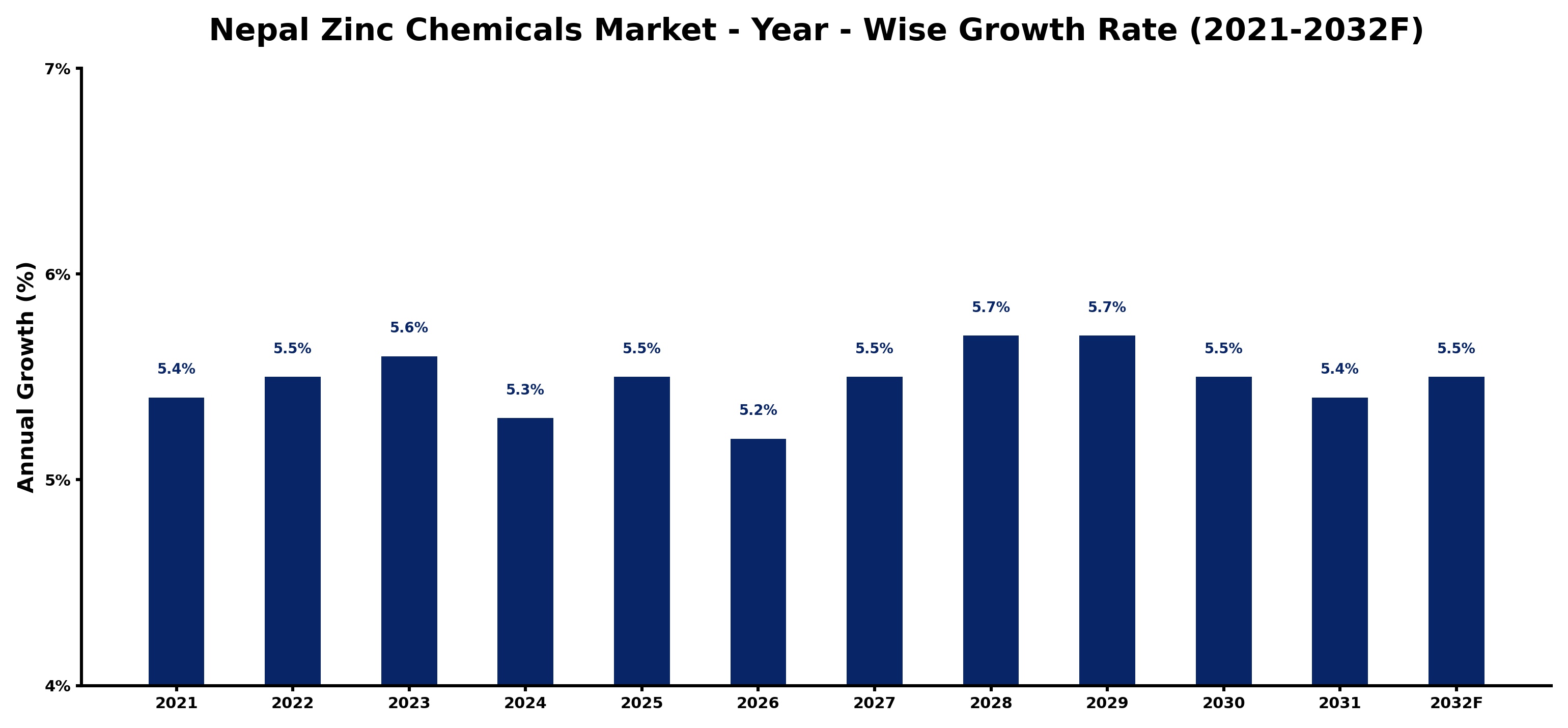
The table below presents the year‑wise growth rates along with the key drivers influencing the market
| Year | Growth Rate | Major Drivers |
| 2021 | 5.4% | Infrastructure development increased demand |
| 2022 | 5.5% | Industrial applications expanded significantly |
| 2023 | 5.6% | Construction sector growth accelerated usage |
| 2024 | 5.3% | Agricultural sector adoption increased |
| 2025 | 5.5% | Automotive industry requirements rose |
| 2026 | 5.2% | Consumer electronics production expanded |
| 2027 | 5.5% | Pharmaceutical applications gained traction |
| 2028 | 5.7% | Renewable energy projects boosted consumption |
| 2029 | 5.7% | Export opportunities enhanced market reach |
| 2030 | 5.5% | Technological advancements improved efficiency |
| 2031 | 5.4% | Regulatory support encouraged investments |
| 2032 | 5.5% | Sustainability initiatives drove innovation |
Note - Market size estimations and growth projections presented in this report are based on 6Wresearch’s advanced forecasting approach, validated with industry datasets as of June 2026.
Nepal Zinc Chemicals Market Synopsis
The demand for zinc oxide, a significant component in agriculture for enhancing crop yield, is steadily increasing in Nepal. As farmers recognize the critical role zinc plays in plant health, the agricultural sector is emerging as a vital driver of market growth.
In addition to agriculture, the construction and automotive sectors are significantly contributing to the zinc chemicals market. The ongoing infrastructure development projects in the country have prompted a surge in the need for zinc-based materials, creating a robust demand that industry stakeholders are eager to meet.
Nepal Zinc Chemicals Market Key Takeaways
- The market is experiencing heightened demand due to increased agricultural activities and infrastructure development.
- Innovations in eco-friendly zinc chemicals are gaining traction in response to rising environmental awareness.
- Investments in research and development are expanding the applications of zinc chemicals across multiple industries.
- Manufacturers are focusing on enhancing product purity and performance to better cater to market needs.
- Government policies are fostering domestic production, thus encouraging market growth and competitiveness.
Evaluation of Restraints in Nepal Zinc Chemicals Market
Despite the promising growth outlook, the Nepal Zinc Chemicals Market faces several restraints. A significant challenge is the limited awareness among consumers and businesses regarding the benefits of zinc chemicals, which can lead to inconsistent demand. Moreover, fluctuations in raw material prices and quality inconsistency hamper reliability and product performance. Addressing these issues will be crucial for stakeholders aiming to enhance market penetration and consumer trust.
Nepal Zinc Chemicals Market Trends
The Nepal Zinc Chemicals Market is currently witnessing a shift towards sustainable practices. Manufacturers are increasingly adopting eco-friendly production methods and developing green products that align with global environmental standards. This trend is being driven by consumer demand for safer and more sustainable options in agricultural and industrial applications.
Additionally, the market is seeing a surge in technological advancements aimed at improving the efficiency and effectiveness of zinc chemicals. Innovations in product formulations are focusing on higher purity levels, which are essential for specialized applications in pharmaceuticals and cosmetics, further diversifying the market landscape.
Nepal Zinc Chemicals Market Opportunities
The growing demand for zinc chemicals presents substantial investment opportunities across various sectors, particularly agriculture and construction. With Nepal strategically located between India and China, there is potential for regional exports of zinc chemicals. Moreover, the increasing inclination towards sustainable and eco-friendly products opens avenues for investment in innovative formulations, thus catering to a niche but expanding market.
Government Initiatives in the Nepal Zinc Chemicals Market
The Nepali government has implemented policies aimed at promoting the growth of the zinc chemicals sector. These include import restrictions that encourage local production, alongside incentives for manufacturers to enhance their production capacity and improve quality standards. The government also emphasizes environmental regulations to ensure safe handling of zinc products, fostering a balanced approach to industrial development in line with sustainable practices.
Future Insights of the Nepal Zinc Chemicals Market
Looking ahead to 2026-2032, the outlook for the Nepal Zinc Chemicals Market remains bright. Continued industrialization, coupled with expanding infrastructure projects and agricultural initiatives, will propel the demand for zinc chemicals. The agriculture sector, in particular, will be pivotal as the importance of soil health becomes increasingly recognized. Furthermore, advancements in technology and sustained investments in research and development will stimulate innovation and broaden the market's application landscape.
Nepal Zinc Chemicals Market Latest Developments (May 2025 - June 2026)
In recent months, there have been notable shifts within the Nepal Zinc Chemicals Market as companies focus on sustainable production practices. Several manufacturers have unveiled new lines of eco-friendly zinc chemicals designed to meet increasing environmental regulations and consumer expectations. Furthermore, collaborative research initiatives are emerging between industry stakeholders and academic institutions, aimed at developing innovative applications for zinc chemicals across various sectors.
Nepal Zinc Chemicals Market - Key Attractiveness of the Report
- 10 Years of Market Numbers
- Historical Data Starting from 2022 to 2025
- Base Year: 2025
- Forecast Data until 2032
- Key Performance Indicators Impacting the Market
- Major Upcoming Developments and Projects
Key Highlights of the Report:
- Nepal Zinc Chemicals Market Outlook
- Market Size of Nepal Zinc Chemicals Market, 2025
- Forecast of Nepal Zinc Chemicals Market, 2032
- Historical Data and Forecast of Nepal Zinc Chemicals Revenues & Volume for the Period 2022-2032F
- Nepal Zinc Chemicals Market Trend Evolution
- Nepal Zinc Chemicals Market Drivers and Challenges
- Nepal Zinc Chemicals Price Trends
- Nepal Zinc Chemicals Porter's Five Forces
- Nepal Zinc Chemicals Industry Life Cycle
- Historical Data and Forecast of Nepal Zinc Chemicals Market Revenues & Volume By Type for the Period 2022-2032F
- Historical Data and Forecast of Nepal Zinc Chemicals Market Revenues & Volume By Zinc Oxide for the Period 2022-2032F
- Historical Data and Forecast of Nepal Zinc Chemicals Market Revenues & Volume By Zinc Sulfate for the Period 2022-2032F
- Historical Data and Forecast of Nepal Zinc Chemicals Market Revenues & Volume By Zinc Carbonate for the Period 2022-2032F
- Historical Data and Forecast of Nepal Zinc Chemicals Market Revenues & Volume By Zinc Chloride for the Period 2022-2032F
- Historical Data and Forecast of Nepal Zinc Chemicals Market Revenues & Volume By Other for the Period 2022-2032F
- Historical Data and Forecast of Nepal Zinc Chemicals Market Revenues & Volume By End-user Industry for the Period 2022-2032F
- Historical Data and Forecast of Nepal Zinc Chemicals Market Revenues & Volume By Agriculture for the Period 2022-2032F
- Historical Data and Forecast of Nepal Zinc Chemicals Market Revenues & Volume By Chemicals and Petrochemicals for the Period 2022-2032F
- Historical Data and Forecast of Nepal Zinc Chemicals Market Revenues & Volume By Ceramic for the Period 2022-2032F
- Historical Data and Forecast of Nepal Zinc Chemicals Market Revenues & Volume By Pharmaceutical for the Period 2022-2032F
- Historical Data and Forecast of Nepal Zinc Chemicals Market Revenues & Volume By Paints and Coatings for the Period 2022-2032F
- Historical Data and Forecast of Nepal Zinc Chemicals Market Revenues & Volume By Rubber Processing for the Period 2022-2032F
- Historical Data and Forecast of Nepal Zinc Chemicals Market Revenues & Volume By Other for the Period 2022-2032F
- Nepal Zinc Chemicals Import Export Trade Statistics
- Market Opportunity Assessment By Type
- Market Opportunity Assessment By End-user Industry
- Nepal Zinc Chemicals Top Companies Market Share
- Nepal Zinc Chemicals Competitive Benchmarking By Technical and Operational Parameters
- Nepal Zinc Chemicals Company Profiles
- Nepal Zinc Chemicals Key Strategic Recommendations






































