Netherlands Analytical Instrumentation Market Top 5 Importing Countries and Market Competition (HHI) Analysis
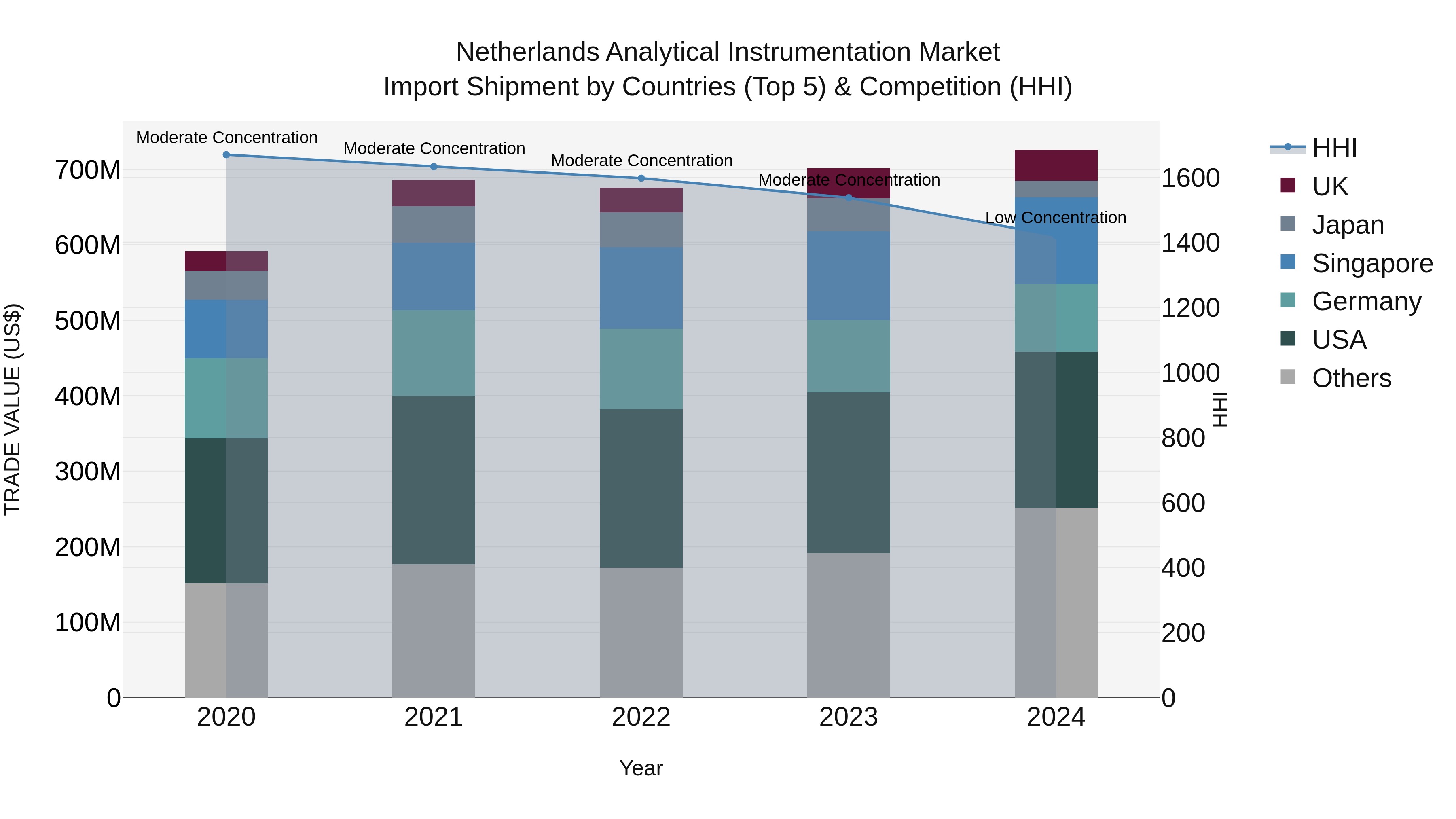
The Netherlands saw a diverse range of analytical instrumentation imports in 2024, with top exporters including the USA, Singapore, Germany, Switzerland, and the UK. The Herfindahl-Hirschman Index (HHI) indicated a shift from moderate to low concentration in the market from 2023 to 2024, reflecting increased competition. With a healthy Compound Annual Growth Rate (CAGR) of 5.22% from 2020 to 2024 and a respectable growth rate of 3.4% in 2024 alone, the Netherlands continues to be an attractive market for analytical instrumentation imports.
Netherlands Analytical Instrumentation Market Overview
The analytical instrumentation market in the Netherlands is characterized by a growing demand for high-quality and technologically advanced instruments across various industries including pharmaceuticals, biotechnology, environmental monitoring, and food and beverage. Key players in the market offer a wide range of products such as chromatography, spectroscopy, mass spectrometry, and lab automation systems to meet the evolving needs of research laboratories and manufacturing facilities. The market is driven by factors such as increasing government investments in research and development, stringent regulations for quality control, and the rising focus on precision and accuracy in analytical testing. With a strong presence of leading manufacturers and a well-established infrastructure for research and innovation, the Netherlands serves as a hub for analytical instrumentation technologies in Europe.
Netherlands Analytical Instrumentation Market Trends
The analytical instrumentation market in the Netherlands is witnessing several key trends. One prominent trend is the increasing demand for advanced technologies such as mass spectrometry, chromatography, and spectroscopy for applications in pharmaceuticals, environmental testing, and food safety. Another notable trend is the emphasis on automation and integration of analytical systems to improve efficiency and reduce human error. Additionally, there is a growing focus on sustainability and green technologies in analytical instrumentation, with companies seeking more eco-friendly solutions. Furthermore, the rise of data analytics and artificial intelligence is driving innovation in the sector, enabling faster and more accurate analysis of complex data sets. Overall, the Netherlands analytical instrumentation market is evolving towards more sophisticated, automated, and sustainable solutions to meet the demands of various industries.
Netherlands Analytical Instrumentation Market Challenges
In the Netherlands analytical instrumentation market, some key challenges include intense competition among market players, rapid technological advancements leading to the need for continuous innovation, and increasing regulatory requirements for product quality and safety. Additionally, budget constraints among end-users, especially in sectors like healthcare and environmental monitoring, can hinder the adoption of expensive analytical instruments. Moreover, the market is highly influenced by global economic conditions and geopolitical factors, which can impact investment decisions and market growth. Overall, companies operating in the Netherlands analytical instrumentation market need to navigate these challenges by investing in research and development, maintaining strong relationships with customers, and staying updated on market trends to remain competitive and sustain growth.
Netherlands Analytical Instrumentation Market Investment Opportunities
The Netherlands analytical instrumentation market presents various investment opportunities across sectors such as healthcare, pharmaceuticals, environmental monitoring, and food safety. With a strong emphasis on research and development, the demand for advanced analytical instruments like chromatography systems, spectroscopy devices, and mass spectrometers is steadily increasing. Additionally, the country`s robust infrastructure and skilled workforce make it an attractive market for companies looking to expand their presence in Europe. Investing in innovative technologies that improve efficiency, accuracy, and sensitivity of analytical instruments, as well as those that cater to emerging trends such as personalized medicine and sustainability, could yield significant returns in the Netherlands analytical instrumentation market.
Netherlands Analytical Instrumentation Market Government Policy
In the Netherlands, the government has implemented various policies to support the analytical instrumentation market, particularly in the areas of environmental monitoring, healthcare, and research. The government has allocated funding for research and development initiatives in analytical instrumentation to drive innovation and technological advancements in the sector. Additionally, there are regulations in place to ensure the quality and accuracy of analytical instruments used in critical applications such as food safety and environmental protection. The government also encourages collaboration between industry players and academic institutions to foster knowledge exchange and promote the growth of the analytical instrumentation market in the Netherlands. Overall, the government`s policies aim to create a conducive environment for the development and adoption of advanced analytical instrumentation technologies across various sectors.
Netherlands Analytical Instrumentation Market Future Outlook
The future outlook for the analytical instrumentation market in the Netherlands looks promising, driven by factors such as technological advancements, increasing investments in research and development activities, and growing demand for efficient and accurate testing solutions across various industries including pharmaceuticals, environmental monitoring, and food and beverage. The market is expected to witness significant growth due to the rising adoption of automation and digitalization in laboratories, as well as the increasing focus on quality control and regulatory compliance. Additionally, the emergence of new application areas such as personalized medicine and the expansion of the healthcare sector are anticipated to further fuel the demand for analytical instrumentation in the Netherlands. Overall, the market is projected to experience steady growth in the coming years, presenting opportunities for market players to innovate and expand their product offerings to meet the evolving needs of customers.
Key Highlights of the Report:
- Netherlands Analytical Instrumentation Market Outlook
- Market Size of Netherlands Analytical Instrumentation Market, 2024
- Forecast of Netherlands Analytical Instrumentation Market, 2031
- Historical Data and Forecast of Netherlands Analytical Instrumentation Revenues & Volume for the Period 2021-2031
- Netherlands Analytical Instrumentation Market Trend Evolution
- Netherlands Analytical Instrumentation Market Drivers and Challenges
- Netherlands Analytical Instrumentation Price Trends
- Netherlands Analytical Instrumentation Porter's Five Forces
- Netherlands Analytical Instrumentation Industry Life Cycle
- Historical Data and Forecast of Netherlands Analytical Instrumentation Market Revenues & Volume By Product Type for the Period 2021-2031
- Historical Data and Forecast of Netherlands Analytical Instrumentation Market Revenues & Volume By Chromatographs for the Period 2021-2031
- Historical Data and Forecast of Netherlands Analytical Instrumentation Market Revenues & Volume By Spectrometers for the Period 2021-2031
- Historical Data and Forecast of Netherlands Analytical Instrumentation Market Revenues & Volume By Mass Spectrometers for the Period 2021-2031
- Historical Data and Forecast of Netherlands Analytical Instrumentation Market Revenues & Volume By Microscopes for the Period 2021-2031
- Historical Data and Forecast of Netherlands Analytical Instrumentation Market Revenues & Volume By Calorimeters for the Period 2021 - 2031
- Historical Data and Forecast of Netherlands Analytical Instrumentation Market Revenues & Volume By Application Area for the Period 2021-2031
- Historical Data and Forecast of Netherlands Analytical Instrumentation Market Revenues & Volume By Chemical Analysis for the Period 2021-2031
- Historical Data and Forecast of Netherlands Analytical Instrumentation Market Revenues & Volume By Molecular Analysis for the Period 2021-2031
- Historical Data and Forecast of Netherlands Analytical Instrumentation Market Revenues & Volume By Elemental Analysis for the Period 2021-2031
- Historical Data and Forecast of Netherlands Analytical Instrumentation Market Revenues & Volume By Imaging and Analysis for the Period 2021-2031
- Historical Data and Forecast of Netherlands Analytical Instrumentation Market Revenues & Volume By Thermal Analysis for the Period 2021 - 2031
- Historical Data and Forecast of Netherlands Analytical Instrumentation Market Revenues & Volume By End User for the Period 2021-2031
- Historical Data and Forecast of Netherlands Analytical Instrumentation Market Revenues & Volume By Pharmaceutical for the Period 2021-2031
- Historical Data and Forecast of Netherlands Analytical Instrumentation Market Revenues & Volume By Chemical for the Period 2021-2031
- Historical Data and Forecast of Netherlands Analytical Instrumentation Market Revenues & Volume By Environmental for the Period 2021-2031
- Historical Data and Forecast of Netherlands Analytical Instrumentation Market Revenues & Volume By Material Science for the Period 2021-2031
- Historical Data and Forecast of Netherlands Analytical Instrumentation Market Revenues & Volume By Food and Beverage for the Period 2021 - 2031
- Historical Data and Forecast of Netherlands Analytical Instrumentation Market Revenues & Volume By Distribution Channel for the Period 2021-2031
- Historical Data and Forecast of Netherlands Analytical Instrumentation Market Revenues & Volume By Direct Sales for the Period 2021-2031
- Historical Data and Forecast of Netherlands Analytical Instrumentation Market Revenues & Volume By Online Sales for the Period 2021-2031
- Netherlands Analytical Instrumentation Import Export Trade Statistics
- Market Opportunity Assessment By Product Type
- Market Opportunity Assessment By Application Area
- Market Opportunity Assessment By End User
- Market Opportunity Assessment By Distribution Channel
- Netherlands Analytical Instrumentation Top Companies Market Share
- Netherlands Analytical Instrumentation Competitive Benchmarking By Technical and Operational Parameters
- Netherlands Analytical Instrumentation Company Profiles
- Netherlands Analytical Instrumentation Key Strategic Recommendations






































