Netherlands Breastfeeding Accessories Market Top 5 Importing Countries and Market Competition (HHI) Analysis
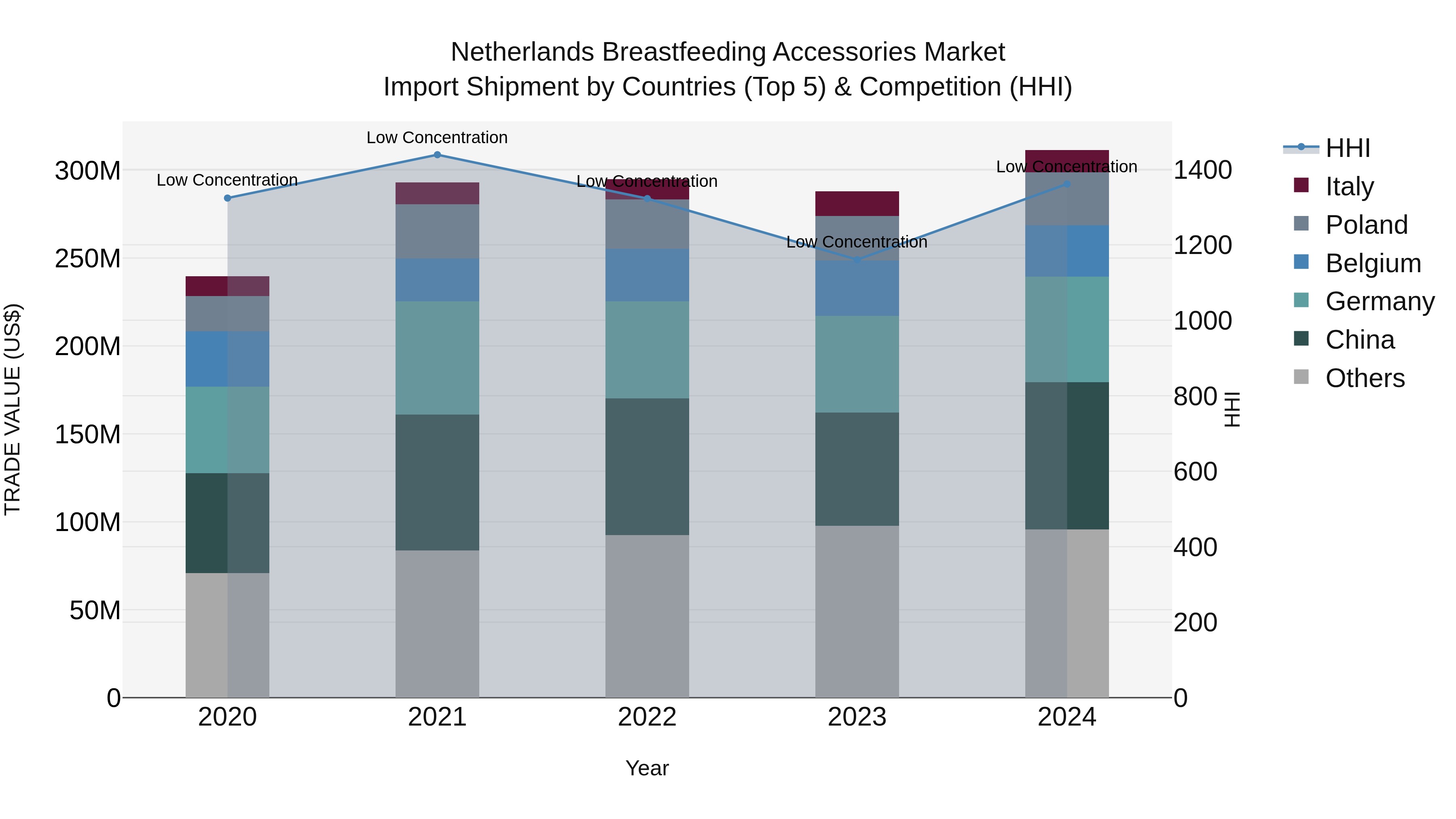
The Netherlands continues to be a significant importer of breastfeeding accessories, with top suppliers including China, Germany, Poland, Belgium, and Italy in 2024. The market shows a healthy Compound Annual Growth Rate (CAGR) of 6.75% from 2020 to 2024, indicating sustained demand. Import shipments have seen a notable growth rate of 8.15% from 2023 to 2024, reflecting increasing consumer interest in breastfeeding products. Despite the strong growth, market concentration, as measured by the Herfindahl-Hirschman Index (HHI), remains low in 2024, suggesting a diverse and competitive landscape for breastfeeding accessory imports in the Netherlands.
Key Highlights of the Report:
- Netherlands Breastfeeding Accessories Market Outlook
- Market Size of Netherlands Breastfeeding Accessories Market, 2025
- Forecast of Netherlands Breastfeeding Accessories Market, 2032
- Historical Data and Forecast of Netherlands Breastfeeding Accessories Revenues & Volume for the Period 2022 - 2032
- Netherlands Breastfeeding Accessories Market Trend Evolution
- Netherlands Breastfeeding Accessories Market Drivers and Challenges
- Netherlands Breastfeeding Accessories Price Trends
- Netherlands Breastfeeding Accessories Porter's Five Forces
- Netherlands Breastfeeding Accessories Industry Life Cycle
- Historical Data and Forecast of Netherlands Breastfeeding Accessories Market Revenues & Volume By Product for the Period 2022 - 2032
- Historical Data and Forecast of Netherlands Breastfeeding Accessories Market Revenues & Volume By Nipple Care Products for the Period 2022 - 2032
- Historical Data and Forecast of Netherlands Breastfeeding Accessories Market Revenues & Volume By Breast Shells for the Period 2022 - 2032
- Historical Data and Forecast of Netherlands Breastfeeding Accessories Market Revenues & Volume By Breast Pads for the Period 2022 - 2032
- Historical Data and Forecast of Netherlands Breastfeeding Accessories Market Revenues & Volume By Breastmilk Preparation & Cleaning Products for the Period 2022 - 2032
- Historical Data and Forecast of Netherlands Breastfeeding Accessories Market Revenues & Volume By Breastmilk Storage & Feeding for the Period 2022 - 2032
- Netherlands Breastfeeding Accessories Import Export Trade Statistics
- Market Opportunity Assessment By Product
- Netherlands Breastfeeding Accessories Top Companies Market Share
- Netherlands Breastfeeding Accessories Competitive Benchmarking By Technical and Operational Parameters
- Netherlands Breastfeeding Accessories Company Profiles
- Netherlands Breastfeeding Accessories Key Strategic Recommendations






































