Netherlands Coffee Capsules Market Top 5 Importing Countries and Market Competition (HHI) Analysis
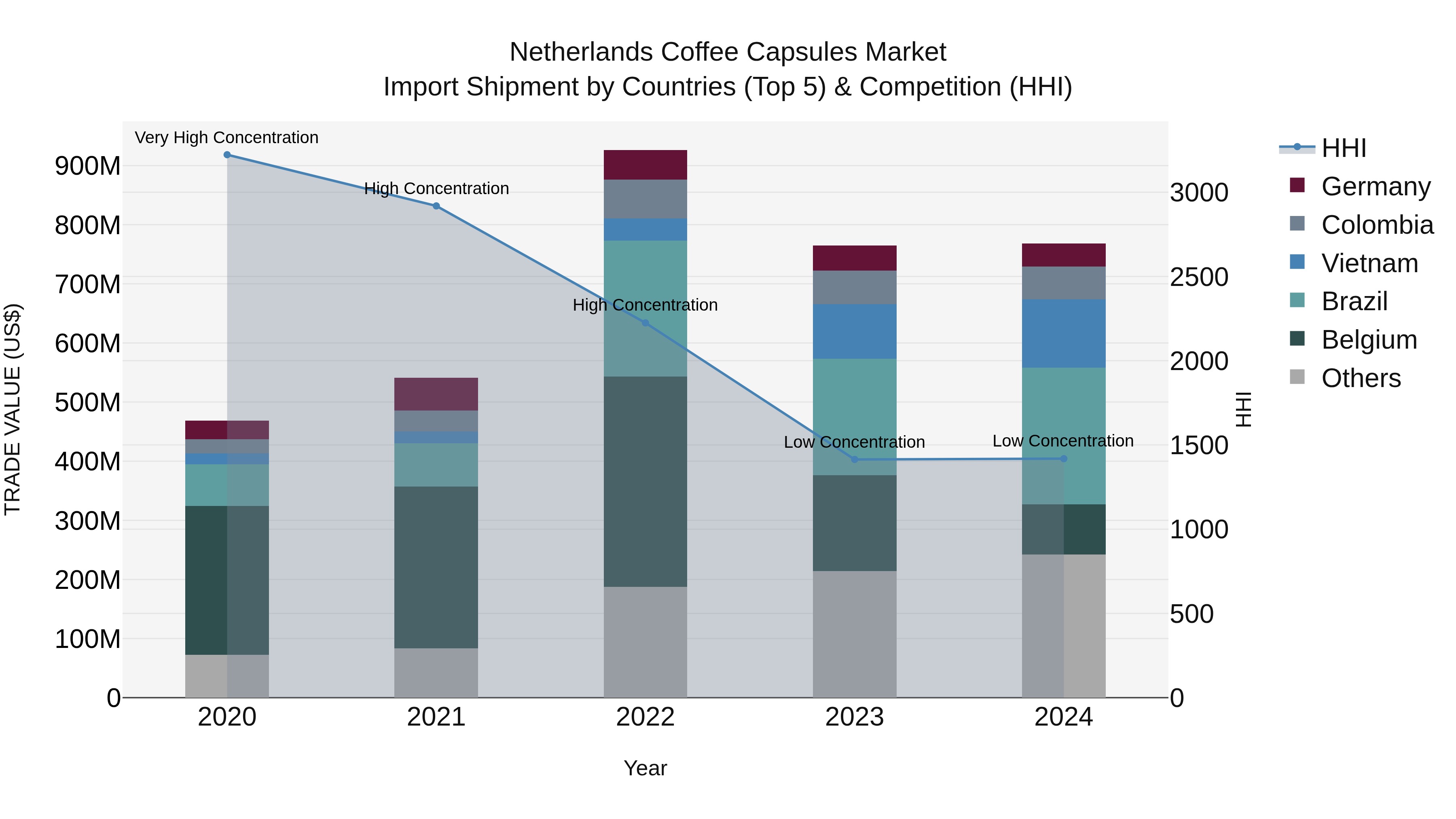
The Netherlands saw continued growth in coffee capsule imports in 2024, with key suppliers including Brazil, Vietnam, and Colombia. Despite the presence of diverse sources, the market remains competitive with low concentration levels indicated by the Herfindahl-Hirschman Index (HHI). The compound annual growth rate (CAGR) from 2020 to 2024 was a strong 13.15%, showcasing sustained demand. Although the growth rate slightly slowed in 2024, at 0.47%, the overall outlook for the coffee capsule import market in the Netherlands remains positive and dynamic.
Netherlands Coffee Capsules Market Overview
The Netherlands coffee capsules market is experiencing steady growth due to the increasing preference for convenience and premium coffee experiences. The market is driven by factors such as busy lifestyles, rising disposable incomes, and a growing coffee culture in the country. Major players in the market are focusing on product innovation, offering a wide range of flavors and coffee blends to cater to diverse consumer preferences. Sustainability and eco-friendly practices are also becoming important considerations for consumers, leading to the introduction of biodegradable and compostable coffee capsules. With the increasing emphasis on quality coffee and convenience, the Netherlands coffee capsules market is expected to continue its growth trajectory in the coming years, presenting opportunities for both established brands and new entrants to capitalize on the demand for premium coffee products.
Netherlands Coffee Capsules Market Trends
In the Netherlands, the coffee capsules market is experiencing a shift towards sustainability and premiumization. Consumers are increasingly seeking eco-friendly options such as compostable or biodegradable coffee capsules, reflecting a growing awareness of environmental issues. Premium and specialty coffee capsules are also gaining popularity as consumers look for higher quality and unique flavor profiles. Additionally, convenience remains a key driver in the market, with a rise in demand for compatible capsules that work with various coffee machines. The market is also witnessing innovation in terms of flavors and blends, catering to diverse consumer preferences. Overall, the Netherlands coffee capsules market is evolving towards sustainability, premiumization, and innovation to meet the changing demands of consumers.
Netherlands Coffee Capsules Market Challenges
In the Netherlands coffee capsules market, challenges arise mainly from increasing competition among established brands and a growing number of new entrants. This heightened competition puts pressure on pricing strategies and product differentiation efforts. Additionally, there is a growing consumer demand for sustainable and eco-friendly packaging solutions, posing a challenge for companies to develop more environmentally friendly coffee capsule options. Furthermore, the market is influenced by changing consumer preferences towards specialty and premium coffee offerings, requiring companies to continuously innovate and adapt their product portfolios. Regulatory developments related to waste management and recycling also present challenges for companies operating in the coffee capsule market in the Netherlands, as they are required to comply with strict environmental regulations. Overall, companies in this market must navigate these challenges to stay competitive and meet evolving consumer demands.
Netherlands Coffee Capsules Market Investment Opportunities
The Netherlands coffee capsules market presents attractive investment opportunities due to the growing trend of coffee consumption and the increasing preference for convenience among consumers. With a strong coffee culture in the country, the demand for premium and specialty coffee capsules is on the rise. Investing in the development and marketing of sustainable and ethically sourced coffee capsules could appeal to environmentally conscious consumers. Additionally, introducing innovative flavors and blends tailored to the local taste preferences could help capture a larger market share. Collaborating with local coffee roasters or partnering with retailers to expand distribution channels would also be beneficial. Overall, the Netherlands coffee capsules market offers potential for growth and profitability for investors seeking opportunities in the coffee industry.
Netherlands Coffee Capsules Market Government Policy
In the Netherlands, government policies related to the coffee capsules market primarily focus on environmental sustainability and waste management. The Dutch government has implemented regulations to promote the recycling and proper disposal of coffee capsules to reduce environmental impact. They encourage manufacturers and retailers to use eco-friendly materials for packaging and promote the development of recyclable or biodegradable coffee capsules. Additionally, there are initiatives in place to raise awareness among consumers about the importance of choosing sustainable options when purchasing coffee capsules. These policies aim to support a more environmentally conscious approach within the coffee industry and promote a circular economy model in the Netherlands.
Netherlands Coffee Capsules Market Future Outlook
The Netherlands coffee capsules market is expected to witness steady growth in the coming years due to increasing consumer preference for convenience and premium coffee experiences. Factors such as busy lifestyles, growing interest in specialty coffee, and the rise of home brewing systems are driving the demand for coffee capsules. Additionally, the sustainability trend is likely to influence consumer choices, leading to a shift towards eco-friendly and recyclable capsule options. Market players are anticipated to focus on product innovation, offering a diverse range of flavors and blends to cater to varying consumer tastes. As the market becomes more competitive, strategic partnerships, and marketing initiatives will play a crucial role in capturing market share and sustaining growth in the Netherlands coffee capsules market.
Key Highlights of the Report:
- Netherlands Coffee Capsules Market Outlook
- Market Size of Netherlands Coffee Capsules Market, 2024
- Forecast of Netherlands Coffee Capsules Market, 2031
- Historical Data and Forecast of Netherlands Coffee Capsules Revenues & Volume for the Period 2021-2031
- Netherlands Coffee Capsules Market Trend Evolution
- Netherlands Coffee Capsules Market Drivers and Challenges
- Netherlands Coffee Capsules Price Trends
- Netherlands Coffee Capsules Porter's Five Forces
- Netherlands Coffee Capsules Industry Life Cycle
- Historical Data and Forecast of Netherlands Coffee Capsules Market Revenues & Volume By Material Type for the Period 2021-2031
- Historical Data and Forecast of Netherlands Coffee Capsules Market Revenues & Volume By Aluminium for the Period 2021-2031
- Historical Data and Forecast of Netherlands Coffee Capsules Market Revenues & Volume By Compostable for the Period 2021-2031
- Historical Data and Forecast of Netherlands Coffee Capsules Market Revenues & Volume By PBT Plastic for the Period 2021-2031
- Historical Data and Forecast of Netherlands Coffee Capsules Market Revenues & Volume By End user for the Period 2021-2031
- Historical Data and Forecast of Netherlands Coffee Capsules Market Revenues & Volume By Commercial for the Period 2021-2031
- Historical Data and Forecast of Netherlands Coffee Capsules Market Revenues & Volume By Residential for the Period 2021-2031
- Historical Data and Forecast of Netherlands Coffee Capsules Market Revenues & Volume By Distribution Channel for the Period 2021-2031
- Historical Data and Forecast of Netherlands Coffee Capsules Market Revenues & Volume By Supermarkets and Hypermarkets for the Period 2021-2031
- Historical Data and Forecast of Netherlands Coffee Capsules Market Revenues & Volume By Convenience Stores for the Period 2021-2031
- Historical Data and Forecast of Netherlands Coffee Capsules Market Revenues & Volume By Online Stores for the Period 2021-2031
- Historical Data and Forecast of Netherlands Coffee Capsules Market Revenues & Volume By Specialty Stores for the Period 2021-2031
- Historical Data and Forecast of Netherlands Coffee Capsules Market Revenues & Volume By Others for the Period 2021 - 2031
- Netherlands Coffee Capsules Import Export Trade Statistics
- Market Opportunity Assessment By Material Type
- Market Opportunity Assessment By End user
- Market Opportunity Assessment By Distribution Channel
- Netherlands Coffee Capsules Top Companies Market Share
- Netherlands Coffee Capsules Competitive Benchmarking By Technical and Operational Parameters
- Netherlands Coffee Capsules Company Profiles
- Netherlands Coffee Capsules Key Strategic Recommendations






































