Netherlands Control Valve Market Top 5 Importing Countries and Market Competition (HHI) Analysis
The control valve import shipments to the Netherlands in 2024 continued to be dominated by key exporters such as Germany, USA, Japan, Italy, and Belgium. The market showed a significant increase in concentration levels from moderate in 2023 to high in 2024, indicating a potential shift in market dynamics. Despite a negative CAGR of -5.1% from 2020 to 2024, the growth rate took a sharper decline of -12.64% from 2023 to 2024. These trends suggest a challenging environment for control valve imports into the Netherlands, signaling the need for strategic adjustments in the market.
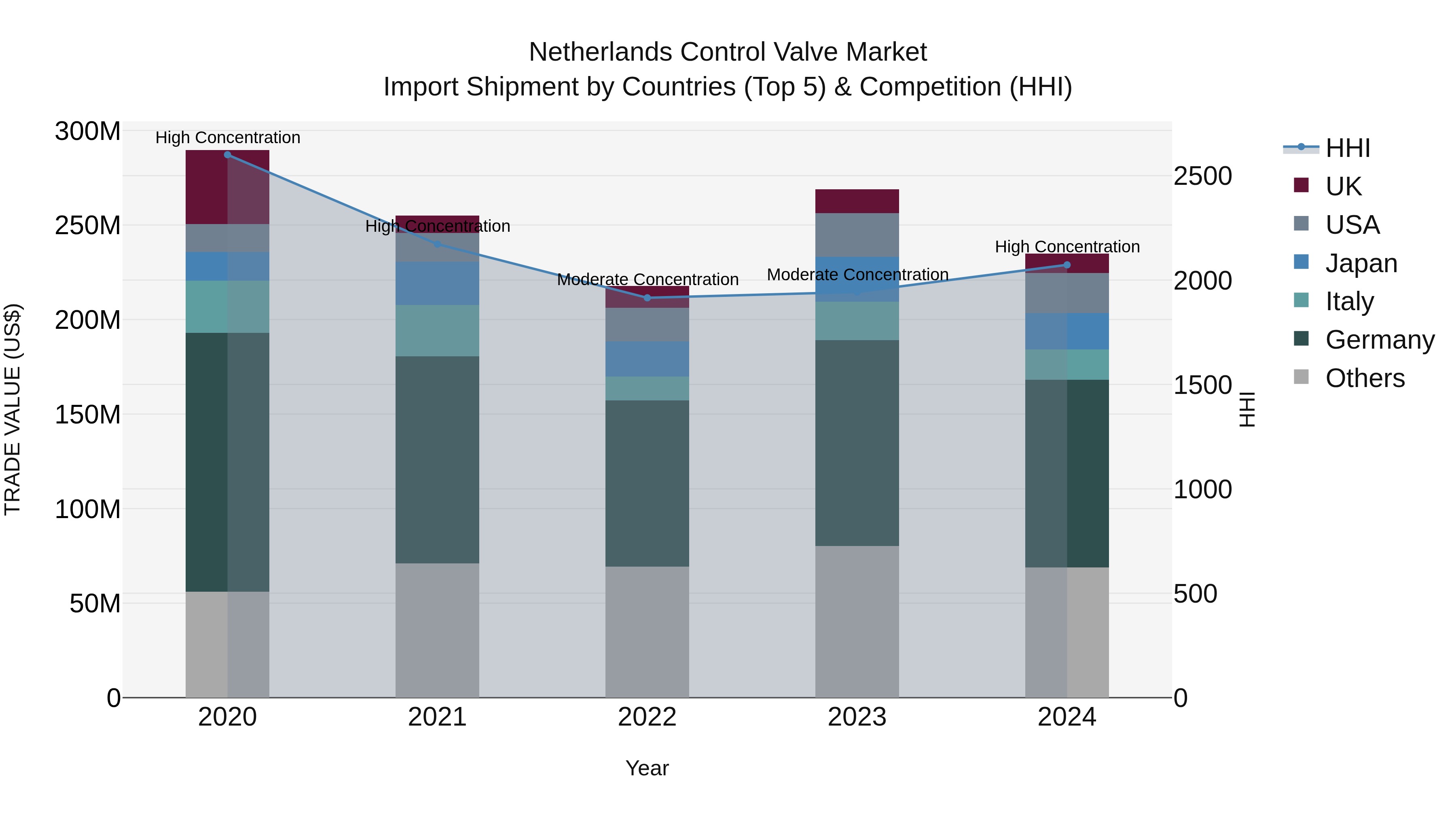
Netherlands Control Valve Market Synopsis
The Netherlands control valve market is characterized by steady growth driven by increasing industrial automation and emphasis on energy efficiency. The market is witnessing a demand for advanced control valves in various sectors including oil & gas, water & wastewater, power generation, and chemical processing. With a focus on sustainability and environmental regulations, there is a growing adoption of smart control valve technologies to optimize processes and reduce energy consumption. Key players in the Netherlands control valve market include companies such as Emerson Electric Co., Flowserve Corporation, and Metso Corporation, offering a wide range of products catering to different industry requirements. The market is expected to continue its growth trajectory, propelled by ongoing investments in infrastructure and industrial development in the country.
Netherlands Control Valve Market Trends
The Netherlands control valve market is experiencing steady growth driven by factors such as increasing industrial automation, emphasis on energy efficiency, and the adoption of advanced technologies. One of the key trends in the market is the rising demand for smart control valves integrated with IoT capabilities for remote monitoring and control. Additionally, the focus on reducing greenhouse gas emissions and improving process efficiency is creating opportunities for control valve manufacturers to develop innovative solutions. The water and wastewater treatment sector is also a significant end-user segment driving the demand for control valves in the Netherlands. Overall, the market presents promising opportunities for companies offering technologically advanced and energy-efficient control valve products tailored to the specific needs of industries in the region.
Netherlands Control Valve Market Challenges
In the Netherlands Control Valve Market, some key challenges include increasing competition from international players, rapid technological advancements requiring continuous innovation to stay competitive, and the need to comply with stringent regulations related to environmental protection and safety standards. Additionally, fluctuating raw material prices and macroeconomic factors can impact the market dynamics. Companies operating in the Netherlands Control Valve Market must also navigate the shift towards digitalization and automation, which requires investment in new technologies and skilled workforce. Overall, staying ahead in this market requires a combination of strategic planning, product differentiation, and adapting to changing market demands while ensuring compliance with regulatory requirements.
Netherlands Control Valve Market Investment Opportunities
The Netherlands Control Valve market is primarily driven by factors such as increasing demand from industries like oil & gas, water & wastewater, and chemical processing for efficient flow control and automation. The focus on energy efficiency and environmental sustainability is also pushing the adoption of control valves in various industrial applications. Additionally, technological advancements in control valve designs, such as the integration of smart technologies for remote monitoring and predictive maintenance, are fueling market growth. The need for improving process efficiency, reducing operational costs, and ensuring regulatory compliance further contribute to the demand for control valves in the Netherlands. Overall, the market is expected to continue expanding due to the growing industrial infrastructure and the emphasis on enhancing productivity and operational performance.
Netherlands Control Valve Market Government Polices
The Netherlands government has implemented various policies impacting the control valve market, primarily focusing on energy efficiency and environmental sustainability. The government has set ambitious targets to reduce greenhouse gas emissions, leading to a growing demand for control valves in industries such as oil and gas, water and wastewater management, and power generation. Additionally, the Netherlands has been promoting the use of smart technologies and automation in industrial processes to enhance efficiency and reduce energy consumption, further driving the adoption of advanced control valves. Government initiatives such as subsidies for energy-efficient equipment and regulations promoting sustainable practices are influencing the growth and development of the control valve market in the Netherlands.
Netherlands Control Valve Market Future Outlook
The Netherlands Control Valve Market is expected to witness steady growth in the coming years, driven by factors such as increasing industrial automation, growing demand for energy efficiency in various industries, and the focus on process optimization. The market is likely to benefit from advancements in technology, particularly in terms of smart control valves and digitalization. Additionally, stringent regulations related to environmental protection and safety standards are expected to drive the adoption of control valves in the region. The market is also likely to see opportunities in sectors such as water and wastewater treatment, oil and gas, and power generation. Overall, the Netherlands Control Valve Market is forecasted to experience sustained growth, with a focus on innovation and efficiency driving market expansion.
Key Highlights of the Report:
- Netherlands Control Valve Market Outlook
- Market Size of Netherlands Control Valve Market, 2024
- Forecast of Netherlands Control Valve Market, 2031
- Historical Data and Forecast of Netherlands Control Valve Revenues & Volume for the Period 2021-2031
- Netherlands Control Valve Market Trend Evolution
- Netherlands Control Valve Market Drivers and Challenges
- Netherlands Control Valve Price Trends
- Netherlands Control Valve Porter`s Five Forces
- Netherlands Control Valve Industry Life Cycle
- Historical Data and Forecast of Netherlands Control Valve Market Revenues & Volume By Component for the Period 2021-2031
- Historical Data and Forecast of Netherlands Control Valve Market Revenues & Volume By Actuators for the Period 2021-2031
- Historical Data and Forecast of Netherlands Control Valve Market Revenues & Volume By Valve Body for the Period 2021-2031
- Historical Data and Forecast of Netherlands Control Valve Market Revenues & Volume By Type for the Period 2021-2031
- Historical Data and Forecast of Netherlands Control Valve Market Revenues & Volume By Rotary for the Period 2021-2031
- Historical Data and Forecast of Netherlands Control Valve Market Revenues & Volume By Linear for the Period 2021-2031
- Historical Data and Forecast of Netherlands Control Valve Market Revenues & Volume By Industry for the Period 2021-2031
- Historical Data and Forecast of Netherlands Control Valve Market Revenues & Volume By Oil & Gas for the Period 2021-2031
- Historical Data and Forecast of Netherlands Control Valve Market Revenues & Volume By Water & Wastewater Treatment for the Period 2021-2031
- Historical Data and Forecast of Netherlands Control Valve Market Revenues & Volume By Energy & Power for the Period 2021-2031
- Historical Data and Forecast of Netherlands Control Valve Market Revenues & Volume By Chemicals for the Period 2021-2031
- Netherlands Control Valve Import Export Trade Statistics
- Market Opportunity Assessment By Component
- Market Opportunity Assessment By Type
- Market Opportunity Assessment By Industry
- Netherlands Control Valve Top Companies Market Share
- Netherlands Control Valve Competitive Benchmarking By Technical and Operational Parameters
- Netherlands Control Valve Company Profiles
- Netherlands Control Valve Key Strategic Recommendations






































