Netherlands Cryogenic Freezers Market Top 5 Importing Countries and Market Competition (HHI) Analysis
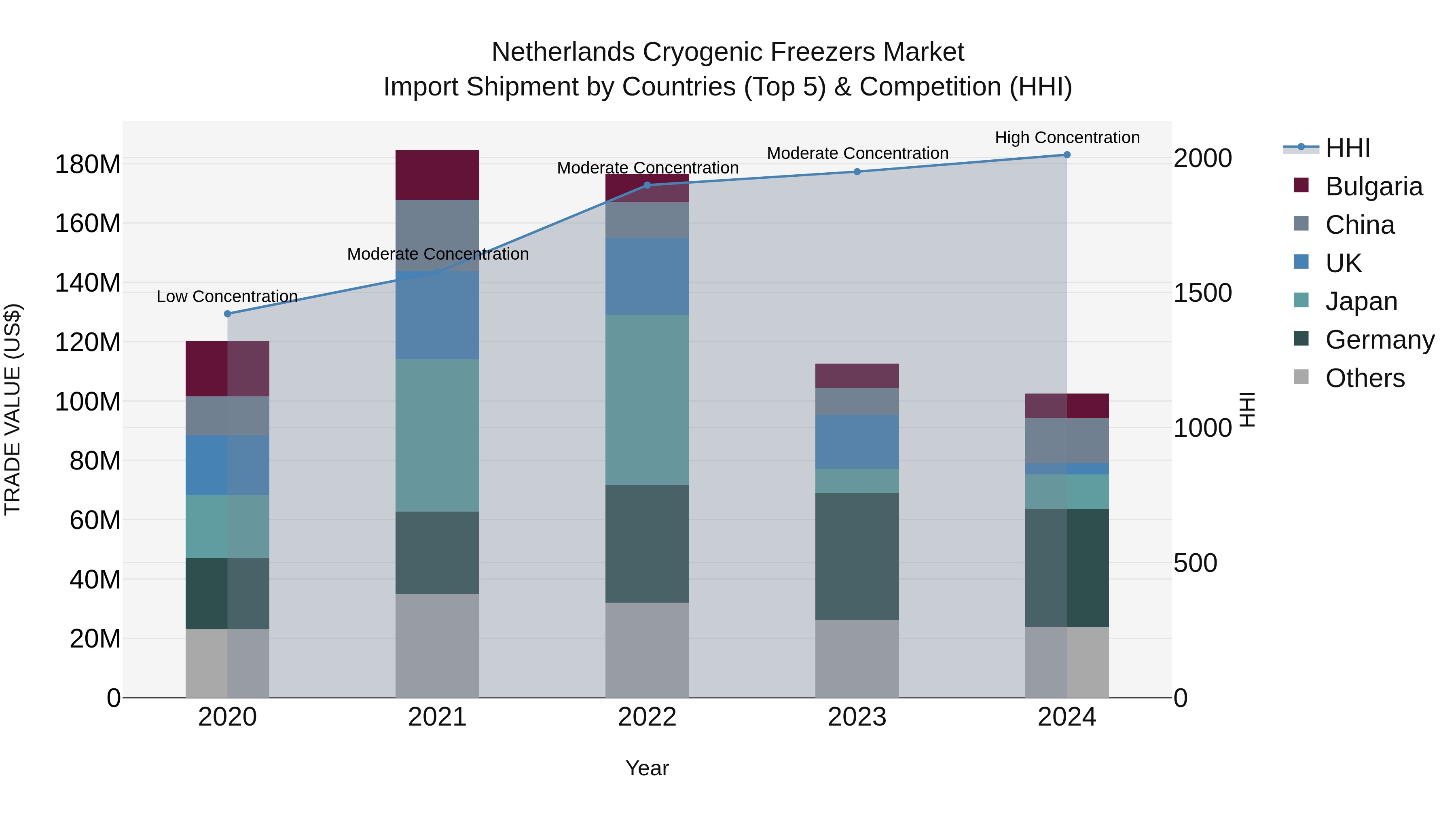
The Netherlands experienced a shift in cryogenic freezers import dynamics in 2024, with top exporters including Germany, China, Japan, Bulgaria, and Belgium. The market concentration, as measured by the HHI, rose from moderate to high levels within a year. The industry saw a negative compound annual growth rate of -3.92% from 2020 to 2024, with a further decline in the growth rate from 2023 to 2024 at -8.98%. These trends suggest a challenging environment for cryogenic freezer imports in the Netherlands, indicating potential shifts in market dynamics and competitive landscape.
Netherlands Cryogenic Freezers Market Synopsis
The Netherlands Cryogenic Freezers Market is experiencing steady growth driven by the increasing demand for cryopreservation across various industries such as healthcare, pharmaceuticals, and biotechnology. The market is characterized by the presence of key players offering a wide range of cryogenic freezers with advanced features like temperature monitoring systems, automated controls, and enhanced safety measures. The growing adoption of cryogenic freezers for long-term storage of biological samples, tissues, and cells is further fueling market expansion. Additionally, the rising investments in research and development activities in the life sciences sector are expected to propel the demand for cryogenic freezers in the Netherlands. However, stringent regulatory requirements and high initial costs associated with these freezers may pose challenges to market growth in the region.
Netherlands Cryogenic Freezers Market Trends
In the Netherlands, the Cryogenic Freezers Market is experiencing a surge in demand due to the growing adoption of cryogenic technology in various industries such as food processing, pharmaceuticals, and research. The market is witnessing a trend towards more advanced cryogenic freezers with features like improved energy efficiency, automation, and remote monitoring capabilities. Additionally, there is a rising focus on sustainability, driving the development of eco-friendly cryogenic freezers that use natural refrigerants. Opportunities in the market include the potential for partnerships with research institutions for product innovation, expansion of distribution networks to reach a wider customer base, and catering to the increasing demand for customized cryogenic freezing solutions tailored to specific industry needs. Overall, the Netherlands Cryogenic Freezers Market is poised for growth and innovation in the coming years.
Netherlands Cryogenic Freezers Market Challenges
In the Netherlands Cryogenic Freezers Market, some challenges include high initial investment costs for purchasing and installing cryogenic freezers, which can deter smaller businesses from entering the market. Additionally, the maintenance and operating costs of these specialized freezers are relatively high, impacting overall profitability for businesses. Another challenge is the need for skilled technicians to operate and maintain cryogenic freezers, as any errors or malfunctions can result in costly downtime and potential loss of products. Furthermore, the regulatory environment surrounding cryogenic technology in the Netherlands may pose challenges in terms of compliance and ensuring that all safety standards are met. Overall, navigating these challenges requires strategic planning, investment, and a deep understanding of the market dynamics in order to succeed in the Netherlands Cryogenic Freezers Market.
Netherlands Cryogenic Freezers Market Investment Opportunities
The Netherlands Cryogenic Freezers Market is primarily driven by the increasing demand for cryogenic freezers in the healthcare and biomedical research industries for the preservation of biological samples and materials. The growing focus on personalized medicine and advancements in regenerative medicine are further boosting the adoption of cryogenic freezers for long-term storage of stem cells, tissues, and other biological specimens. Additionally, the expansion of the food processing industry in the region is also driving the demand for cryogenic freezers for quick freezing and preservation of food products. Technological advancements such as the development of automated cryogenic freezers with improved energy efficiency and temperature control capabilities are also contributing to the market growth by enhancing the storage and preservation capabilities of these freezers.
Netherlands Cryogenic Freezers Market Government Polices
The Netherlands has strict regulations on the use of cryogenic freezers in various industries, particularly in the healthcare and food sectors. The government has implemented guidelines regarding the safe handling and storage of cryogenic materials to ensure public safety and environmental protection. Additionally, there are specific licensing requirements and quality standards that companies must adhere to when using cryogenic freezers. The government also promotes research and development in cryogenic technology to drive innovation and enhance competitiveness in the market. Overall, the regulatory framework in the Netherlands aims to balance the benefits of using cryogenic freezers with the need to mitigate potential risks and safeguard the well-being of both people and the environment.
Netherlands Cryogenic Freezers Market Future Outlook
The Netherlands Cryogenic Freezers Market is expected to witness steady growth in the coming years due to factors such as increasing demand for cryopreservation in various industries including healthcare, biotechnology, and food processing. Technological advancements leading to the development of more efficient and user-friendly cryogenic freezers are also anticipated to drive market expansion. Additionally, the rising adoption of cryogenic freezers for long-term storage of biological samples, organs, and other sensitive materials is likely to further boost market growth. However, challenges such as high initial investment costs and stringent regulatory requirements may hinder the market`s full potential. Overall, with the increasing focus on preserving biological materials and advancing research activities, the Netherlands Cryogenic Freezers Market is expected to show promising growth prospects in the foreseeable future.
Key Highlights of the Report:
- Netherlands Cryogenic Freezers Market Outlook
- Market Size of Netherlands Cryogenic Freezers Market, 2024
- Forecast of Netherlands Cryogenic Freezers Market, 2031
- Historical Data and Forecast of Netherlands Cryogenic Freezers Revenues & Volume for the Period 2021- 2031
- Netherlands Cryogenic Freezers Market Trend Evolution
- Netherlands Cryogenic Freezers Market Drivers and Challenges
- Netherlands Cryogenic Freezers Price Trends
- Netherlands Cryogenic Freezers Porter's Five Forces
- Netherlands Cryogenic Freezers Industry Life Cycle
- Historical Data and Forecast of Netherlands Cryogenic Freezers Market Revenues & Volume By Product Type for the Period 2021- 2031
- Historical Data and Forecast of Netherlands Cryogenic Freezers Market Revenues & Volume By Tunnel Freezer for the Period 2021- 2031
- Historical Data and Forecast of Netherlands Cryogenic Freezers Market Revenues & Volume By IQF Freezer for the Period 2021- 2031
- Historical Data and Forecast of Netherlands Cryogenic Freezers Market Revenues & Volume By Immersion Freezer for the Period 2021- 2031
- Historical Data and Forecast of Netherlands Cryogenic Freezers Market Revenues & Volume By Spiral Freezer for the Period 2021- 2031
- Historical Data and Forecast of Netherlands Cryogenic Freezers Market Revenues & Volume By Others for the Period 2021- 2031
- Historical Data and Forecast of Netherlands Cryogenic Freezers Market Revenues & Volume By Application for the Period 2021- 2031
- Historical Data and Forecast of Netherlands Cryogenic Freezers Market Revenues & Volume By Corporate Laboratories for the Period 2021- 2031
- Historical Data and Forecast of Netherlands Cryogenic Freezers Market Revenues & Volume By Hospitals and Blood Centers for the Period 2021- 2031
- Historical Data and Forecast of Netherlands Cryogenic Freezers Market Revenues & Volume By Universities and Research Institutions for the Period 2021- 2031
- Historical Data and Forecast of Netherlands Cryogenic Freezers Market Revenues & Volume By Others for the Period 2021- 2031
- Historical Data and Forecast of Netherlands Cryogenic Freezers Market Revenues & Volume By End-User for the Period 2021- 2031
- Historical Data and Forecast of Netherlands Cryogenic Freezers Market Revenues & Volume By Food and Beverages for the Period 2021- 2031
- Historical Data and Forecast of Netherlands Cryogenic Freezers Market Revenues & Volume By Medical and Healthcare for the Period 2021- 2031
- Historical Data and Forecast of Netherlands Cryogenic Freezers Market Revenues & Volume By Pharmaceuticals for the Period 2021- 2031
- Historical Data and Forecast of Netherlands Cryogenic Freezers Market Revenues & Volume By Chemicals for the Period 2021- 2031
- Historical Data and Forecast of Netherlands Cryogenic Freezers Market Revenues & Volume By Others for the Period 2021- 2031
- Netherlands Cryogenic Freezers Import Export Trade Statistics
- Market Opportunity Assessment By Product Type
- Market Opportunity Assessment By Application
- Market Opportunity Assessment By End-User
- Netherlands Cryogenic Freezers Top Companies Market Share
- Netherlands Cryogenic Freezers Competitive Benchmarking By Technical and Operational Parameters
- Netherlands Cryogenic Freezers Company Profiles
- Netherlands Cryogenic Freezers Key Strategic Recommendations






































