Netherlands Curtains and Window Blinds Market Top 5 Importing Countries and Market Competition (HHI) Analysis
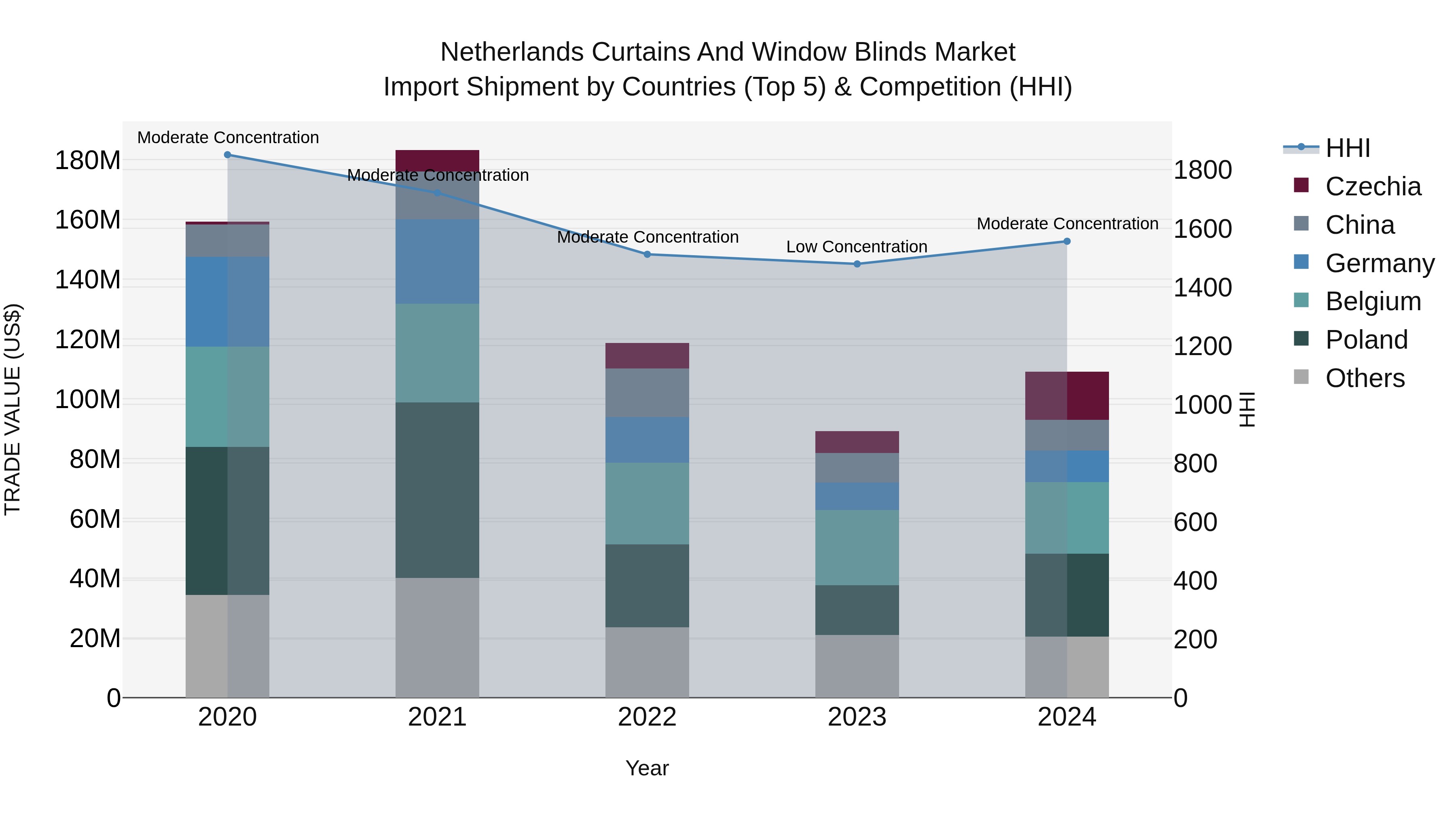
The Netherlands witnessed a significant shift in the curtains and window blinds import market in 2024, with top exporting countries being Poland, Belgium, Czechia, Germany, and China. The market moved from low to moderate concentration, indicating a more competitive landscape. Despite a negative CAGR from 2020 to 2024, the industry experienced a notable growth rate of 22.38% in 2024 compared to the previous year. This suggests a potential rebound in the market and increased demand for imported curtains and window blinds in the Netherlands.
Key Highlights of the Report:
- Netherlands Curtains and Window Blinds Market Outlook
- Market Size of Netherlands Curtains and Window Blinds Market, 2025
- Forecast of Netherlands Curtains and Window Blinds Market, 2032
- Historical Data and Forecast of Netherlands Curtains and Window Blinds Revenues & Volume for the Period 2022 - 2032F
- Netherlands Curtains and Window Blinds Market Trend Evolution
- Netherlands Curtains and Window Blinds Market Drivers and Challenges
- Netherlands Curtains and Window Blinds Price Trends
- Netherlands Curtains and Window Blinds Porter`s Five Forces
- Netherlands Curtains and Window Blinds Industry Life Cycle
- Historical Data and Forecast of Netherlands Curtains and Window Blinds Market Revenues & Volume By Materials for the Period 2022 - 2032F
- Historical Data and Forecast of Netherlands Curtains and Window Blinds Market Revenues & Volume By Curtains (Cotton, Linen, Polyester) for the Period 2022 - 2032F
- Historical Data and Forecast of Netherlands Curtains and Window Blinds Market Revenues & Volume By Window Blinds (Cotton, Linen, Wood, PVC, Metal) for the Period 2022 - 2032F
- Historical Data and Forecast of Netherlands Curtains and Window Blinds Market Revenues & Volume By Product for the Period 2022 - 2032F
- Historical Data and Forecast of Netherlands Curtains and Window Blinds Market Revenues & Volume By Curtains (Box pleat curtains, Pinch pleat curtains & drapery, Goblet pleat curtains & drapery, Eyelet curtains & drapery) for the Period 2022 - 2032F
- Historical Data and Forecast of Netherlands Curtains and Window Blinds Market Revenues & Volume By Window Blinds (Window Shades,, Window Screens, Connected) for the Period 2022 - 2032F
- Historical Data and Forecast of Netherlands Curtains and Window Blinds Market Revenues & Volume By Distribution Channel for the Period 2022 - 2032F
- Historical Data and Forecast of Netherlands Curtains and Window Blinds Market Revenues & Volume By B2B for the Period 2022 - 2032F
- Historical Data and Forecast of Netherlands Curtains and Window Blinds Market Revenues & Volume By B2C for the Period 2022 - 2032F
- Historical Data and Forecast of Netherlands Curtains and Window Blinds Market Revenues & Volume By E-commerce for the Period 2022 - 2032F
- Historical Data and Forecast of Netherlands Curtains and Window Blinds Market Revenues & Volume By Price Range for the Period 2022 - 2032F
- Historical Data and Forecast of Netherlands Curtains and Window Blinds Market Revenues & Volume By High for the Period 2022 - 2032F
- Historical Data and Forecast of Netherlands Curtains and Window Blinds Market Revenues & Volume By Medium for the Period 2022 - 2032F
- Historical Data and Forecast of Netherlands Curtains and Window Blinds Market Revenues & Volume By Low for the Period 2022 - 2032F
- Netherlands Curtains and Window Blinds Import Export Trade Statistics
- Market Opportunity Assessment By Materials
- Market Opportunity Assessment By Product
- Market Opportunity Assessment By Distribution Channel
- Market Opportunity Assessment By Price Range
- Netherlands Curtains and Window Blinds Top Companies Market Share
- Netherlands Curtains and Window Blinds Competitive Benchmarking By Technical and Operational Parameters
- Netherlands Curtains and Window Blinds Company Profiles
- Netherlands Curtains and Window Blinds Key Strategic Recommendations






































