Netherlands Diesel Engine Market Size (2020-2030)

The Netherlands Diesel Engine Market experienced significant fluctuations between 2020 and 2024, peaking in 2023 with a market size of €3.35 million, following a steep decline of 59.77% in 2021. However, a robust recovery ensued, with growth rates of 116.63% and 69.66% in 2022 and 2023, respectively, propelled by increased demand for efficient power solutions and sustainability initiatives. The actual market size is projected to reach €4.61 million by 2024, reflecting a CAGR of 52.73% from 2022 to 2024. Looking ahead, the market is expected to maintain a positive trajectory with forecasted sizes reaching €22.23 million by 2030, supported by a steady CAGR of 30.00% from 2025 to 2030. Key industry drivers include advancements in diesel technology and the growing need for reliable energy sources in industrial applications, alongside anticipated infrastructure projects that will bolster demand.
Netherlands Diesel Engine Market: Production & Trade Performance (2019-2025)
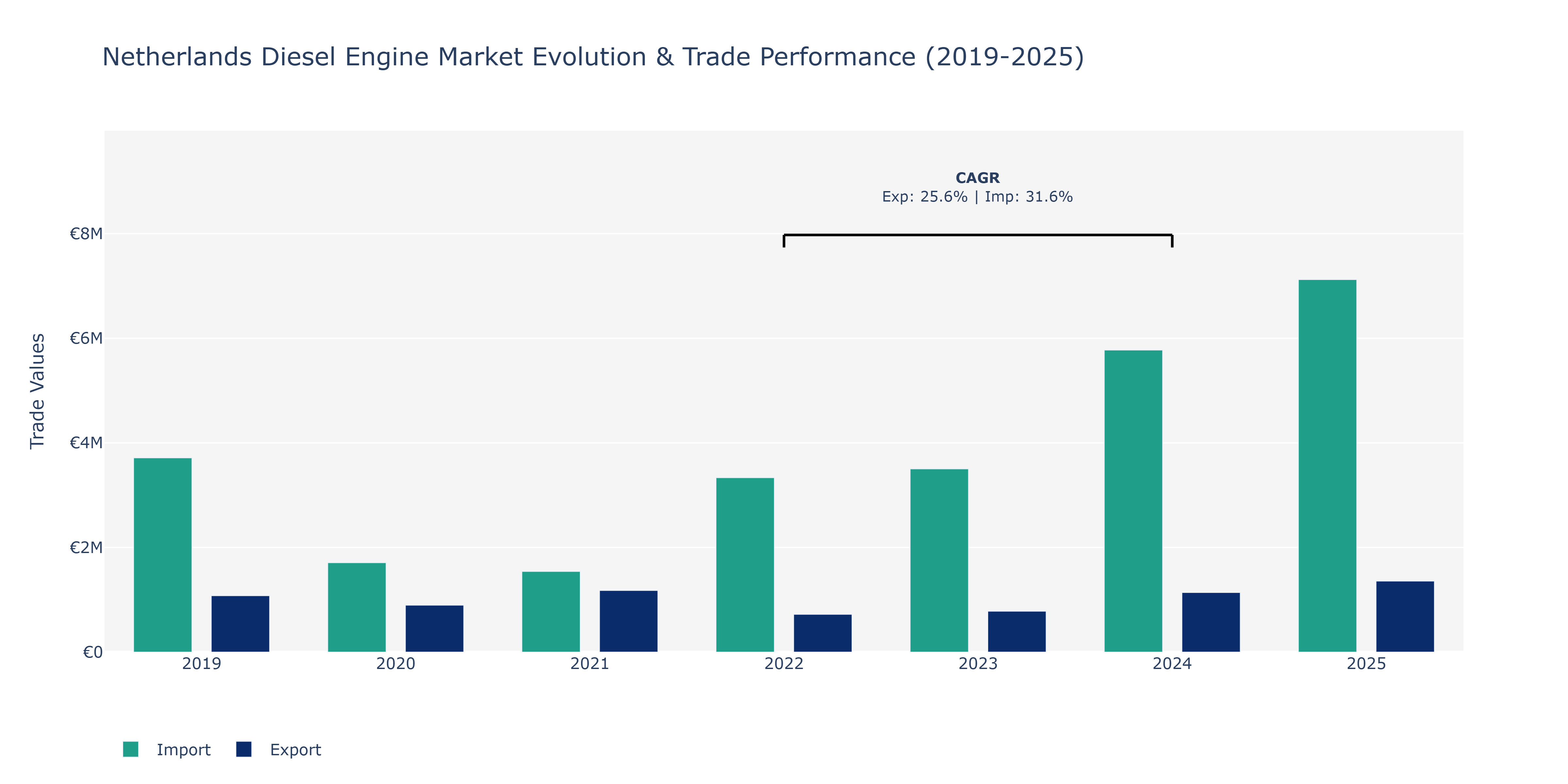
The Netherlands Diesel Engine Market experienced notable fluctuations in both exports and imports from 2019 to 2025. Exports peaked in 2025 at approximately €1.36 million, showing a consistent upward trajectory from 2019. In contrast, imports reached their highest point in 2025 at around €7.12 million, demonstrating a substantial increase compared to previous years. The surge in exports can be attributed to the growing demand for Dutch diesel engines in international markets, driven by technological advancements and the reputation of Dutch manufacturers for producing high-quality products. On the imports side, the significant rise could be linked to increased industrial activities in the Netherlands requiring a higher volume of imported diesel engines to support various sectors. The CAGRs for exports and imports between 2022 and 2024 further indicate a strong positive momentum in the market, reflecting continuous growth and competitiveness in the industry. These trends align with reports highlighting the Netherlands as a key player in the diesel engine market, supported by its robust manufacturing capabilities and strategic geographical location facilitating trade relationships.
Key Highlights of the Report:
- Netherlands Diesel Engine Market Outlook
- Market Size of Netherlands Diesel Engine Market, 2025
- Forecast of Netherlands Diesel Engine Market, 2032
- Historical Data and Forecast of Netherlands Diesel Engine Revenues & Volume for the Period 2022 - 2032F
- Netherlands Diesel Engine Market Trend Evolution
- Netherlands Diesel Engine Market Drivers and Challenges
- Netherlands Diesel Engine Price Trends
- Netherlands Diesel Engine Porter`s Five Forces
- Netherlands Diesel Engine Industry Life Cycle
- Historical Data and Forecast of Netherlands Diesel Engine Market Revenues & Volume By Power Rating for the Period 2022 - 2032F
- Historical Data and Forecast of Netherlands Diesel Engine Market Revenues & Volume By 0.5 MW 1 MW for the Period 2022 - 2032F
- Historical Data and Forecast of Netherlands Diesel Engine Market Revenues & Volume By Up to 0.5 MW for the Period 2022 - 2032F
- Historical Data and Forecast of Netherlands Diesel Engine Market Revenues & Volume By 2 MW 5 MW for the Period 2022 - 2032F
- Historical Data and Forecast of Netherlands Diesel Engine Market Revenues & Volume By 1 MW 2 MW for the Period 2022 - 2032F
- Historical Data and Forecast of Netherlands Diesel Engine Market Revenues & Volume By Above 5 MW for the Period 2022 - 2032F
- Historical Data and Forecast of Netherlands Diesel Engine Market Revenues & Volume By for the Period 2022 - 2032F
- Historical Data and Forecast of Netherlands Diesel Engine Market Revenues & Volume By End User for the Period 2022 - 2032F
- Historical Data and Forecast of Netherlands Diesel Engine Market Revenues & Volume By Automotive for the Period 2022 - 2032F
- Historical Data and Forecast of Netherlands Diesel Engine Market Revenues & Volume By Non-Automotive for the Period 2022 - 2032F
- Netherlands Diesel Engine Import Export Trade Statistics
- Market Opportunity Assessment By Power Rating
- Market Opportunity Assessment By End User
- Netherlands Diesel Engine Top Companies Market Share
- Netherlands Diesel Engine Competitive Benchmarking By Technical and Operational Parameters
- Netherlands Diesel Engine Company Profiles
- Netherlands Diesel Engine Key Strategic Recommendations






































