Netherlands Egg Powder Market Size (2020-2030)
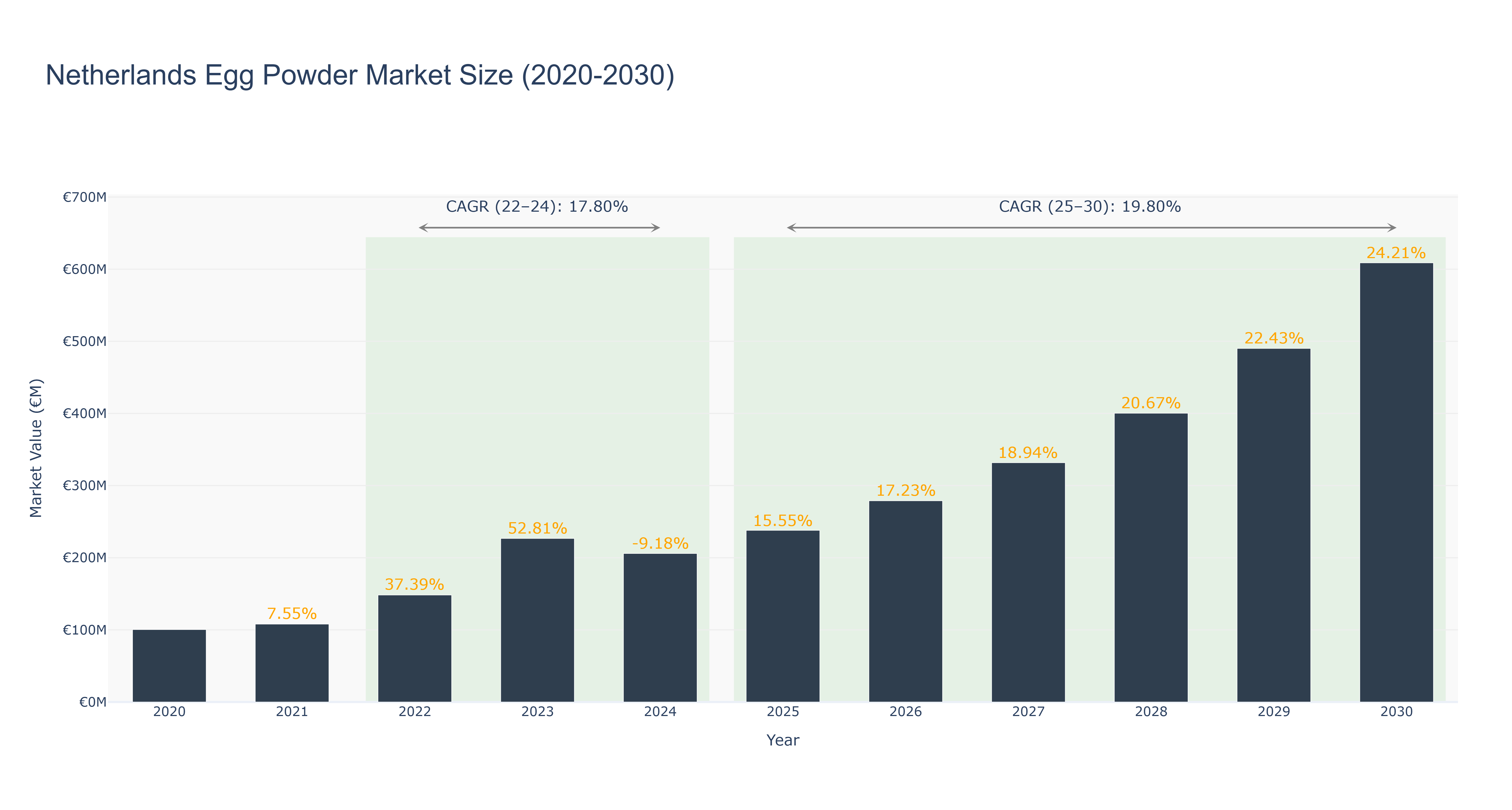
Netherlands Egg Powder Market has shown a steady growth trajectory over the past decade. The market reached its peak size of €608.78 million in 2030, with a notable increase from €100.40 million in 2020. The actual market size saw fluctuations, with a decline in 2024 to €205.88 million, attributed to market saturation and changing consumer preferences. However, the market rebounded swiftly, showcasing a strong recovery with a 15.55% growth in 2025. The forecasted growth from 2025 to 2030 is promising, with a CAGR of 19.80%, indicating sustained market expansion. The industry drivers behind this growth include increased health consciousness among consumers and the versatility of egg powder in various food applications. Looking ahead, upcoming investments in sustainable production practices and innovative product offerings are set to further propel the market's growth in the Netherlands.
Netherlands Egg Powder Market: Production & Trade Performance (2019-2025)
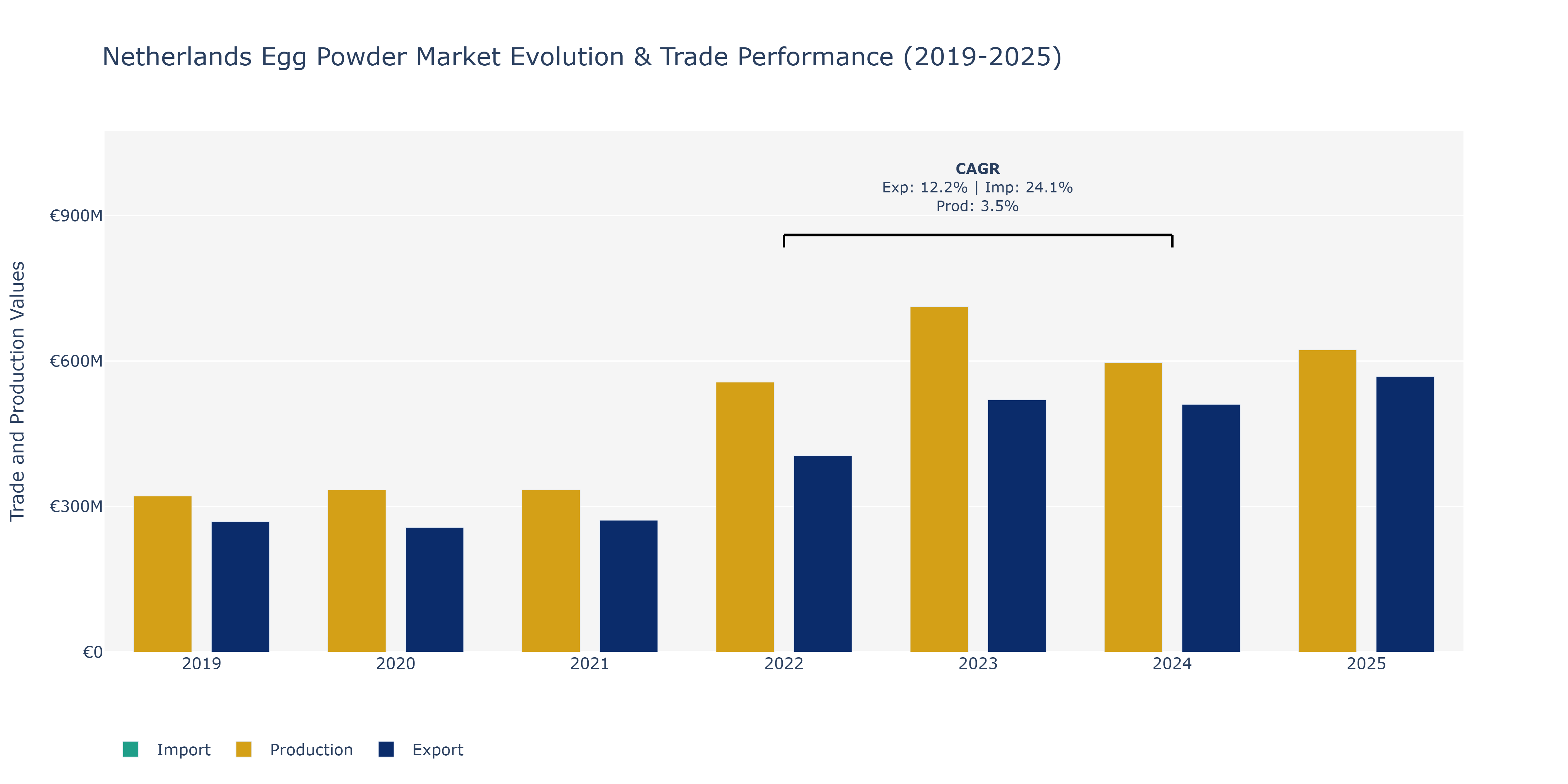
The Netherlands Egg Powder Market saw notable fluctuations in Exports, Imports, and Production from 2019 to 2025. Exports showcased a general upward trend, with 2025 marking a peak at approximately €568.08 million, reflecting a growing demand for Dutch egg powder globally. In contrast, Imports experienced fluctuations, reaching their highest point in 2025 at around €67.09 million, possibly indicating increased inbound shipments for processing or distribution within the country. Production value varied, with a peak in 2023 at €712.4 million before declining to €596.7 million in 2024 and then slightly recovering in 2025 to around €623.0 million. These fluctuations could be attributed to factors such as changing consumer preferences, export demand shifts due to global economic conditions, and domestic production capacity adjustments in response to market dynamics. Strategies focusing on product innovation, quality assurance, and sustainable sourcing may aid Dutch egg powder market players in navigating these fluctuations effectively.
Key Highlights of the Report:
- Netherlands Egg Powder Market Outlook
- Market Size of Netherlands Egg Powder Market, 2025
- Forecast of Netherlands Egg Powder Market, 2032
- Historical Data and Forecast of Netherlands Egg Powder Revenues & Volume for the Period 2022 - 2032F
- Netherlands Egg Powder Market Trend Evolution
- Netherlands Egg Powder Market Drivers and Challenges
- Netherlands Egg Powder Price Trends
- Netherlands Egg Powder Porter`s Five Forces
- Netherlands Egg Powder Industry Life Cycle
- Historical Data and Forecast of Netherlands Egg Powder Market Revenues & Volume By Types for the Period 2022 - 2032F
- Historical Data and Forecast of Netherlands Egg Powder Market Revenues & Volume By Whole Eggfor the Period 2022 - 2032F
- Historical Data and Forecast of Netherlands Egg Powder Market Revenues & Volume By Egg Yolkfor the Period 2022 - 2032F
- Historical Data and Forecast of Netherlands Egg Powder Market Revenues & Volume By White Eggfor the Period 2022 - 2032F
- Historical Data and Forecast of Netherlands Egg Powder Market Revenues & Volume By End-user for the Period 2022 - 2032F
- Historical Data and Forecast of Netherlands Egg Powder Market Revenues & Volume By Bakery for the Period 2022 - 2032F
- Historical Data and Forecast of Netherlands Egg Powder Market Revenues & Volume By Sauces, Dressings, and Mixesfor the Period 2022 - 2032F
- Historical Data and Forecast of Netherlands Egg Powder Market Revenues & Volume By Others for the Period 2022 - 2032F
- Netherlands Egg Powder Import Export Trade Statistics
- Market Opportunity Assessment By Types
- Market Opportunity Assessment By End-user
- Netherlands Egg Powder Top Companies Market Share
- Netherlands Egg Powder Competitive Benchmarking By Technical and Operational Parameters
- Netherlands Egg Powder Company Profiles
- Netherlands Egg Powder Key Strategic Recommendations






































