Netherlands Marine Plywood Market Import Shipment by Countries (Top 5) & Competition (HHI)
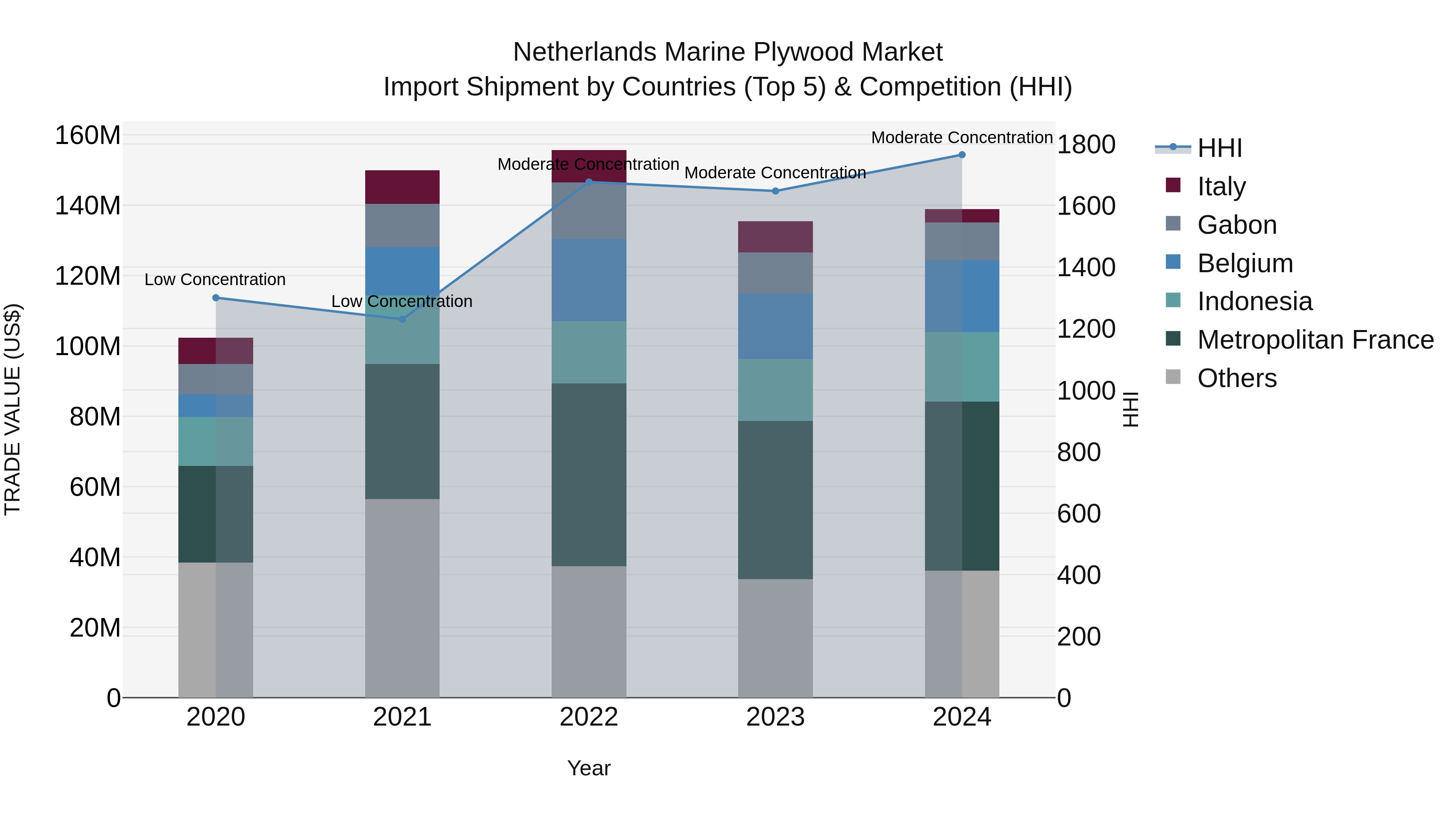
The Netherlands continues to be a key importer of marine plywood, with significant shipments from top exporting countries such as Metropolitan France, Belgium, Indonesia, Gabon, and Morocco in 2024. The market shows moderate concentration with a consistent Compound Annual Growth Rate (CAGR) of 7.93% from 2020 to 2024. The growth rate in 2024 remained steady at 2.51%, indicating a resilient and stable market for marine plywood imports in the Netherlands.
Netherlands Marine Plywood Market Overview
The Netherlands marine plywood market is experiencing steady growth driven by the country`s strong maritime industry and increasing demand for high-quality, durable plywood products. The market is characterized by a focus on sustainability and environmentally friendly practices, with a growing preference for certified plywood sourced from responsibly managed forests. Key players in the market are investing in research and development to innovate new products that meet the stringent requirements of marine applications, such as resistance to water, humidity, and fungal decay. Additionally, the market is witnessing a trend towards customized solutions to cater to specific project requirements. Overall, the Netherlands marine plywood market is expected to continue its upward trajectory, driven by the country`s robust maritime sector and emphasis on quality and sustainability.
Netherlands Marine Plywood Market Trends
Currently, the Netherlands Marine Plywood Market is experiencing a growing demand for sustainable and eco-friendly products. Consumers are increasingly conscious of the environmental impact of their purchasing decisions, leading to a higher preference for plywood produced from responsibly managed forests and with low formaldehyde emissions. Additionally, there is a trend towards higher quality marine plywood that offers enhanced durability and resistance to water damage, particularly in the construction and marine industries. Manufacturers in the Netherlands are also focusing on innovative product designs and customization options to cater to the needs of diverse customer segments. Overall, the market is witnessing a shift towards more environmentally friendly and high-performance marine plywood products to meet the evolving demands of consumers and industries.
Netherlands Marine Plywood Market Challenges
In the Netherlands Marine Plywood Market, challenges primarily revolve around the competition from alternative materials such as composite panels and plastics, which offer similar properties at potentially lower costs. Additionally, environmental concerns and regulations surrounding the sourcing of raw materials and production processes are becoming increasingly stringent, impacting the sustainability of marine plywood production. The market also faces challenges related to fluctuating raw material prices, transportation costs, and global economic uncertainties. Furthermore, the need for continuous innovation to meet evolving customer requirements and technological advancements poses a challenge for companies operating in the Netherlands Marine Plywood Market. Overall, companies in this market need to navigate these challenges effectively to maintain their competitiveness and sustainability in the long run.
Netherlands Marine Plywood Market Investment Opportunities
The Netherlands Marine Plywood Market offers attractive investment opportunities due to the strong demand for high-quality plywood in various industries such as construction, marine, and furniture manufacturing. The market is driven by factors like the growing construction sector, increasing adoption of marine plywood for boat building and water-related applications, and the rising trend of eco-friendly and sustainable construction materials. Investors can explore opportunities in plywood manufacturing companies operating in the Netherlands, as well as suppliers of raw materials and distributors catering to the marine plywood market. Additionally, with the emphasis on green building practices and the shift towards environmentally friendly products, investments in innovative plywood technologies and sustainable manufacturing processes could also be promising in the Netherlands Marine Plywood Market.
Netherlands Marine Plywood Market Government Policy
The government policies related to the Netherlands Marine Plywood Market primarily focus on sustainability and environmental protection. The Dutch government has implemented strict regulations to ensure the responsible sourcing of raw materials for plywood production, promoting the use of certified sustainable wood. Additionally, there are policies in place to monitor and control the emissions and waste generated by plywood manufacturing processes to minimize environmental impact. The government also supports research and innovation in the industry to promote the development of eco-friendly and energy-efficient production techniques. Overall, the Netherlands government`s policies aim to balance economic growth in the marine plywood market with environmental preservation and sustainability, encouraging companies to operate in a socially responsible manner.
Netherlands Marine Plywood Market Future Outlook
The future outlook for the Netherlands Marine Plywood Market is positive, with growth expected in the coming years. The increasing demand for marine plywood in the construction and marine industries, driven by factors such as urbanization, infrastructure development, and the rising popularity of water-based recreational activities, will fuel market expansion. Additionally, the Netherlands` strong economy and focus on sustainability and environmental protection are likely to drive the adoption of eco-friendly marine plywood products. Technological advancements in the manufacturing process, leading to improved quality and durability of marine plywood, will also contribute to market growth. Overall, the Netherlands Marine Plywood Market is poised for steady growth, offering opportunities for manufacturers and suppliers to capitalize on the increasing demand in the region.
Key Highlights of the Report:
- Netherlands Marine Plywood Market Outlook
- Market Size of Netherlands Marine Plywood Market, 2024
- Forecast of Netherlands Marine Plywood Market, 2031
- Historical Data and Forecast of Netherlands Marine Plywood Revenues & Volume for the Period 2021- 2031
- Netherlands Marine Plywood Market Trend Evolution
- Netherlands Marine Plywood Market Drivers and Challenges
- Netherlands Marine Plywood Price Trends
- Netherlands Marine Plywood Porter's Five Forces
- Netherlands Marine Plywood Industry Life Cycle
- Historical Data and Forecast of Netherlands Marine Plywood Market Revenues & Volume By Application for the Period 2021- 2031
- Historical Data and Forecast of Netherlands Marine Plywood Market Revenues & Volume By Marine Applications for the Period 2021- 2031
- Historical Data and Forecast of Netherlands Marine Plywood Market Revenues & Volume By Non-Marine Applications for the Period 2021- 2031
- Netherlands Marine Plywood Import Export Trade Statistics
- Market Opportunity Assessment By Application
- Netherlands Marine Plywood Top Companies Market Share
- Netherlands Marine Plywood Competitive Benchmarking By Technical and Operational Parameters
- Netherlands Marine Plywood Company Profiles
- Netherlands Marine Plywood Key Strategic Recommendations






































