Netherlands Medical Gases Market Size (2020-2030)
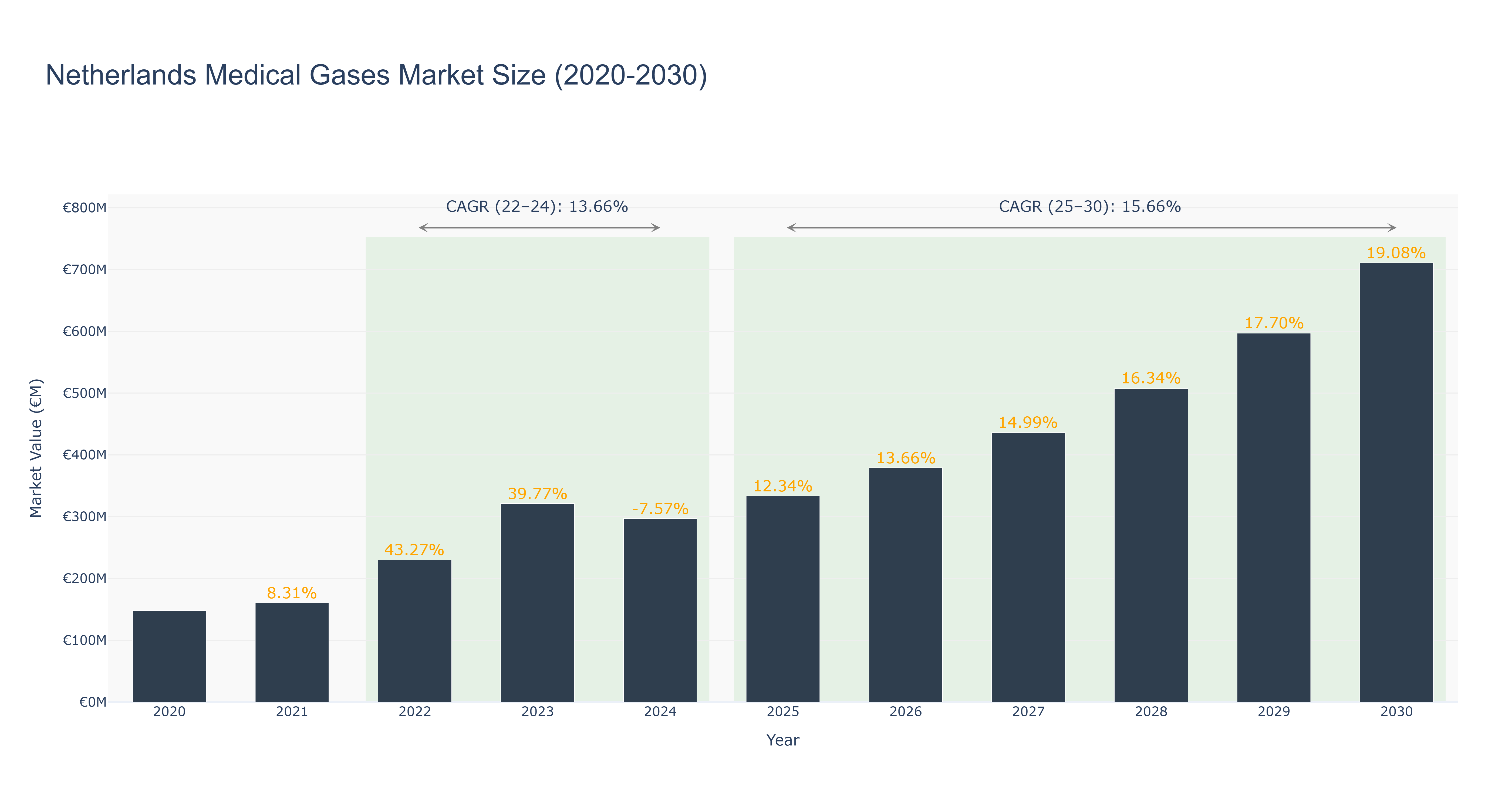
Netherlands Medical Gases Market has shown a promising growth trajectory over the years. The market peaked at €710.78 million in 2030, with a steady increase from €148.10 million in 2020. Notably, the market experienced a dip in 2024 to €296.90 million, attributed to a temporary decline in demand for medical gases. However, strong recovery ensued, with a forecasted market size of €596.91 million in 2029 and a projected growth to €710.78 million in 2030. The CAGR for the period 2025-2030 stands at 15.66%, indicating sustained growth. Industry drivers such as the increasing prevalence of chronic diseases and advancements in healthcare infrastructure are propelling market expansion. Looking ahead, upcoming projects in the Netherlands include the modernization of medical gas delivery systems in hospitals to enhance patient care and safety.
Netherlands Medical Gases Market: Production & Trade Performance (2019-2025)
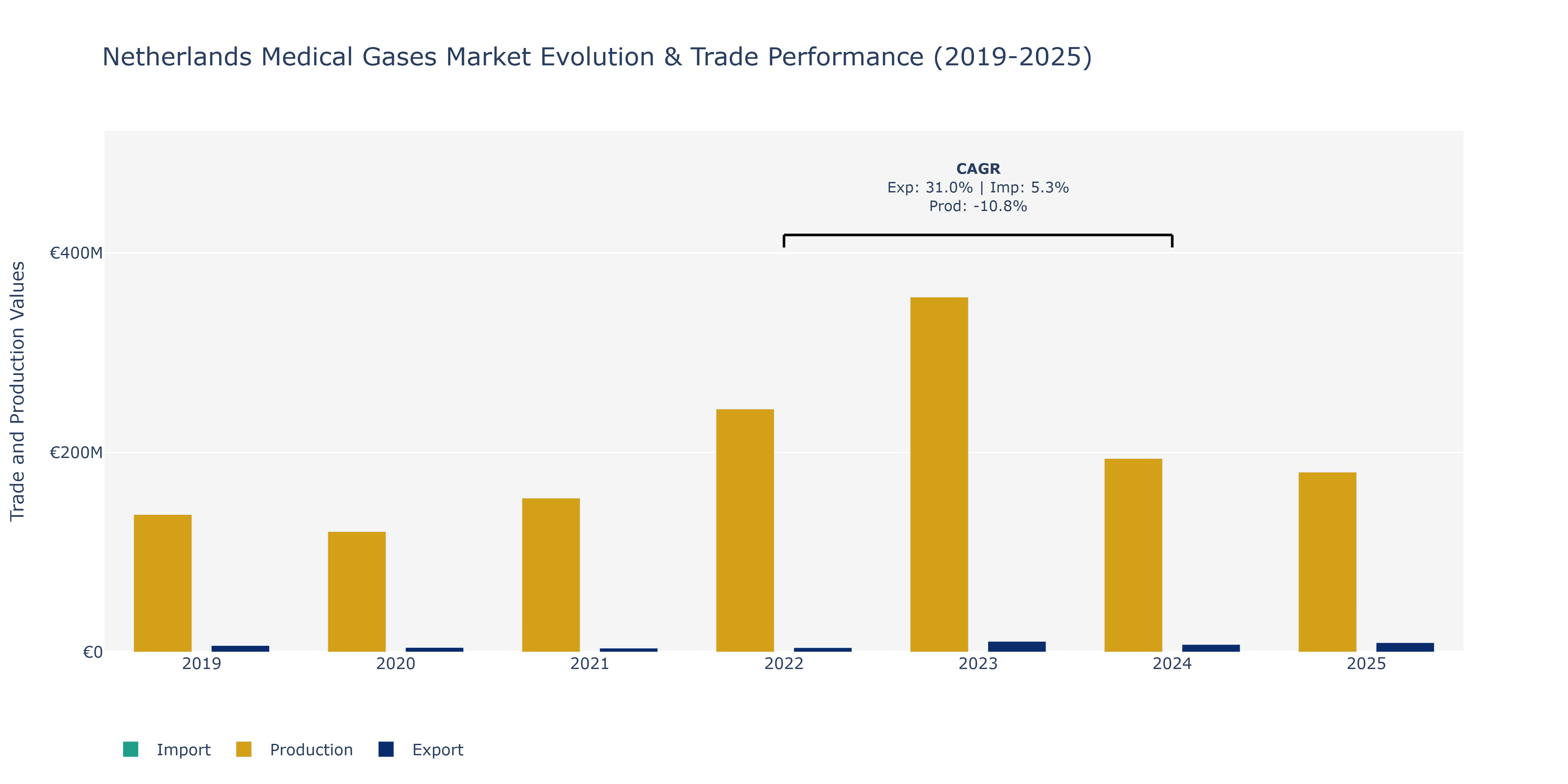
The Netherlands Medical Gases Market experienced notable shifts in key metrics over the years. Exports saw a decrease from €6.58 million in 2019 to €3.91 million in 2021 before rebounding to €9.4 million in 2025, showing a fluctuating trend. Imports followed a similar pattern, declining from €22.69 million in 2019 to €17.45 million in 2023 and then rising to €36.68 million in 2025. Production peaked at €355.67 million in 2023, then dropped to €193.94 million in 2024, attributed to market adjustments and evolving demand dynamics. The surge in exports and imports post-2023 could be linked to technological advancements in medical gas manufacturing and increased global demand for healthcare services. These shifts underline the market's adaptability to changing conditions and the importance of innovation in sustaining growth.
Netherlands Medical Gases Market Overview
The Netherlands medical gases market is a growing sector driven by factors such as an increasing elderly population, rising prevalence of chronic diseases, and advancements in healthcare infrastructure. The market includes a wide range of medical gases such as oxygen, nitrous oxide, carbon dioxide, and helium, among others, which are essential for various medical procedures and therapies. Key players in the market provide these gases to hospitals, clinics, and home healthcare settings. Regulatory standards and safety protocols set by organizations like the Dutch Healthcare Authority and the European Medicines Agency play a crucial role in shaping the market landscape. The market is competitive with several domestic and international suppliers vying for market share through strategies like product innovation, partnerships, and acquisitions. Overall, the Netherlands medical gases market is poised for steady growth in the coming years.
Netherlands Medical Gases Market Trends
The Netherlands medical gases market is witnessing several key trends. One prominent trend is the increasing demand for home healthcare services, leading to a higher usage of medical gases for respiratory therapy outside traditional healthcare settings. Another trend is the growing focus on sustainable practices, driving the adoption of eco-friendly medical gas production methods and packaging. Additionally, advancements in technology are enabling the development of innovative delivery systems for precise administration of medical gases, improving patient care outcomes. The market is also experiencing a rise in collaborations between medical gas suppliers and healthcare providers to ensure a reliable supply chain and enhance service quality. Overall, these trends are shaping the Netherlands medical gases market towards greater accessibility, sustainability, and efficiency.
Netherlands Medical Gases Market Challenges
In the Netherlands medical gases market, several challenges are faced, including increasing competition among suppliers leading to pricing pressures, stringent regulations and quality standards necessitating continuous investment in technology and infrastructure, and the need for efficient distribution networks to ensure timely delivery to healthcare facilities. Additionally, the market is influenced by factors such as fluctuating raw material costs, evolving healthcare policies, and the growing demand for specialized medical gases for various applications. Companies operating in this market must navigate these challenges by focusing on innovation, compliance with regulatory requirements, and building strong relationships with healthcare providers to maintain a competitive edge and meet the evolving needs of the industry.
Netherlands Medical Gases Market Investment Opportunities
The Netherlands medical gases market offers several investment opportunities due to the increasing demand for medical gases across various healthcare facilities. One potential opportunity lies in the growing adoption of home healthcare services, which require a reliable supply of medical gases for patients with chronic conditions. Additionally, advancements in medical gas delivery systems and technologies present opportunities for investment in innovative solutions that improve the efficiency and safety of gas administration. With the rising focus on sustainable healthcare practices, investments in environmentally friendly production and distribution methods for medical gases could also be lucrative. Overall, the Netherlands medical gases market is poised for growth, making it an attractive sector for potential investors seeking to capitalize on the evolving healthcare landscape.
Netherlands Medical Gases Market Government Policy
In the Netherlands, the medical gases market is governed by strict regulations and policies to ensure the safety and quality of products. The Dutch Healthcare Inspectorate (IGJ) oversees the production, distribution, and use of medical gases, requiring companies to comply with Good Manufacturing Practices (GMP) and Good Distribution Practices (GDP) standards. The Ministry of Health, Welfare, and Sport (VWS) also plays a key role in setting guidelines for the procurement and supply of medical gases in healthcare facilities. Additionally, the Dutch Pharmacists Association (KNMP) provides guidelines for the storage and handling of medical gases in pharmacies. These regulations aim to maintain high standards of quality, safety, and efficacy in the medical gases market to safeguard patient health and well-being.
Netherlands Medical Gases Market Future Outlook
The future outlook for the Netherlands medical gases market appears positive, driven by factors such as the increasing prevalence of chronic diseases, technological advancements in healthcare delivery, and the growing geriatric population. The demand for medical gases, including oxygen, nitrogen, and carbon dioxide, is expected to rise as these gases are essential for various medical procedures such as anesthesia, respiratory therapy, and surgical applications. Additionally, the government`s focus on improving healthcare infrastructure and the rise in healthcare expenditure are likely to further fuel market growth. Companies operating in the medical gases sector are anticipated to invest in research and development to introduce innovative products, enhance distribution networks, and forge strategic partnerships to capitalize on the expanding opportunities in the Netherlands medical gases market.
Key Highlights of the Report:
- Netherlands Medical Gases Market Outlook
- Market Size of Netherlands Medical Gases Market,2024
- Forecast of Netherlands Medical Gases Market, 2031
- Historical Data and Forecast of Netherlands Medical Gases Revenues & Volume for the Period 2021-2031
- Netherlands Medical Gases Market Trend Evolution
- Netherlands Medical Gases Market Drivers and Challenges
- Netherlands Medical Gases Price Trends
- Netherlands Medical Gases Porter's Five Forces
- Netherlands Medical Gases Industry Life Cycle
- Historical Data and Forecast of Netherlands Medical Gases Market Revenues & Volume By Technology Type for the Period 2021-2031
- Historical Data and Forecast of Netherlands Medical Gases Market Revenues & Volume By Fractional Distillation for the Period 2021-2031
- Historical Data and Forecast of Netherlands Medical Gases Market Revenues & Volume By Molecular Sieve for the Period 2021-2031
- Historical Data and Forecast of Netherlands Medical Gases Market Revenues & Volume By Semipermeable Membrane for the Period 2021-2031
- Historical Data and Forecast of Netherlands Medical Gases Market Revenues & Volume By Physical Separators for the Period 2021-2031
- Historical Data and Forecast of Netherlands Medical Gases Market Revenues & Volume By Application Area for the Period 2021-2031
- Historical Data and Forecast of Netherlands Medical Gases Market Revenues & Volume By Therapeutic Applications for the Period 2021-2031
- Historical Data and Forecast of Netherlands Medical Gases Market Revenues & Volume By Pharmaceutical Manufacturing for the Period 2021-2031
- Historical Data and Forecast of Netherlands Medical Gases Market Revenues & Volume By Diagnostic Applications for the Period 2021-2031
- Historical Data and Forecast of Netherlands Medical Gases Market Revenues & Volume By Drug Discovery for the Period 2021-2031
- Historical Data and Forecast of Netherlands Medical Gases Market Revenues & Volume By Quality Control for the Period 2021 - 2029
- Historical Data and Forecast of Netherlands Medical Gases Market Revenues & Volume By End User for the Period 2021-2031
- Historical Data and Forecast of Netherlands Medical Gases Market Revenues & Volume By Hospitals for the Period 2021-2031
- Historical Data and Forecast of Netherlands Medical Gases Market Revenues & Volume By Home Healthcare for the Period 2021-2031
- Historical Data and Forecast of Netherlands Medical Gases Market Revenues & Volume By Pharmaceutical Companies for the Period 2021-2031
- Historical Data and Forecast of Netherlands Medical Gases Market Revenues & Volume By Academic Institutions for the Period 2021-2031
- Historical Data and Forecast of Netherlands Medical Gases Market Revenues & Volume By Emergency Service Providers for the Period 2021 - 2029
- Historical Data and Forecast of Netherlands Medical Gases Market Revenues & Volume By Product Type for the Period 2021-2031
- Historical Data and Forecast of Netherlands Medical Gases Market Revenues & Volume By Oxygen Gases for the Period 2021-2031
- Historical Data and Forecast of Netherlands Medical Gases Market Revenues & Volume By Carbon Dioxide Gases for the Period 2021-2031
- Historical Data and Forecast of Netherlands Medical Gases Market Revenues & Volume By Nitrogen Gases for the Period 2021-2031
- Historical Data and Forecast of Netherlands Medical Gases Market Revenues & Volume By Helium Gases for the Period 2021-2031
- Historical Data and Forecast of Netherlands Medical Gases Market Revenues & Volume By Gas Mixtures for the Period 2021 - 2029
- Netherlands Medical Gases Import Export Trade Statistics
- Market Opportunity Assessment By Technology Type
- Market Opportunity Assessment By Application Area
- Market Opportunity Assessment By End User
- Market Opportunity Assessment By Product Type
- Netherlands Medical Gases Top Companies Market Share
- Netherlands Medical Gases Competitive Benchmarking By Technical and Operational Parameters
- Netherlands Medical Gases Company Profiles
- Netherlands Medical Gases Key Strategic Recommendations






































