Netherlands Methyl Cellulose Market Top 5 Importing Countries and Market Competition (HHI) Analysis
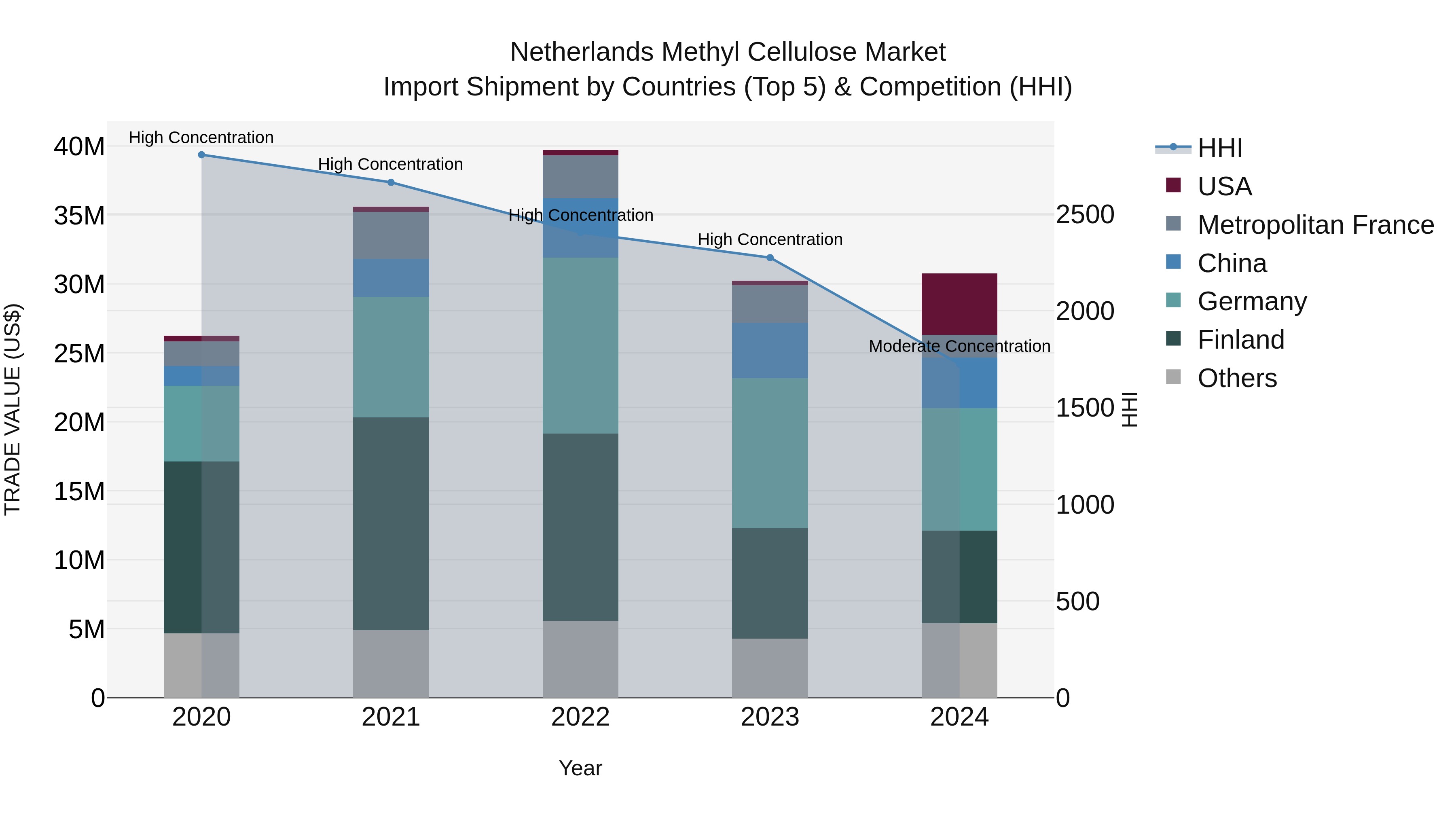
The Netherlands saw a diverse range of countries exporting methyl cellulose in 2024, with Germany, Finland, USA, China, and Metropolitan France leading the way. The market concentration, as measured by the HHI, shifted from high to moderate in 2024, indicating a more balanced import landscape. The compound annual growth rate (CAGR) for 2020-2024 was a steady 4.05%, while the growth rate from 2023-2024 was a positive 1.68%. These trends suggest a stable and growing market for methyl cellulose imports in the Netherlands.
Netherlands Methyl Cellulose Market Overview
The Netherlands methyl cellulose market is experiencing steady growth driven by the increasing demand from various industries such as food and beverages, pharmaceuticals, construction, and personal care. Methyl cellulose, a versatile and cost-effective additive, is widely used as a thickener, stabilizer, and emulsifier in various products. In the food industry, it is commonly used in dairy products, sauces, and bakery items. In the pharmaceutical sector, methyl cellulose is utilized in the formulation of tablets and as a binder in drug manufacturing. The construction industry also relies on methyl cellulose for its properties as a water retention agent in cement and gypsum-based products. With ongoing research and development activities to enhance its properties, the Netherlands methyl cellulose market is poised for further growth in the coming years.
Netherlands Methyl Cellulose Market Trends
Currently, the Netherlands methyl cellulose market is experiencing a growing demand due to its wide range of applications in various industries such as food and beverages, pharmaceuticals, construction, and personal care products. The increasing awareness about the benefits of methyl cellulose, such as its thickening and stabilizing properties, as well as its role in improving the texture and shelf-life of products, is driving this trend. Additionally, the rise in consumer preferences for natural and plant-based ingredients in products is further fueling the demand for methyl cellulose as it is derived from cellulose, a natural polymer. Manufacturers in the Netherlands are also focusing on developing innovative formulations and customized solutions to cater to the specific needs of different industries, contributing to the overall growth of the methyl cellulose market in the country.
Netherlands Methyl Cellulose Market Challenges
In the Netherlands, the methyl cellulose market faces several challenges, including increasing competition from alternative products, fluctuating raw material prices, and stringent regulations on chemical substances. The demand for eco-friendly and sustainable products is also impacting the market, with consumers and industries shifting towards more environmentally friendly options. Additionally, the COVID-19 pandemic has disrupted supply chains and manufacturing processes, leading to potential delays and shortages in the availability of methyl cellulose. To stay competitive, companies in the Netherlands methyl cellulose market need to focus on innovation, product differentiation, and sustainability to meet changing market demands and regulatory requirements.
Netherlands Methyl Cellulose Market Investment Opportunities
In the Netherlands methyl cellulose market, there are several promising investment opportunities. With increasing demand for sustainable and eco-friendly products in various industries such as construction, pharmaceuticals, food, and cosmetics, investing in the production and distribution of methyl cellulose can be lucrative. Additionally, the Netherlands` strong focus on innovation and technology provides a conducive environment for research and development in this sector, leading to potential advancements and new product opportunities. Furthermore, collaborations with key players in the market and strategic partnerships can help leverage market growth and expansion. Overall, investing in the Netherlands methyl cellulose market presents opportunities for long-term growth and profitability, especially in response to the growing demand for environmentally friendly solutions.
Netherlands Methyl Cellulose Market Government Policy
In the Netherlands, the methyl cellulose market is subject to government policies primarily focused on ensuring product safety, environmental protection, and consumer rights. Regulatory bodies such as the Dutch Food and Consumer Product Safety Authority (NVWA) oversee the market to guarantee compliance with quality standards and regulations. Additionally, environmental sustainability is a key consideration, with the Dutch government encouraging the use of eco-friendly production methods and promoting the recycling of packaging materials. Consumer protection laws also play a significant role in the methyl cellulose market, with strict guidelines in place to safeguard consumers against misleading advertising and unfair business practices. Overall, the Netherlands has a well-established regulatory framework that aims to promote a competitive and sustainable methyl cellulose market while prioritizing the protection of public health and the environment.
Netherlands Methyl Cellulose Market Future Outlook
The future outlook for the Netherlands methyl cellulose market appears positive, with steady growth anticipated in the coming years. Factors such as the increasing demand for eco-friendly and sustainable products in various industries, including construction, pharmaceuticals, and food and beverage, are expected to drive the market growth. Methyl cellulose`s versatility as a thickener, emulsifier, and stabilizer, coupled with its properties such as water retention and film formation, make it a popular choice in a wide range of applications. Additionally, ongoing research and development efforts to enhance the properties and applications of methyl cellulose are likely to further boost its market demand in the Netherlands. Overall, the market is poised for expansion as industries continue to prioritize sustainable and innovative solutions.
Key Highlights of the Report:
- Netherlands Methyl Cellulose Market Outlook
- Market Size of Netherlands Methyl Cellulose Market,2024
- Forecast of Netherlands Methyl Cellulose Market, 2031
- Historical Data and Forecast of Netherlands Methyl Cellulose Revenues & Volume for the Period 2021-2031
- Netherlands Methyl Cellulose Market Trend Evolution
- Netherlands Methyl Cellulose Market Drivers and Challenges
- Netherlands Methyl Cellulose Price Trends
- Netherlands Methyl Cellulose Porter's Five Forces
- Netherlands Methyl Cellulose Industry Life Cycle
- Historical Data and Forecast of Netherlands Methyl Cellulose Market Revenues & Volume By Type for the Period 2021-2031
- Historical Data and Forecast of Netherlands Methyl Cellulose Market Revenues & Volume By Powder for the Period 2021-2031
- Historical Data and Forecast of Netherlands Methyl Cellulose Market Revenues & Volume By Granules for the Period 2021-2031
- Historical Data and Forecast of Netherlands Methyl Cellulose Market Revenues & Volume By Liquid for the Period 2021-2031
- Historical Data and Forecast of Netherlands Methyl Cellulose Market Revenues & Volume By Application for the Period 2021-2031
- Historical Data and Forecast of Netherlands Methyl Cellulose Market Revenues & Volume By Pharmaceuticals for the Period 2021-2031
- Historical Data and Forecast of Netherlands Methyl Cellulose Market Revenues & Volume By Food Additives for the Period 2021-2031
- Historical Data and Forecast of Netherlands Methyl Cellulose Market Revenues & Volume By Coatings for the Period 2021-2031
- Historical Data and Forecast of Netherlands Methyl Cellulose Market Revenues & Volume By End Use for the Period 2021-2031
- Historical Data and Forecast of Netherlands Methyl Cellulose Market Revenues & Volume By Construction for the Period 2021-2031
- Historical Data and Forecast of Netherlands Methyl Cellulose Market Revenues & Volume By Personal Care for the Period 2021-2031
- Historical Data and Forecast of Netherlands Methyl Cellulose Market Revenues & Volume By Paper & Textiles for the Period 2021-2031
- Historical Data and Forecast of Netherlands Methyl Cellulose Market Revenues & Volume By Purity Level for the Period 2021-2031
- Historical Data and Forecast of Netherlands Methyl Cellulose Market Revenues & Volume By High Purity for the Period 2021-2031
- Historical Data and Forecast of Netherlands Methyl Cellulose Market Revenues & Volume By Industrial Grade for the Period 2021-2031
- Historical Data and Forecast of Netherlands Methyl Cellulose Market Revenues & Volume By Low Purity for the Period 2021-2031
- Historical Data and Forecast of Netherlands Methyl Cellulose Market Revenues & Volume By Manufacturing Process for the Period 2021-2031
- Historical Data and Forecast of Netherlands Methyl Cellulose Market Revenues & Volume By Etherification for the Period 2021-2031
- Historical Data and Forecast of Netherlands Methyl Cellulose Market Revenues & Volume By Hydroxypropylation for the Period 2021-2031
- Historical Data and Forecast of Netherlands Methyl Cellulose Market Revenues & Volume By Others for the Period 2021-2031
- Netherlands Methyl Cellulose Import Export Trade Statistics
- Market Opportunity Assessment By Type
- Market Opportunity Assessment By Application
- Market Opportunity Assessment By End Use
- Market Opportunity Assessment By Purity Level
- Market Opportunity Assessment By Manufacturing Process
- Netherlands Methyl Cellulose Top Companies Market Share
- Netherlands Methyl Cellulose Competitive Benchmarking By Technical and Operational Parameters
- Netherlands Methyl Cellulose Company Profiles
- Netherlands Methyl Cellulose Key Strategic Recommendations






































