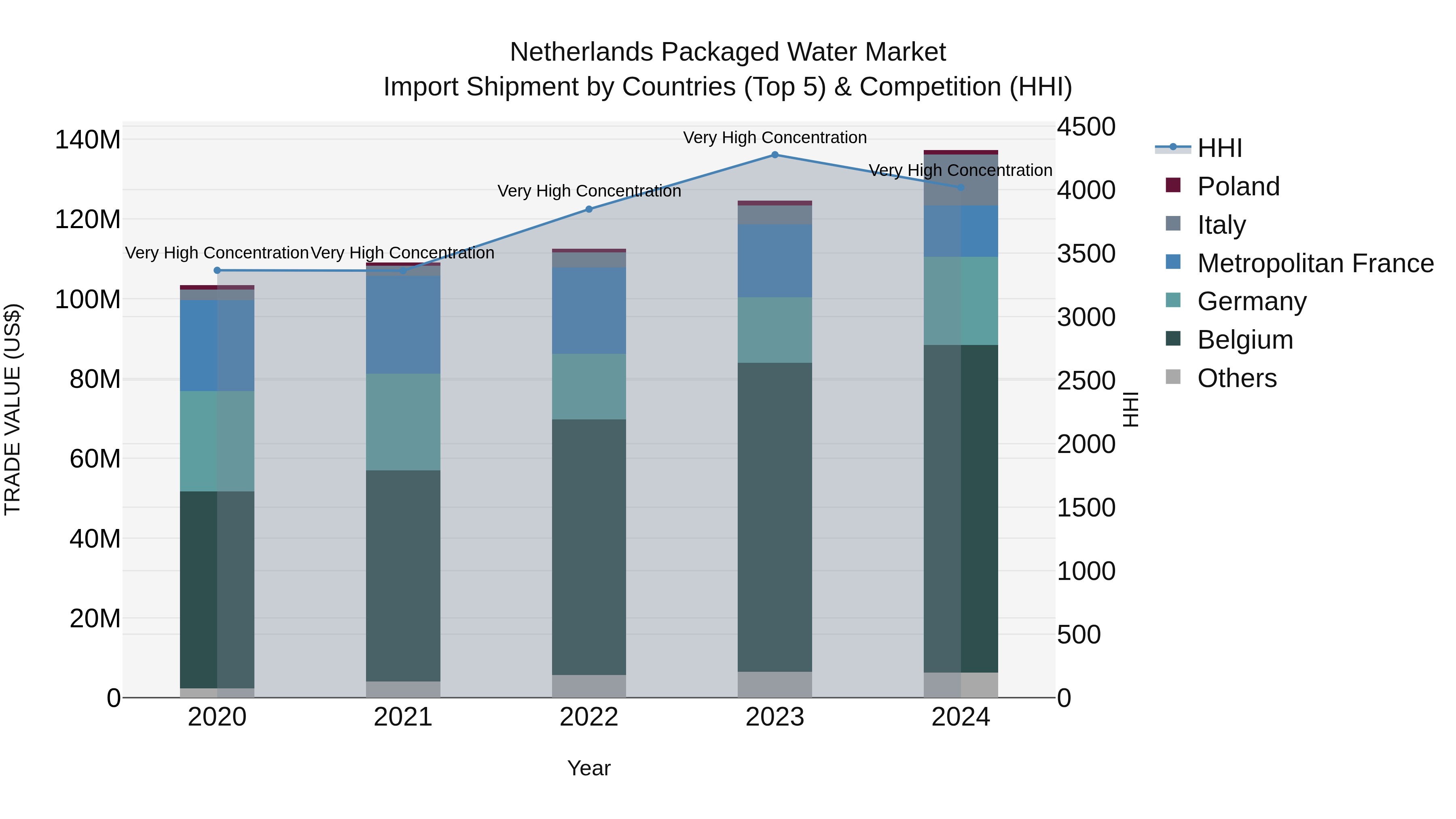
Netherlands Packaged Water Market Import Shipment by Countries (Top 5) & Competition (HHI)
The Netherlands continues to be a key market for packaged water imports, with significant contributions from neighboring countries like Belgium, Germany, and Metropolitan France. The high concentration levels indicated by the Herfindahl-Hirschman Index (HHI) in 2024 suggest a competitive landscape dominated by a few major players. The impressive compound annual growth rate (CAGR) of 7.32% from 2020 to 2024 reflects sustained market expansion, while the growth rate of 10.19% in 2024 highlights accelerating momentum within the industry. These trends indicate a buoyant market for packaged water imports in the Netherlands, driven by strong demand and robust supplier performance.
Netherlands Packaged water Market Overview
The Netherlands packaged water market is characterized by a high level of consumer awareness regarding health and wellness, leading to a growing demand for convenient and safe drinking water options. The market is dominated by well-known brands offering a variety of products, including still, sparkling, flavored, and functional waters. Sustainability and eco-friendly packaging have become key focus areas for companies in response to increasing environmental concerns among consumers. The market is also witnessing a shift towards premium and value-added products, such as vitamin-enhanced or natural mineral waters, as consumers seek healthier hydration options. With a strong distribution network and a culture that values clean and safe drinking water, the Netherlands packaged water market is expected to continue its growth trajectory in the coming years.
Netherlands Packaged water Market Trends and Opportunities
The Netherlands Packaged water Market is experiencing a growing trend towards healthier beverage options, with consumers increasingly preferring packaged water over sugary drinks. The market is also seeing a rise in demand for convenient on-the-go packaging formats such as single-serve bottles and eco-friendly packaging materials. Opportunities lie in the premiumization of packaged water products, as consumers are willing to pay a premium for enhanced features such as infused flavors, functional benefits, and sustainable packaging. Additionally, the increasing focus on health and wellness is driving the market towards innovative product offerings like vitamin-enhanced water and natural mineral water. Collaborations with retailers and online platforms for distribution, as well as targeted marketing strategies to emphasize the purity and quality of packaged water, can further propel growth in the Netherlands Packaged water Market.
Netherlands Packaged water Market Challenges
In the Netherlands Packaged water market, some challenges include increasing competition from other beverage categories like flavored water and sports drinks, as well as concerns over sustainability and environmental impact of single-use plastic bottles. Consumers are becoming more conscious of the waste generated by plastic packaging and are demanding more sustainable alternatives. Additionally, the market is facing pressure to innovate and introduce new products to meet changing consumer preferences, such as a shift towards healthier and functional beverages. Regulatory changes regarding plastic waste management and recycling also present challenges for companies operating in the packaged water market in the Netherlands. Overall, companies in this market need to adapt to these challenges by focusing on sustainability, innovation, and meeting consumer demands for healthier and environmentally friendly products.
Netherlands Packaged water Market Drivers
The Netherlands Packaged water market is primarily driven by the increasing health consciousness among consumers, leading to a growing preference for healthier beverage options over sugary drinks. The convenience and portability of packaged water also contribute to its popularity, especially among the on-the-go urban population. Additionally, concerns about water quality and safety have boosted the demand for packaged water as a trustworthy alternative to tap water. The rising trend of sustainability and environmental awareness has further fueled the market, with consumers seeking eco-friendly packaging options. Marketing strategies emphasizing the benefits of hydration, as well as innovative product offerings such as flavored and functional waters, are also driving growth in the Netherlands Packaged water market.
Netherlands Packaged water Market Government Policy
The Netherlands government has put in place regulations to ensure the safety and quality of packaged water in the market. The Dutch Food and Consumer Product Safety Authority (NVWA) oversees the compliance of packaged water companies with strict guidelines regarding hygiene, labeling, and product composition. Additionally, the government has implemented measures to promote sustainability in packaging materials, encouraging companies to use eco-friendly materials and reduce plastic waste. The Netherlands also enforces pricing policies to prevent unfair competition and protect consumer interests. Overall, government policies in the Netherlands packaged water market focus on ensuring consumer safety, promoting sustainability, and maintaining fair market practices.
Netherlands Packaged water Market Future Outlook
The Netherlands Packaged water market is expected to experience steady growth in the coming years due to increasing health consciousness among consumers, growing concerns about water quality, and the convenience factor of packaged water. The market is likely to be driven by innovations in packaging, such as eco-friendly and sustainable options, as well as the introduction of functional and flavored waters to cater to evolving consumer preferences. Additionally, the rise in online retail channels and e-commerce platforms is anticipated to expand the market reach and accessibility of packaged water products. Despite facing competition from other beverages and concerns about plastic waste, the Netherlands Packaged water market is poised for growth, driven by changing consumer preferences and lifestyle trends towards healthier hydration options.
Key Highlights of the Report:
- Netherlands Packaged water Market Outlook
- Market Size of Netherlands Packaged water Market, 2024
- Forecast of Netherlands Packaged water Market, 2031
- Historical Data and Forecast of Netherlands Packaged water Revenues & Volume for the Period 2021- 2031
- Netherlands Packaged water Market Trend Evolution
- Netherlands Packaged water Market Drivers and Challenges
- Netherlands Packaged water Price Trends
- Netherlands Packaged water Porter's Five Forces
- Netherlands Packaged water Industry Life Cycle
- Historical Data and Forecast of Netherlands Packaged water Market Revenues & Volume By Product for the Period 2021- 2031
- Historical Data and Forecast of Netherlands Packaged water Market Revenues & Volume By Still for the Period 2021- 2031
- Historical Data and Forecast of Netherlands Packaged water Market Revenues & Volume By Carbonated for the Period 2021- 2031
- Historical Data and Forecast of Netherlands Packaged water Market Revenues & Volume By Flavored for the Period 2021- 2031
- Historical Data and Forecast of Netherlands Packaged water Market Revenues & Volume By Functional for the Period 2021- 2031
- Netherlands Packaged water Import Export Trade Statistics
- Market Opportunity Assessment By Product
- Netherlands Packaged water Top Companies Market Share
- Netherlands Packaged water Competitive Benchmarking By Technical and Operational Parameters
- Netherlands Packaged water Company Profiles
- Netherlands Packaged water Key Strategic Recommendations






































