Netherlands Perms and Relaxants Market (2025-2031) | Growth, Forecast, Industry, Analysis, Share, Competitive Landscape, Segmentation, Companies, Size & Revenue, Trends, Value, Outlook
Market Forecast By Product Type (Perms, Relaxants), By Distribution Channel (Supermarkets/Hypermarkets, Convenience Stores, Specialist Retailers, Online Stores, Others) And Competitive Landscape
| Product Code: ETC8545608 | Publication Date: Sep 2024 | Updated Date: Nov 2025 | Product Type: Market Research Report | |
| Publisher: 6Wresearch | Author: Sumit Sagar | No. of Pages: 75 | No. of Figures: 35 | No. of Tables: 20 |
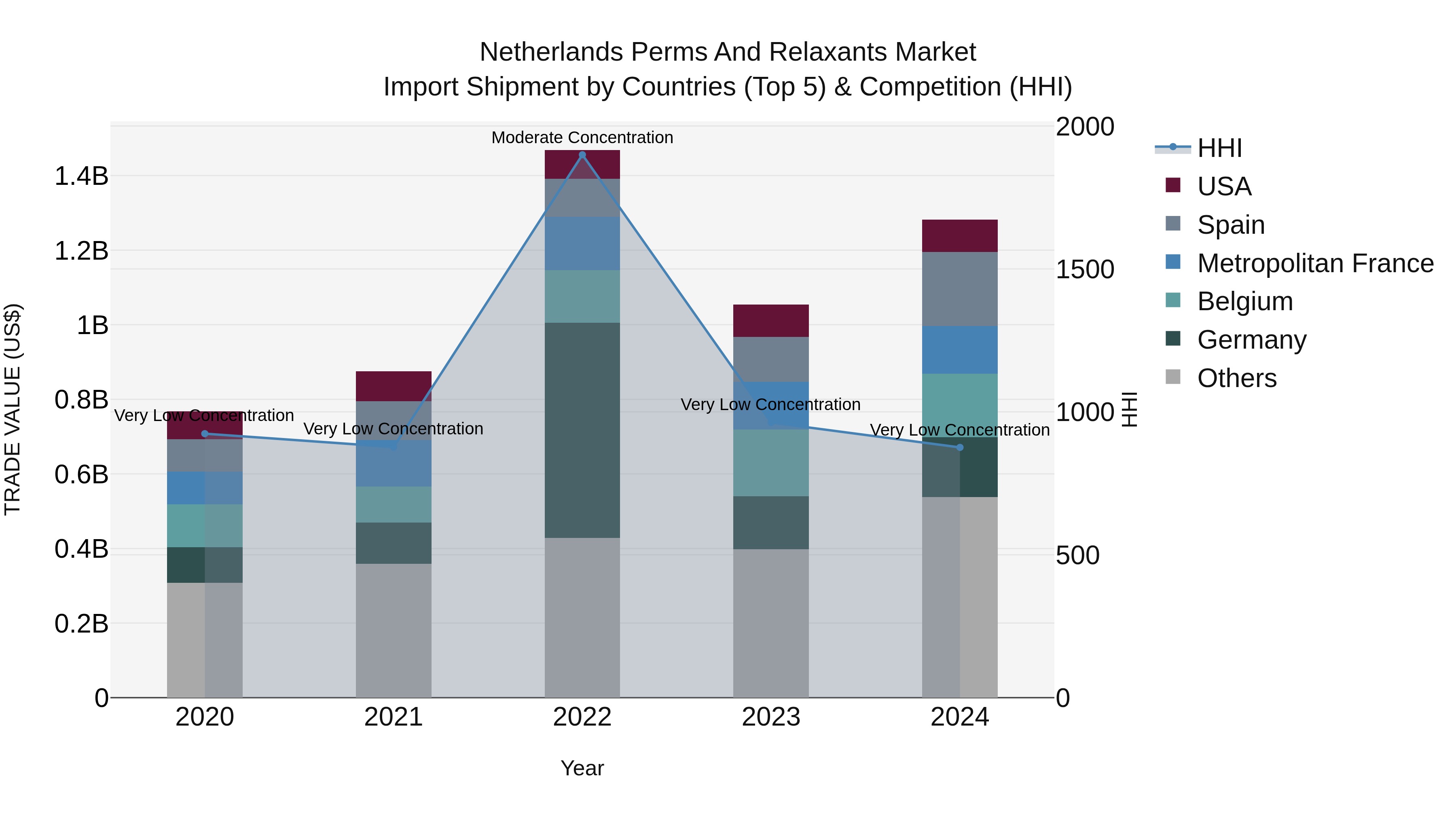
Netherlands Perms And Relaxants Market Import Shipment by Countries (Top 5) & Competition (HHI)
The Netherlands continues to be a key destination for perms and relaxants imports, with top suppliers including Spain, Belgium, and Germany. The market remains diverse with a low concentration level, ensuring healthy competition. The impressive compound annual growth rate (CAGR) of 13.67% from 2020 to 2024 indicates a thriving market, further supported by a notable growth rate of 21.58% between 2023 and 2024. With significant contributions from countries like Metropolitan France and Italy, the Netherlands' perms and relaxants import sector shows promising growth prospects.
Netherlands Perms and Relaxants Market Synopsis
The Netherlands perms and relaxants market is characterized by a moderate growth trajectory driven by a increasing consumer focus on hair care and styling products. Perms and relaxants are popular among consumers looking to achieve different hair textures and styles. Key market trends include a shift towards natural and organic products, as well as an increasing demand for products that offer both styling and hair care benefits. Major players in the market offer a wide range of perms and relaxants catering to various hair types and preferences. The market is also witnessing innovation in product formulations to address specific hair concerns such as damage repair and frizz control. Overall, the Netherlands perms and relaxants market is expected to continue growing as consumers seek personalized and effective hair styling solutions.
Netherlands Perms and Relaxants Market Trends
The Netherlands perms and relaxants market is experiencing a shift towards more natural and organic products as consumers become more conscious of the ingredients used in hair care products. There is a growing demand for chemical-free options that are gentle on the hair and scalp, reflecting a broader trend towards sustainability and health-conscious choices. Additionally, there is a rising interest in products that provide long-lasting results with minimal damage, promoting a more holistic approach to hair styling. Brands are also focusing on innovative formulations that offer versatility, allowing consumers to achieve a variety of styles while maintaining the health and integrity of their hair. Overall, the market is witnessing a move towards products that prioritize both performance and wellness, catering to a more discerning and informed consumer base.
Netherlands Perms and Relaxants Market Challenges
In the Netherlands Perms and Relaxants Market, several challenges are prevalent. One major challenge is the increasing consumer preference for natural and organic hair care products, leading to a decline in the demand for chemical-based perms and relaxants. Additionally, the negative perception of these products due to concerns about hair damage and potential health risks further hinders market growth. Competition from alternative hair styling methods such as keratin treatments and heat styling tools also poses a challenge to the market. Regulatory restrictions on certain chemicals used in perms and relaxants add another layer of complexity for manufacturers and distributors. To remain competitive and address these challenges, companies in the Netherlands Perms and Relaxants Market need to innovate by introducing safer formulations, leveraging digital marketing strategies, and emphasizing product efficacy and safety to regain consumer trust.
Netherlands Perms and Relaxants Market Investment Opportunities
The Netherlands Perms and Relaxants Market presents potential investment opportunities due to the growing demand for haircare products and services. With a trend towards natural and sustainable beauty products, there is a space for innovative and eco-friendly perms and relaxants in the market. Investing in research and development to create products that cater to this demand could lead to significant growth and market share. Additionally, partnering with salons and beauty professionals to offer specialized treatments and services could further expand the market presence. Leveraging digital marketing strategies and online platforms to reach a wider audience and establish a strong brand presence would also be crucial for success in this competitive market. Overall, by tapping into the evolving consumer preferences and trends, there are promising opportunities for investment and growth in the Netherlands Perms and Relaxants Market.
Jordan Agar Market Government Policies
The Netherlands has strict regulations governing the sale and use of perms and relaxants in the beauty industry. All products must comply with the European Union`s regulations on cosmetic products, ensuring safety and efficacy. The Dutch government enforces labeling requirements, ingredient restrictions, and packaging standards to protect consumer health. Additionally, professional hairstylists must undergo training and certification to provide these services, emphasizing the importance of proper application and handling of chemical products. The authorities conduct regular inspections of salons to enforce compliance with regulations, safeguarding both customers and workers. Overall, the government`s policies aim to promote the safe use of perms and relaxants in the Netherlands, maintaining high standards of quality and safety in the beauty industry.
Netherlands Perms and Relaxants Market Future Outlook
The Netherlands perms and relaxants market is expected to see steady growth in the coming years, driven by increasing consumer demand for hair styling products and services. Factors such as rising disposable income, changing fashion trends, and a growing focus on personal grooming are likely to fuel market growth. Additionally, innovations in product formulations and technologies that offer safer and more effective solutions for hair styling are expected to attract more consumers. With a strong emphasis on sustainability and natural ingredients, there is also a growing trend towards eco-friendly and organic perm and relaxant products. Overall, the market is poised for expansion with opportunities for product diversification and targeted marketing strategies to cater to evolving consumer preferences.
Key Highlights of the Report:
- Netherlands Perms and Relaxants Market Outlook
- Market Size of Netherlands Perms and Relaxants Market, 2024
- Forecast of Netherlands Perms and Relaxants Market, 2031
- Historical Data and Forecast of Netherlands Perms and Relaxants Revenues & Volume for the Period 2021- 2031
- Netherlands Perms and Relaxants Market Trend Evolution
- Netherlands Perms and Relaxants Market Drivers and Challenges
- Netherlands Perms and Relaxants Price Trends
- Netherlands Perms and Relaxants Porter's Five Forces
- Netherlands Perms and Relaxants Industry Life Cycle
- Historical Data and Forecast of Netherlands Perms and Relaxants Market Revenues & Volume By Product Type for the Period 2021- 2031
- Historical Data and Forecast of Netherlands Perms and Relaxants Market Revenues & Volume By Perms for the Period 2021- 2031
- Historical Data and Forecast of Netherlands Perms and Relaxants Market Revenues & Volume By Relaxants for the Period 2021- 2031
- Historical Data and Forecast of Netherlands Perms and Relaxants Market Revenues & Volume By Distribution Channel for the Period 2021- 2031
- Historical Data and Forecast of Netherlands Perms and Relaxants Market Revenues & Volume By Supermarkets/Hypermarkets for the Period 2021- 2031
- Historical Data and Forecast of Netherlands Perms and Relaxants Market Revenues & Volume By Convenience Stores for the Period 2021- 2031
- Historical Data and Forecast of Netherlands Perms and Relaxants Market Revenues & Volume By Specialist Retailers for the Period 2021- 2031
- Historical Data and Forecast of Netherlands Perms and Relaxants Market Revenues & Volume By Online Stores for the Period 2021- 2031
- Historical Data and Forecast of Netherlands Perms and Relaxants Market Revenues & Volume By Others for the Period 2021- 2031
- Netherlands Perms and Relaxants Import Export Trade Statistics
- Market Opportunity Assessment By Product Type
- Market Opportunity Assessment By Distribution Channel
- Netherlands Perms and Relaxants Top Companies Market Share
- Netherlands Perms and Relaxants Competitive Benchmarking By Technical and Operational Parameters
- Netherlands Perms and Relaxants Company Profiles
- Netherlands Perms and Relaxants Key Strategic Recommendations
Frequently Asked Questions About the Market Study (FAQs):
6Wresearch actively monitors the Netherlands Perms and Relaxants Market and publishes its comprehensive annual report, highlighting emerging trends, growth drivers, revenue analysis, and forecast outlook. Our insights help businesses to make data-backed strategic decisions with ongoing market dynamics. Our analysts track relevent industries related to the Netherlands Perms and Relaxants Market, allowing our clients with actionable intelligence and reliable forecasts tailored to emerging regional needs.
Yes, we provide customisation as per your requirements. To learn more, feel free to contact us on sales@6wresearch.com
1 Executive Summary |
2 Introduction |
2.1 Key Highlights of the Report |
2.2 Report Description |
2.3 Market Scope & Segmentation |
2.4 Research Methodology |
2.5 Assumptions |
3 Netherlands Perms and Relaxants Market Overview |
3.1 Netherlands Country Macro Economic Indicators |
3.2 Netherlands Perms and Relaxants Market Revenues & Volume, 2021 & 2031F |
3.3 Netherlands Perms and Relaxants Market - Industry Life Cycle |
3.4 Netherlands Perms and Relaxants Market - Porter's Five Forces |
3.5 Netherlands Perms and Relaxants Market Revenues & Volume Share, By Product Type, 2021 & 2031F |
3.6 Netherlands Perms and Relaxants Market Revenues & Volume Share, By Distribution Channel, 2021 & 2031F |
4 Netherlands Perms and Relaxants Market Dynamics |
4.1 Impact Analysis |
4.2 Market Drivers |
4.2.1 Increasing awareness about personal grooming and appearance among the population in the Netherlands |
4.2.2 Growing demand for professional hair care services in salons and spas |
4.2.3 Rising disposable income and changing lifestyle preferences leading to higher spending on beauty products |
4.3 Market Restraints |
4.3.1 Stringent regulations and guidelines related to the chemical composition of hair care products in the Netherlands |
4.3.2 Competition from natural and organic hair care products in the market |
5 Netherlands Perms and Relaxants Market Trends |
6 Netherlands Perms and Relaxants Market, By Types |
6.1 Netherlands Perms and Relaxants Market, By Product Type |
6.1.1 Overview and Analysis |
6.1.2 Netherlands Perms and Relaxants Market Revenues & Volume, By Product Type, 2021- 2031F |
6.1.3 Netherlands Perms and Relaxants Market Revenues & Volume, By Perms, 2021- 2031F |
6.1.4 Netherlands Perms and Relaxants Market Revenues & Volume, By Relaxants, 2021- 2031F |
6.2 Netherlands Perms and Relaxants Market, By Distribution Channel |
6.2.1 Overview and Analysis |
6.2.2 Netherlands Perms and Relaxants Market Revenues & Volume, By Supermarkets/Hypermarkets, 2021- 2031F |
6.2.3 Netherlands Perms and Relaxants Market Revenues & Volume, By Convenience Stores, 2021- 2031F |
6.2.4 Netherlands Perms and Relaxants Market Revenues & Volume, By Specialist Retailers, 2021- 2031F |
6.2.5 Netherlands Perms and Relaxants Market Revenues & Volume, By Online Stores, 2021- 2031F |
6.2.6 Netherlands Perms and Relaxants Market Revenues & Volume, By Others, 2021- 2031F |
7 Netherlands Perms and Relaxants Market Import-Export Trade Statistics |
7.1 Netherlands Perms and Relaxants Market Export to Major Countries |
7.2 Netherlands Perms and Relaxants Market Imports from Major Countries |
8 Netherlands Perms and Relaxants Market Key Performance Indicators |
8.1 Number of new product launches in the perms and relaxants segment |
8.2 Growth in the number of salon and spa establishments offering perms and relaxants services |
8.3 Consumer satisfaction and loyalty metrics for perms and relaxants products |
9 Netherlands Perms and Relaxants Market - Opportunity Assessment |
9.1 Netherlands Perms and Relaxants Market Opportunity Assessment, By Product Type, 2021 & 2031F |
9.2 Netherlands Perms and Relaxants Market Opportunity Assessment, By Distribution Channel, 2021 & 2031F |
10 Netherlands Perms and Relaxants Market - Competitive Landscape |
10.1 Netherlands Perms and Relaxants Market Revenue Share, By Companies, 2024 |
10.2 Netherlands Perms and Relaxants Market Competitive Benchmarking, By Operating and Technical Parameters |
11 Company Profiles |
12 Recommendations |
13 Disclaimer |
Global Go To Market Strategy - 2030
Export potential enables firms to identify high-growth global markets with greater confidence by combining advanced trade intelligence with a structured quantitative methodology. The framework analyzes emerging demand trends and country-level import patterns while integrating macroeconomic and trade datasets such as GDP and population forecasts, bilateral import–export flows, tariff structures, elasticity differentials between developed and developing economies, geographic distance, and import demand projections. Using weighted trade values from 2020–2024 as the base period to project country-to-country export potential for 2030, these inputs are operationalized through calculated drivers such as gravity model parameters, tariff impact factors, and projected GDP per-capita growth. Through an analysis of hidden potentials, demand hotspots, and market conditions that are most favorable to success, this method enables firms to focus on target countries, maximize returns, and global expansion with data, backed by accuracy.
By factoring in the projected importer demand gap that is currently unmet and could be potential opportunity, it identifies the potential for the Exporter (Country) among 190 countries, against the general trade analysis, which identifies the biggest importer or exporter.
To discover high-growth global markets and optimize your business strategy:
Click Here
Pricing
- Single User License$ 1,995
- Department License$ 2,400
- Site License$ 3,120
- Global License$ 3,795

Leadership Perspectives from Industry Events
Search
Thought Leadership and Analyst Meet





Our Clients








6WResearch In News
- Doha a strategic location for EV manufacturing hub: IPA Qatar
- Demand for luxury TVs surging in the GCC, says Samsung
- Empowering Growth: The Thriving Journey of Bangladesh’s Cable Industry
- Demand for luxury TVs surging in the GCC, says Samsung
- Video call with a traditional healer? Once unthinkable, it’s now common in South Africa
- Intelligent Buildings To Smooth GCC’s Path To Net Zero
Latest Reports
- Taiwan Airport Wireless Infrastructure Market (2026-2032)
- Vietnam Airport Wireless Infrastructure Market (2026-2032)
- Thailand Airport Wireless Infrastructure Market (2026-2032)
- South Korea Airport Wireless Infrastructure Market (2026-2032)
- Romania Airport Wireless Infrastructure Market (2026-2032)
- Qatar Airport Wireless Infrastructure Market (2026-2032)
- Philippines Airport Wireless Infrastructure Market (2026-2032)
- Japan Airport Wireless Infrastructure Market (2026-2032)
- Taiwan Airport Winter Services Market (2026-2032)
- Vietnam Airport Winter Services Market (2026-2032)
Industry Events and Analyst Meet

HIMTEX 2026

India Refining Summit 2026

India EV Show 2026

EV tech India Expo 2026

Auto Tech Asia 2026
Whitepaper
- Middle East & Africa Commercial Security Market Click here to view more.
- Middle East & Africa Fire Safety Systems & Equipment Market Click here to view more.
- GCC Drone Market Click here to view more.
- Middle East Lighting Fixture Market Click here to view more.
- GCC Physical & Perimeter Security Market Click here to view more.


