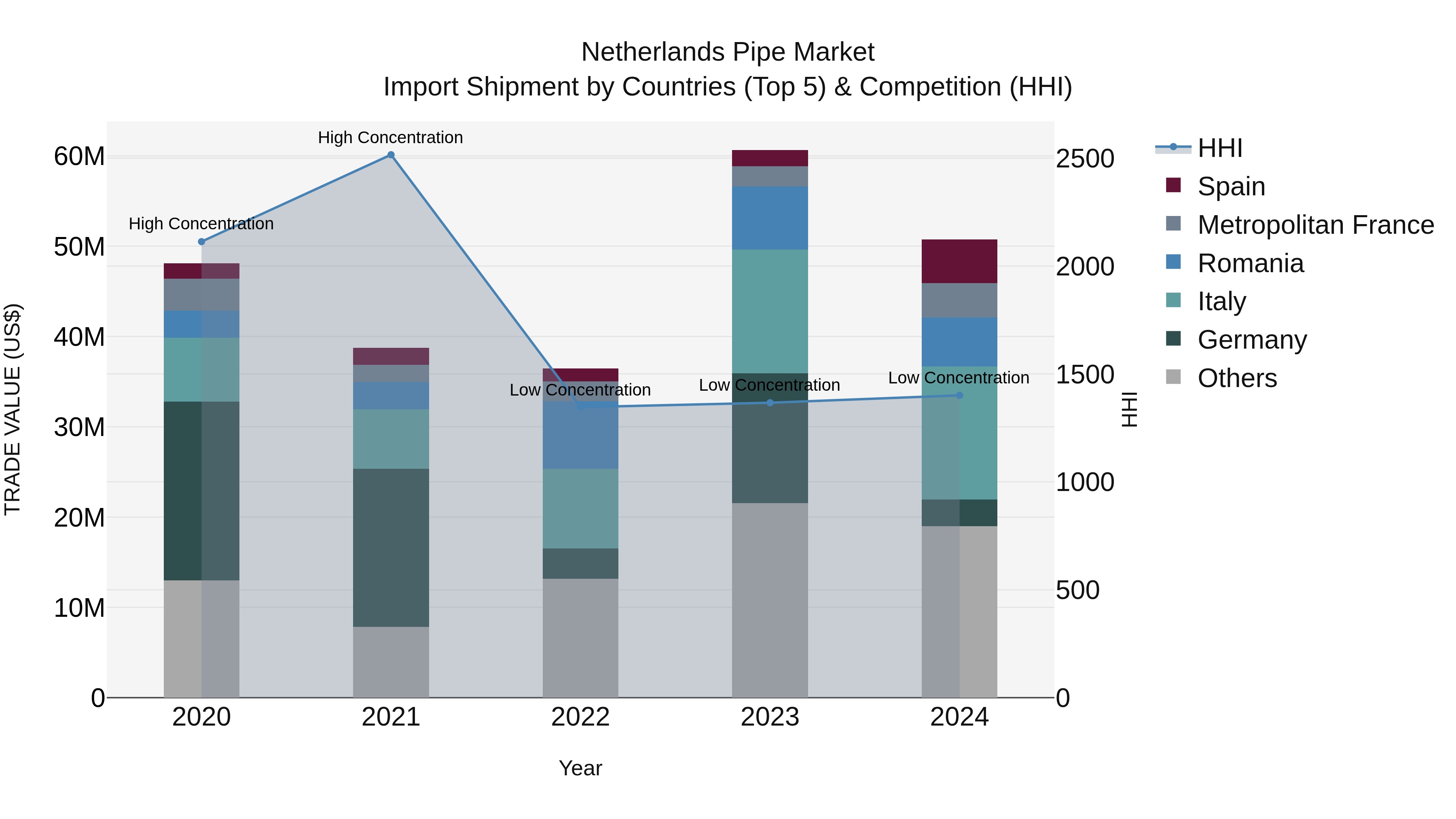
Netherlands Pipe Market Import Shipment by Countries (Top 5) & Competition (HHI)
In 2024, the Netherlands saw a diverse range of countries exporting pipes to its market, with Italy, Areas, nes, Romania, Spain, and Metropolitan France leading the pack. Despite this variety, the market remained relatively unconcentrated, as indicated by the low Herfindahl-Hirschman Index (HHI). The compound annual growth rate (CAGR) from 2020 to 2024 stood at a steady 1.35%, reflecting a stable trend in imports. However, the year-on-year growth rate for 2024 took a dip, with a decrease of 16.29%, possibly influenced by various external factors impacting the industry.
Key Highlights of the Report:
- Netherlands Pipe Market Outlook
- Market Size of Netherlands Pipe Market, 2024
- Forecast of Netherlands Pipe Market, 2031
- Historical Data and Forecast of Netherlands Pipe Revenues & Volume for the Period 2021- 2031
- Netherlands Pipe Market Trend Evolution
- Netherlands Pipe Market Drivers and Challenges
- Netherlands Pipe Price Trends
- Netherlands Pipe Porter's Five Forces
- Netherlands Pipe Industry Life Cycle
- Historical Data and Forecast of Netherlands Pipe Market Revenues & Volume By Material for the Period 2021- 2031
- Historical Data and Forecast of Netherlands Pipe Market Revenues & Volume By Concrete for the Period 2021- 2031
- Historical Data and Forecast of Netherlands Pipe Market Revenues & Volume By Thermoset and composite for the Period 2021- 2031
- Historical Data and Forecast of Netherlands Pipe Market Revenues & Volume By Metal for the Period 2021- 2031
- Historical Data and Forecast of Netherlands Pipe Market Revenues & Volume By Thermoplastic for the Period 2021- 2031
- Historical Data and Forecast of Netherlands Pipe Market Revenues & Volume By Diameter for the Period 2021- 2031
- Historical Data and Forecast of Netherlands Pipe Market Revenues & Volume By DN upto 50 mm for the Period 2021- 2031
- Historical Data and Forecast of Netherlands Pipe Market Revenues & Volume By DN 51 to 150 mm for the Period 2021- 2031
- Historical Data and Forecast of Netherlands Pipe Market Revenues & Volume By DN 151 to 300 mm for the Period 2021- 2031
- Historical Data and Forecast of Netherlands Pipe Market Revenues & Volume By DN 301 to 500 mm for the Period 2021- 2031
- Historical Data and Forecast of Netherlands Pipe Market Revenues & Volume By DN above 501 mm for the Period 2021- 2031
- Historical Data and Forecast of Netherlands Pipe Market Revenues & Volume By Application for the Period 2021- 2031
- Historical Data and Forecast of Netherlands Pipe Market Revenues & Volume By Water and wastewater for the Period 2021- 2031
- Historical Data and Forecast of Netherlands Pipe Market Revenues & Volume By Industrial for the Period 2021- 2031
- Historical Data and Forecast of Netherlands Pipe Market Revenues & Volume By Oil and gas for the Period 2021- 2031
- Historical Data and Forecast of Netherlands Pipe Market Revenues & Volume By Other for the Period 2021- 2031
- Netherlands Pipe Import Export Trade Statistics
- Market Opportunity Assessment By Material
- Market Opportunity Assessment By Diameter
- Market Opportunity Assessment By Application
- Netherlands Pipe Top Companies Market Share
- Netherlands Pipe Competitive Benchmarking By Technical and Operational Parameters
- Netherlands Pipe Company Profiles
- Netherlands Pipe Key Strategic Recommendations






































