Netherlands Shaving Foam Market Import Shipment by Countries (Top 5) & Competition (HHI)
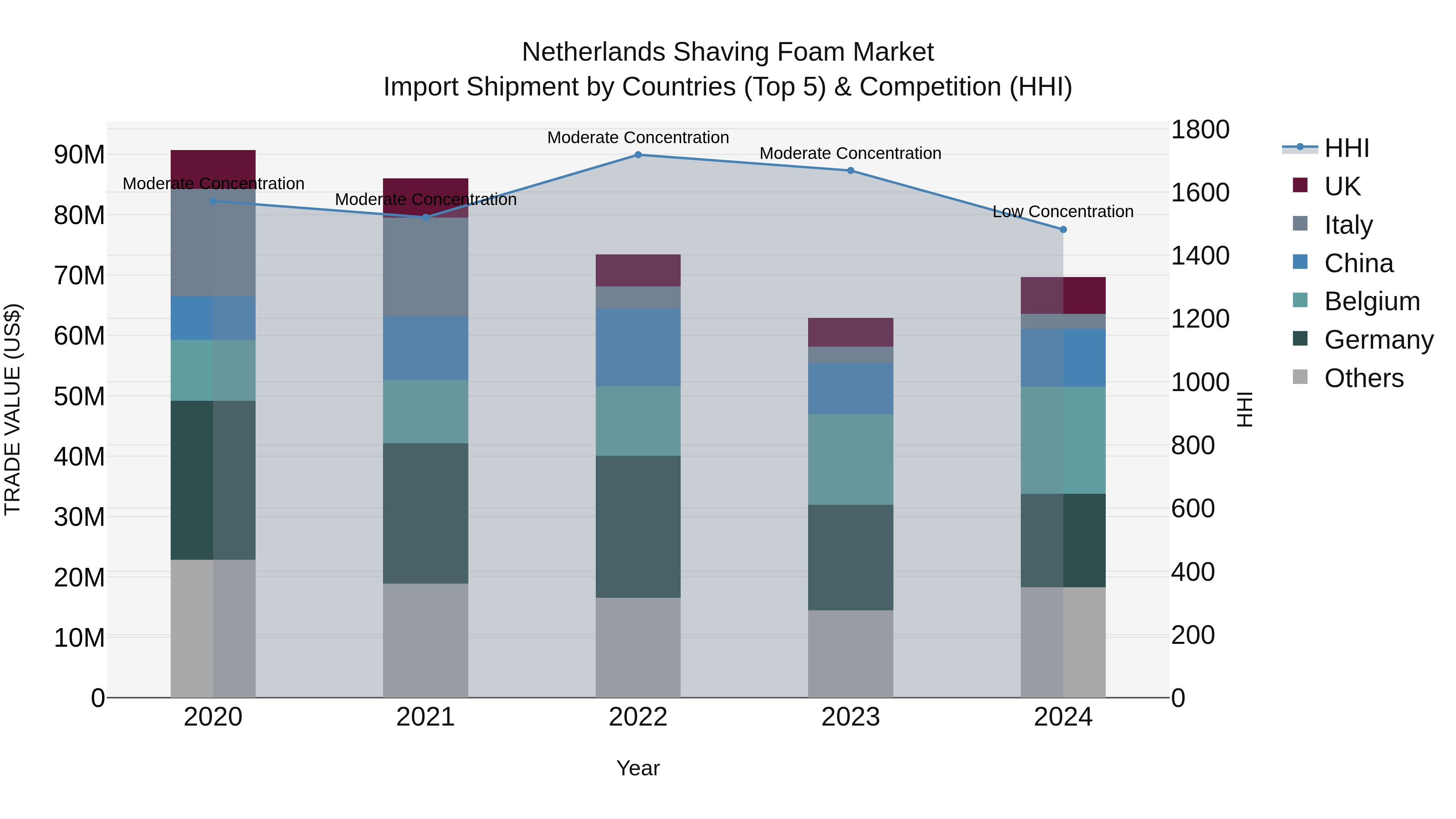
The Netherlands saw a shift in shaving foam import sources in 2024, with Belgium, Germany, China, UK, and Poland emerging as the top exporting countries. The market displayed a decrease in concentration levels from moderate to low, indicating a more diverse import landscape. Despite a negative compound annual growth rate (CAGR) from 2020 to 2024, the industry experienced a notable growth spurt in 2024 with a growth rate of 10.79%. This growth hints at evolving consumer preferences and increasing demand for shaving foam products in the Netherlands market.
Netherlands Shaving Foam Market Synopsis
The Netherlands shaving foam market is characterized by a growing trend towards premium and natural products, driven by increased consumer awareness of ingredients and sustainability. Key players in the market offer a wide range of products catering to different skin types and preferences, with emphasis on moisturizing, sensitive skin formulas, and eco-friendly packaging. E-commerce channels play a significant role in the distribution of shaving foam products, offering convenience and a wide variety of choices for consumers. The market is also witnessing an increase in male grooming products, leading to a higher demand for shaving foam targeted at men. Overall, the Netherlands shaving foam market is poised for steady growth, with a focus on innovation, sustainability, and meeting evolving consumer preferences.
Netherlands Shaving Foam Market Trends
The Netherlands shaving foam market is experiencing a shift towards eco-friendly and natural products as consumers become more conscious of sustainability and health. There is a growing demand for organic, cruelty-free, and vegan shaving foam options in the market. Additionally, innovative packaging designs and convenient travel-sized products are gaining popularity among consumers looking for on-the-go solutions. Opportunities lie in targeting specific consumer segments, such as men with sensitive skin or women interested in multi-functional products. Brands that emphasize transparency in their ingredients and production processes are likely to attract a loyal customer base. E-commerce platforms also present a significant opportunity for brands to reach a wider audience and provide personalized shopping experiences. Overall, the market is ripe for innovation and differentiation to cater to the evolving preferences of Dutch consumers.
Netherlands Shaving Foam Market Challenges
In the Netherlands Shaving Foam Market, some key challenges include intense competition among established brands and a growing trend towards sustainable and natural products. Established brands such as Gillette and Nivea dominate the market, making it difficult for newer or smaller brands to gain significant market share. Additionally, consumers are becoming more conscious of the environmental impact of their purchases, leading to a demand for eco-friendly and natural shaving foam options. Meeting these changing consumer preferences while also competing with well-known brands poses a challenge for companies operating in the Dutch shaving foam market. Adapting product offerings, marketing strategies, and packaging to align with sustainability trends while maintaining product efficacy and affordability will be crucial for companies looking to succeed in this competitive market.
Netherlands Shaving Foam Market Investment Opportunities
The Netherlands Shaving Foam Market is primarily driven by factors such as the growing grooming and personal care trends among men, increasing disposable income levels, and the rising demand for convenient and efficient shaving products. Additionally, the influence of social media, celebrity endorsements, and the emphasis on personal grooming and hygiene have contributed to the market growth. Consumers are increasingly seeking high-quality shaving foams that provide a smooth and comfortable shaving experience while also catering to specific skin types and preferences. The market is also influenced by the availability of a wide range of shaving foam products, innovative packaging designs, and the expansion of distribution channels both online and offline, further fueling the demand for shaving foams in the Netherlands.
Netherlands Shaving Foam Market Government Polices
The Netherlands Shaving Foam Market is subject to various government policies aimed at ensuring consumer safety and environmental sustainability. Regulations set by the Dutch government require shaving foam manufacturers to comply with strict quality standards to guarantee the safety and effectiveness of their products. Additionally, there are regulations regarding the labeling and packaging of shaving foam products to provide clear information to consumers. Environmental policies also play a role in the market, with a focus on reducing the impact of shaving foam production and disposal on the environment. Manufacturers are encouraged to use eco-friendly ingredients and packaging materials, and there are guidelines for proper waste management practices. Overall, government policies in the Netherlands Shaving Foam Market emphasize consumer protection, product quality, and environmental responsibility.
Netherlands Shaving Foam Market Future Outlook
The future outlook for the Netherlands Shaving Foam Market appears promising, with a steady growth trajectory expected driven by several key factors. The market is likely to experience increasing demand due to the growing emphasis on personal grooming and hygiene among the population. Additionally, the rising trend of male grooming and the availability of innovative products catering to specific skin types and preferences are expected to further boost market growth. Moreover, the shift towards eco-friendly and organic shaving foam products is likely to create new opportunities for market expansion. With a focus on product differentiation, marketing strategies, and technological advancements, the Netherlands Shaving Foam Market is poised for sustained growth in the coming years.
Key Highlights of the Report:
- Netherlands Shaving Foam Market Outlook
- Market Size of Netherlands Shaving Foam Market, 2024
- Forecast of Netherlands Shaving Foam Market, 2031
- Historical Data and Forecast of Netherlands Shaving Foam Revenues & Volume for the Period 2021- 2031
- Netherlands Shaving Foam Market Trend Evolution
- Netherlands Shaving Foam Market Drivers and Challenges
- Netherlands Shaving Foam Price Trends
- Netherlands Shaving Foam Porter's Five Forces
- Netherlands Shaving Foam Industry Life Cycle
- Historical Data and Forecast of Netherlands Shaving Foam Market Revenues & Volume By Product for the Period 2021- 2031
- Historical Data and Forecast of Netherlands Shaving Foam Market Revenues & Volume By Organic for the Period 2021- 2031
- Historical Data and Forecast of Netherlands Shaving Foam Market Revenues & Volume By Conventional for the Period 2021- 2031
- Historical Data and Forecast of Netherlands Shaving Foam Market Revenues & Volume By Distribution Channel for the Period 2021- 2031
- Historical Data and Forecast of Netherlands Shaving Foam Market Revenues & Volume By Hypermarkets/Supermarkets for the Period 2021- 2031
- Historical Data and Forecast of Netherlands Shaving Foam Market Revenues & Volume By Departmental Stores for the Period 2021- 2031
- Historical Data and Forecast of Netherlands Shaving Foam Market Revenues & Volume By Speciality Stores for the Period 2021- 2031
- Historical Data and Forecast of Netherlands Shaving Foam Market Revenues & Volume By Online for the Period 2021- 2031
- Netherlands Shaving Foam Import Export Trade Statistics
- Market Opportunity Assessment By Product
- Market Opportunity Assessment By Distribution Channel
- Netherlands Shaving Foam Top Companies Market Share
- Netherlands Shaving Foam Competitive Benchmarking By Technical and Operational Parameters
- Netherlands Shaving Foam Company Profiles
- Netherlands Shaving Foam Key Strategic Recommendations






































