Netherlands Viscose Filament Yarns Market Size (2020-2030)
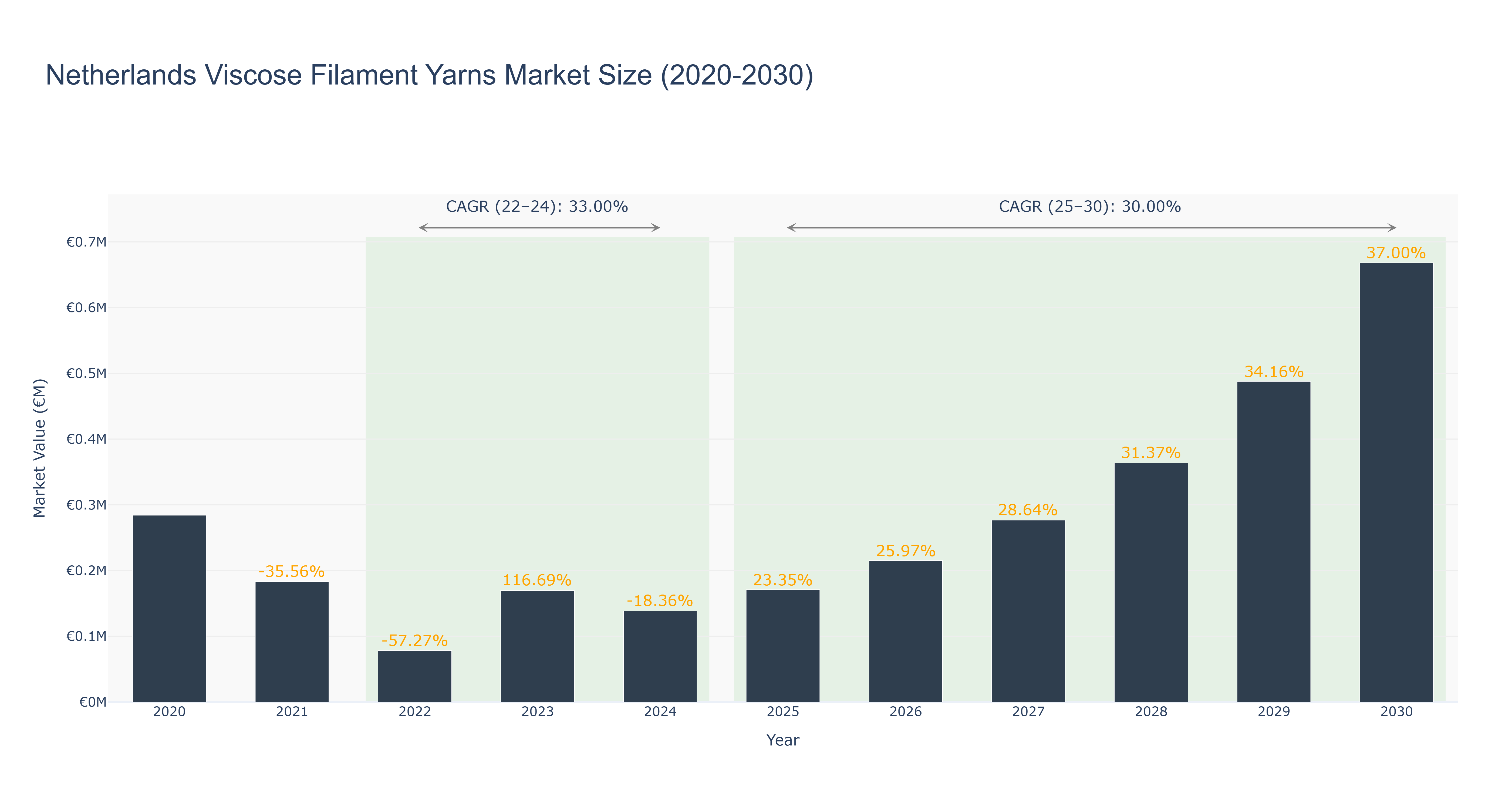
Netherlands Viscose Filament Yarns Market has shown a fluctuating trend over the past decade. The peak market size of €0.67 million was achieved in 2030, with a steady growth rate. However, the market experienced a decline from 2020 to 2022, reaching €0.08 million, attributed to economic downturns. Subsequently, the market saw a significant rebound from 2023 to 2029, driven by increased demand for sustainable textiles and technological advancements in yarn production. The forecasted market size from 2025 to 2030 is expected to maintain a healthy growth trajectory, with a CAGR of 30.0%. Recent developments indicate a shift towards eco-friendly production processes, aligning with the growing global sustainability movement. Future projects focus on enhancing production efficiency and expanding market reach through strategic partnerships with key industry players. Industry drivers include consumer preference for sustainable products and innovations in textile manufacturing techniques.
Netherlands Viscose Filament Yarns Market: Production & Trade Performance (2019-2025)
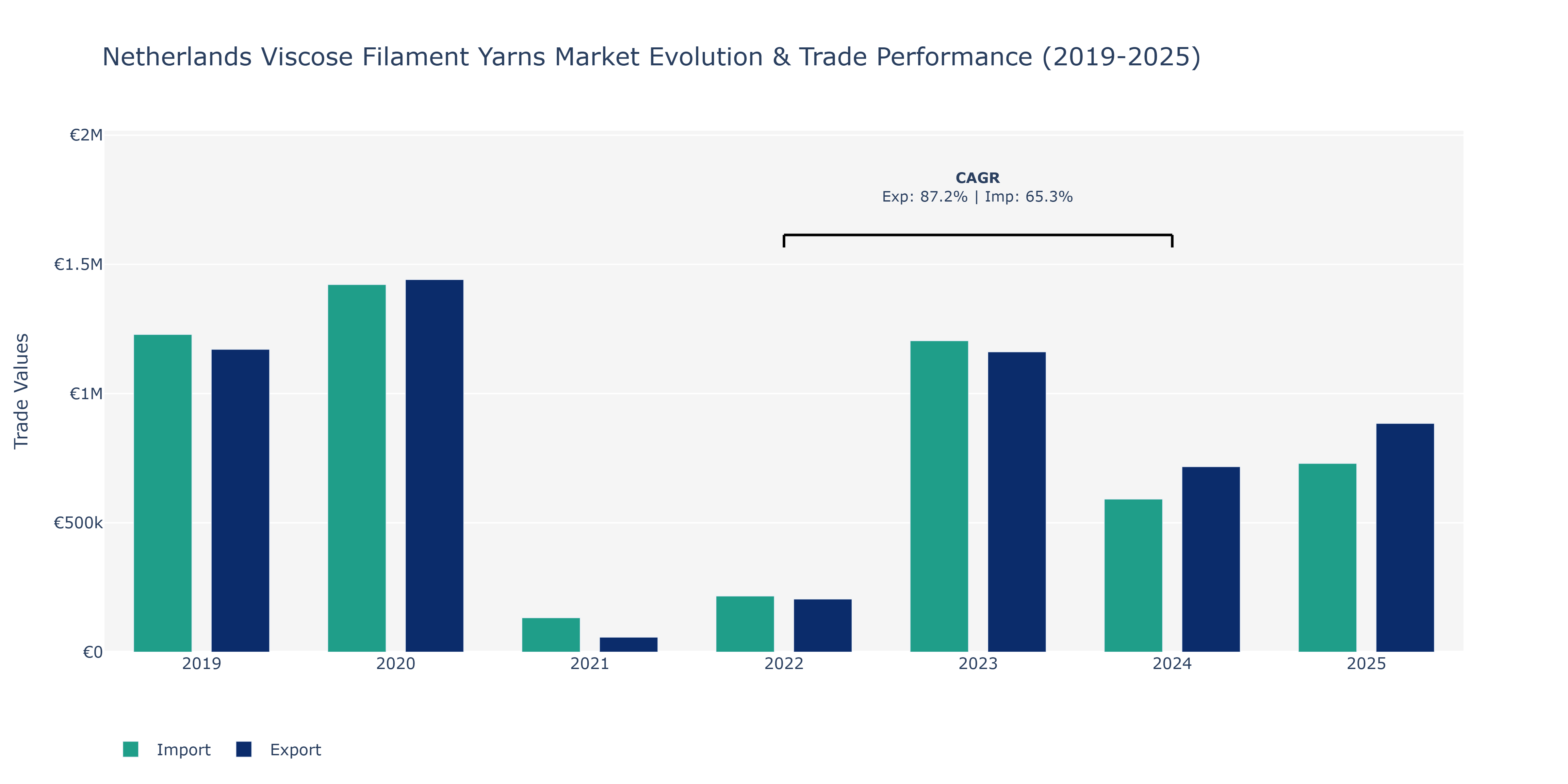
Between 2019 and 2025, the Netherlands Viscose Filament Yarns Market experienced varied trends in Exports and Imports. In 2019, Exports reached €1.17 million and Imports were slightly higher at €1.23 million. Both values saw an increase in 2020, with Exports rising to €1.44 million and Imports to €1.42 million. However, a significant drop was observed in 2021 due to potential market disruptions. Exports plummeted to €57.35 thousand, while Imports decreased to €132.24 thousand. The market rebounded in the following years with a steady increase in Exports and Imports. Notably, between 2022 and 2024, Exports grew at a high CAGR of 87.19%, reaching €716.91 thousand in 2024, while Imports had a CAGR of 65.3%, amounting to €591.5 thousand in the same year. The positive growth can be attributed to increased demand for sustainable textiles in the global market, especially in the Netherlands, where consumers are more environmentally conscious, driving the import and export of Viscose Filament Yarns.
Key Highlights of the Report:
- Netherlands Viscose Filament Yarns Market Outlook
- Market Size of Netherlands Viscose Filament Yarns Market, 2024
- Forecast of Netherlands Viscose Filament Yarns Market, 2031
- Historical Data and Forecast of Netherlands Viscose Filament Yarns Revenues & Volume for the Period 2021-2031
- Netherlands Viscose Filament Yarns Market Trend Evolution
- Netherlands Viscose Filament Yarns Market Drivers and Challenges
- Netherlands Viscose Filament Yarns Price Trends
- Netherlands Viscose Filament Yarns Porter`s Five Forces
- Netherlands Viscose Filament Yarns Industry Life Cycle
- Historical Data and Forecast of Netherlands Viscose Filament Yarns Market Revenues & Volume By Type for the Period 2021-2031
- Historical Data and Forecast of Netherlands Viscose Filament Yarns Market Revenues & Volume By Continuous for the Period 2021-2031
- Historical Data and Forecast of Netherlands Viscose Filament Yarns Market Revenues & Volume By Semi-continuous for the Period 2021-2031
- Historical Data and Forecast of Netherlands Viscose Filament Yarns Market Revenues & Volume By Application for the Period 2021-2031
- Historical Data and Forecast of Netherlands Viscose Filament Yarns Market Revenues & Volume By Garment industry for the Period 2021-2031
- Historical Data and Forecast of Netherlands Viscose Filament Yarns Market Revenues & Volume By Auto industry for the Period 2021-2031
- Historical Data and Forecast of Netherlands Viscose Filament Yarns Market Revenues & Volume By other for the Period 2021-2031
- Netherlands Viscose Filament Yarns Import Export Trade Statistics
- Market Opportunity Assessment By Type
- Market Opportunity Assessment By Application
- Netherlands Viscose Filament Yarns Top Companies Market Share
- Netherlands Viscose Filament Yarns Competitive Benchmarking By Technical and Operational Parameters
- Netherlands Viscose Filament Yarns Company Profiles
- Netherlands Viscose Filament Yarns Key Strategic Recommendations






































