New Zealand Antifreeze Market Year-wise Growth Rate (2021-2031F)
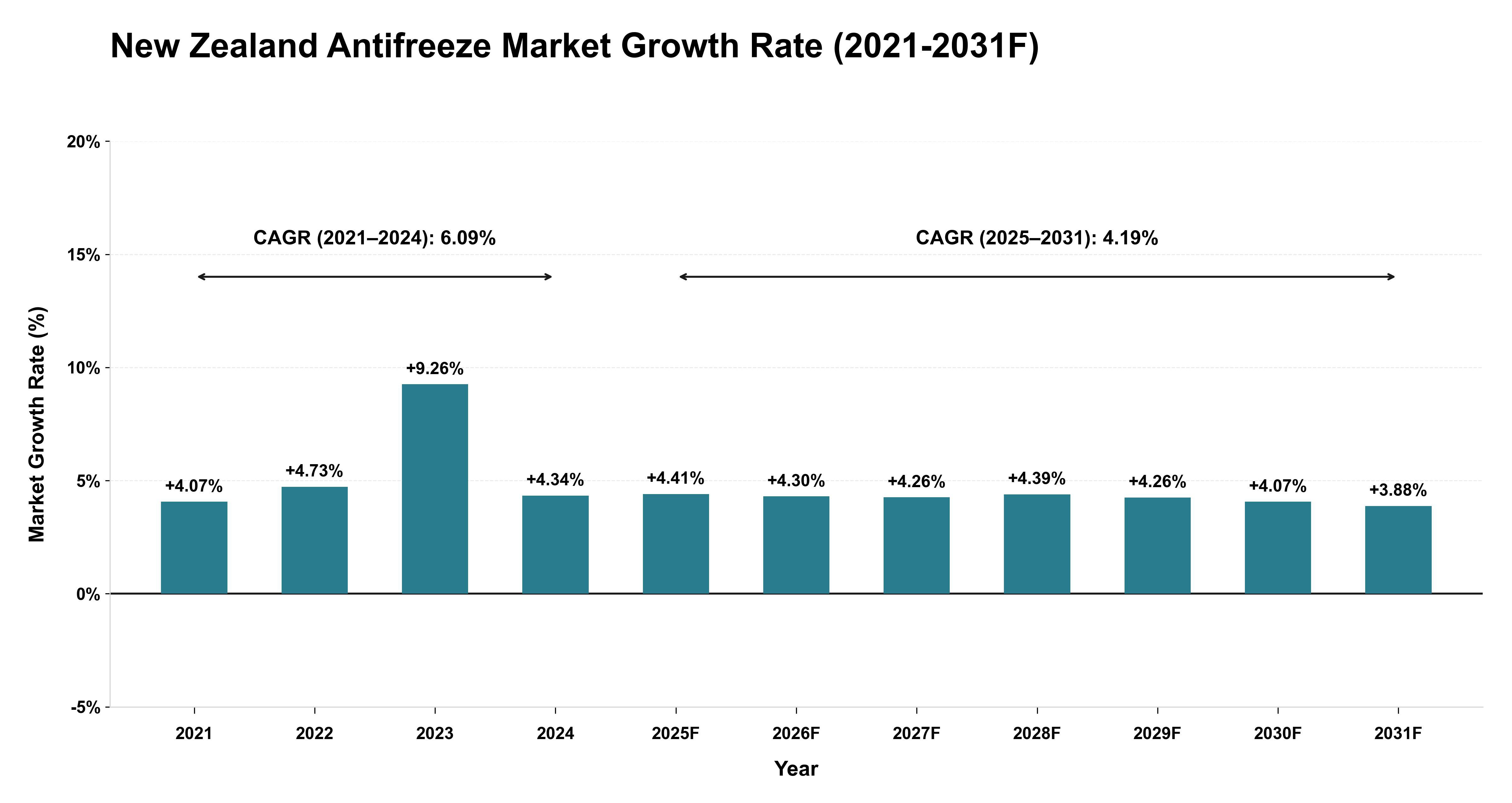
The New Zealand Antifreeze Market experienced a steady historical growth trajectory from 2021 to 2024, with fluctuating annual growth rates ranging from 4.07% to 9.26%, culminating in a CAGR of 6.09%. This period was characterized by increasing demand from end-use industries such as automotive and manufacturing, driven by technological advancements and stringent regulatory requirements promoting product efficiency. Looking ahead to the forecast period of 2025-2031, the market is expected to maintain growth, albeit at a slightly slower pace, with a forecasted CAGR of 4.19%. The deceleration in growth rates reflects a maturing market landscape, where demand stabilizes as consumer preferences and regulatory standards become more established, leading to a more sustainable growth path for the New Zealand Antifreeze Market.
Key Highlights of the Report:
- New Zealand Antifreeze Market Outlook
- Market Size of New Zealand Antifreeze Market, 2024
- Forecast of New Zealand Antifreeze Market, 2031
- Historical Data and Forecast of New Zealand Antifreeze Revenues & Volume for the Period 2021-2031
- New Zealand Antifreeze Market Trend Evolution
- New Zealand Antifreeze Market Drivers and Challenges
- New Zealand Antifreeze Price Trends
- New Zealand Antifreeze Porter`s Five Forces
- New Zealand Antifreeze Industry Life Cycle
- Historical Data and Forecast of New Zealand Antifreeze Market Revenues & Volume By Product for the Period 2021-2031
- Historical Data and Forecast of New Zealand Antifreeze Market Revenues & Volume By Ethylene Glycol for the Period 2021-2031
- Historical Data and Forecast of New Zealand Antifreeze Market Revenues & Volume By Propylene Glycol for the Period 2021-2031
- Historical Data and Forecast of New Zealand Antifreeze Market Revenues & Volume By Glycerine for the Period 2021-2031
- Historical Data and Forecast of New Zealand Antifreeze Market Revenues & Volume By Application for the Period 2021-2031
- Historical Data and Forecast of New Zealand Antifreeze Market Revenues & Volume By Automotive for the Period 2021-2031
- Historical Data and Forecast of New Zealand Antifreeze Market Revenues & Volume By Aerospace for the Period 2021-2031
- Historical Data and Forecast of New Zealand Antifreeze Market Revenues & Volume By Industrial heat transfer and cooling applications for the Period 2021-2031
- Historical Data and Forecast of New Zealand Antifreeze Market Revenues & Volume By Technology for the Period 2021-2031
- Historical Data and Forecast of New Zealand Antifreeze Market Revenues & Volume By OAT for the Period 2021-2031
- Historical Data and Forecast of New Zealand Antifreeze Market Revenues & Volume By HOAT for the Period 2021-2031
- Historical Data and Forecast of New Zealand Antifreeze Market Revenues & Volume By IAT for the Period 2021-2031
- New Zealand Antifreeze Import Export Trade Statistics
- Market Opportunity Assessment By Product
- Market Opportunity Assessment By Application
- Market Opportunity Assessment By Technology
- New Zealand Antifreeze Top Companies Market Share
- New Zealand Antifreeze Competitive Benchmarking By Technical and Operational Parameters
- New Zealand Antifreeze Company Profiles
- New Zealand Antifreeze Key Strategic Recommendations






































