New Zealand Aromatic Compounds Market Top 5 Importing Countries and Market Competition (HHI) Analysis
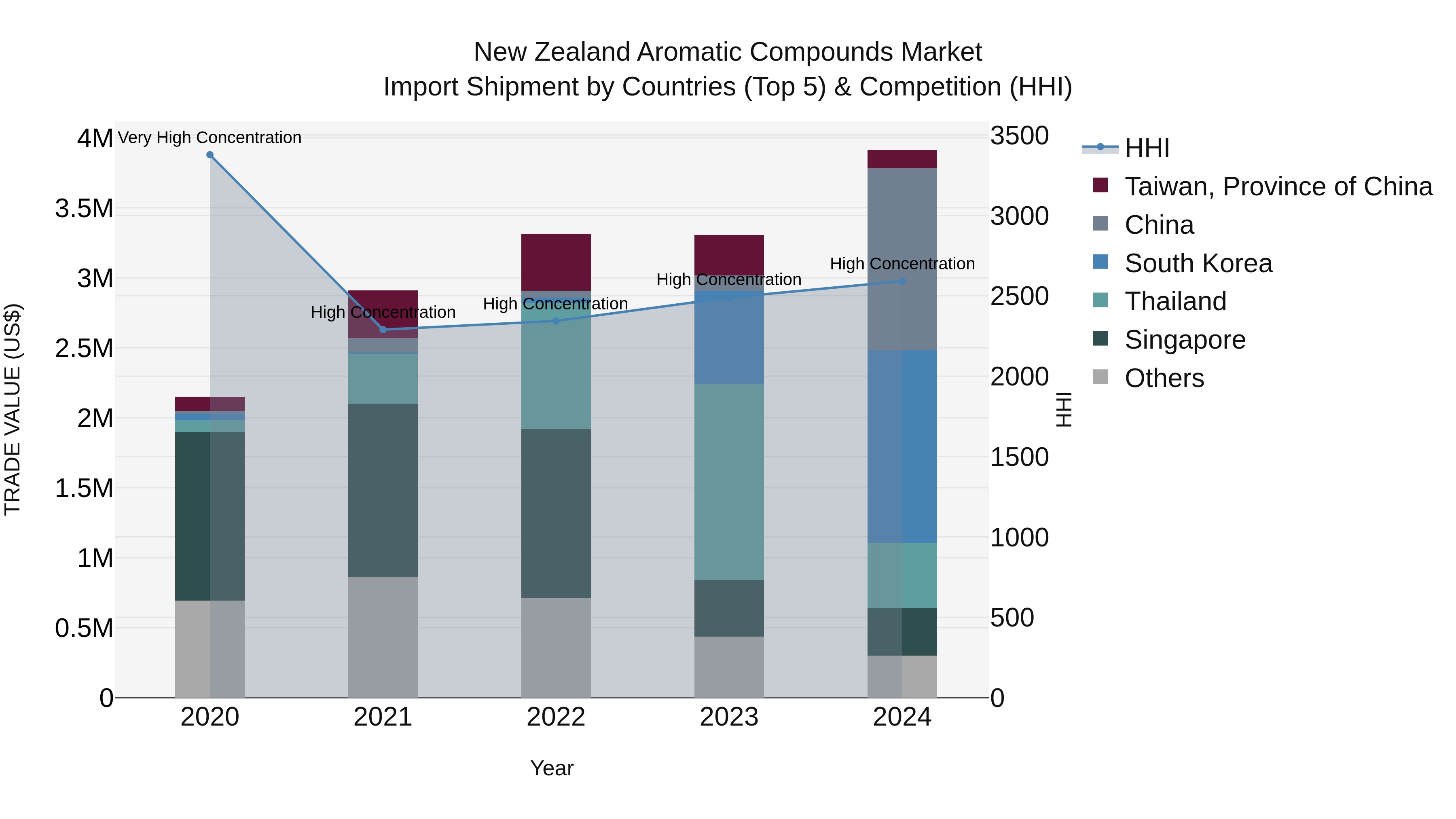
The New Zealand aromatic compounds import market continues to show robust growth, with a notable CAGR of 16.14% from 2020 to 2024. In 2024, top exporters to New Zealand include South Korea, China, Thailand, Singapore, and the Netherlands, indicating a diverse range of sources. Despite this diversity, the market remains concentrated, as evidenced by the high Herfindahl-Hirschman Index (HHI). The impressive growth rate of 18.38% in 2024 highlights the strong demand for aromatic compounds in New Zealand, signaling opportunities for both domestic and international suppliers.
Key Highlights of the Report:
- New Zealand Aromatic Compounds Market Outlook
- Market Size of New Zealand Aromatic Compounds Market, 2025
- Forecast of New Zealand Aromatic Compounds Market, 2032
- Historical Data and Forecast of New Zealand Aromatic Compounds Revenues & Volume for the Period 2022 - 2032F
- New Zealand Aromatic Compounds Market Trend Evolution
- New Zealand Aromatic Compounds Market Drivers and Challenges
- New Zealand Aromatic Compounds Price Trends
- New Zealand Aromatic Compounds Porter`s Five Forces
- New Zealand Aromatic Compounds Industry Life Cycle
- Historical Data and Forecast of New Zealand Aromatic Compounds Market Revenues & Volume By Type for the Period 2022 - 2032F
- Historical Data and Forecast of New Zealand Aromatic Compounds Market Revenues & Volume By Benzene for the Period 2022 - 2032F
- Historical Data and Forecast of New Zealand Aromatic Compounds Market Revenues & Volume By Xylene for the Period 2022 - 2032F
- Historical Data and Forecast of New Zealand Aromatic Compounds Market Revenues & Volume By Toluene for the Period 2022 - 2032F
- Historical Data and Forecast of New Zealand Aromatic Compounds Market Revenues & Volume By Application for the Period 2022 - 2032F
- Historical Data and Forecast of New Zealand Aromatic Compounds Market Revenues & Volume By Solvent for the Period 2022 - 2032F
- Historical Data and Forecast of New Zealand Aromatic Compounds Market Revenues & Volume By Additive for the Period 2022 - 2032F
- Historical Data and Forecast of New Zealand Aromatic Compounds Market Revenues & Volume By End-use for the Period 2022 - 2032F
- Historical Data and Forecast of New Zealand Aromatic Compounds Market Revenues & Volume By Packaging for the Period 2022 - 2032F
- Historical Data and Forecast of New Zealand Aromatic Compounds Market Revenues & Volume By Detergent And Dyes for the Period 2022 - 2032F
- Historical Data and Forecast of New Zealand Aromatic Compounds Market Revenues & Volume By Automobile for the Period 2022 - 2032F
- Historical Data and Forecast of New Zealand Aromatic Compounds Market Revenues & Volume By Electronic Devices for the Period 2022 - 2032F
- Historical Data and Forecast of New Zealand Aromatic Compounds Market Revenues & Volume By Medical Devices for the Period 2022 - 2032F
- Historical Data and Forecast of New Zealand Aromatic Compounds Market Revenues & Volume By Pharmaceuticals for the Period 2022 - 2032F
- Historical Data and Forecast of New Zealand Aromatic Compounds Market Revenues & Volume By Gasoline for the Period 2022 - 2032F
- Historical Data and Forecast of New Zealand Aromatic Compounds Market Revenues & Volume By Tire for the Period 2022 - 2032F
- New Zealand Aromatic Compounds Import Export Trade Statistics
- Market Opportunity Assessment By Type
- Market Opportunity Assessment By Application
- Market Opportunity Assessment By End-use
- New Zealand Aromatic Compounds Top Companies Market Share
- New Zealand Aromatic Compounds Competitive Benchmarking By Technical and Operational Parameters
- New Zealand Aromatic Compounds Company Profiles
- New Zealand Aromatic Compounds Key Strategic Recommendations






































