New Zealand Automotive Wheel Market Top 5 Importing Countries and Market Competition (HHI) Analysis
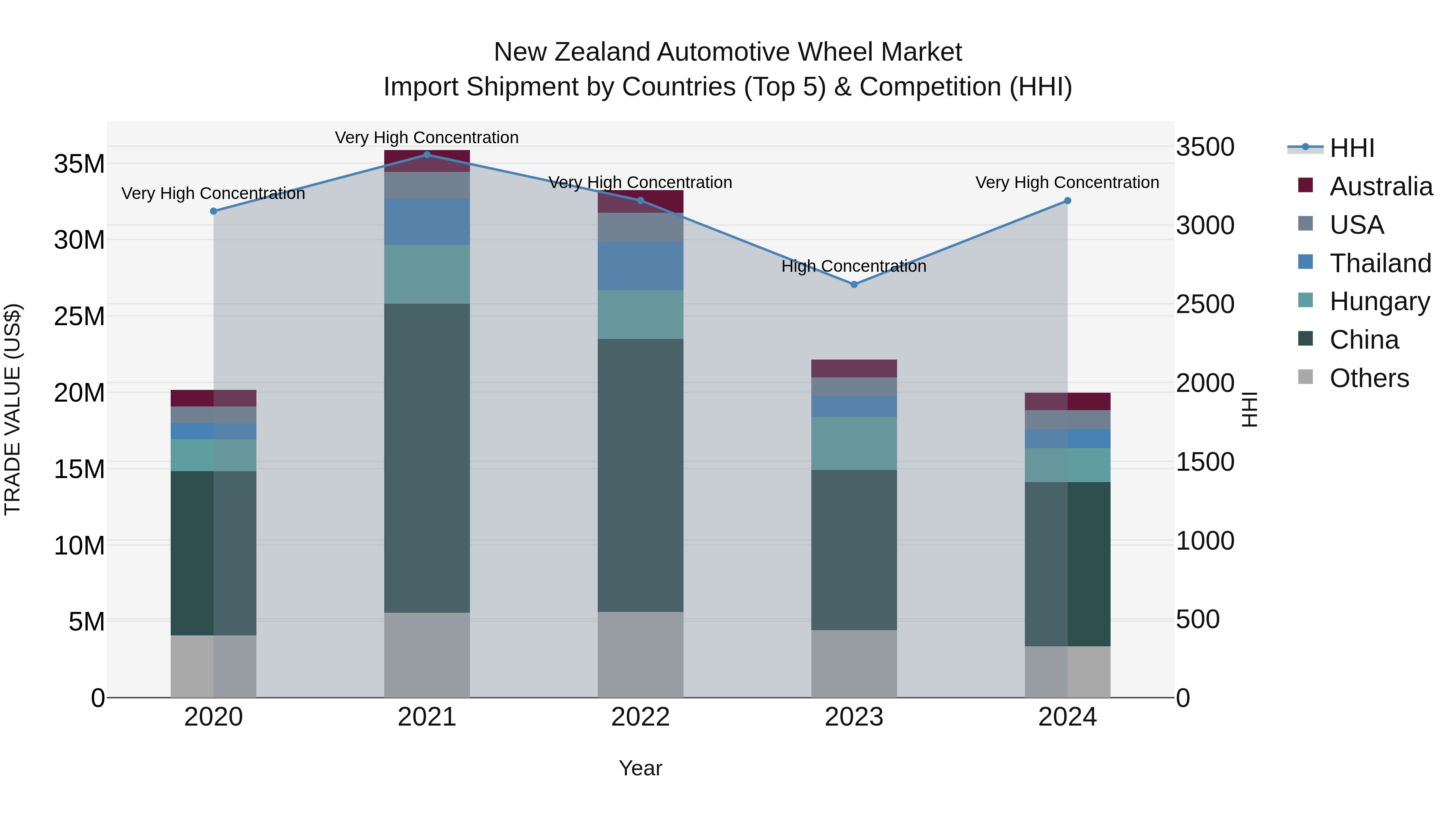
In 2024, New Zealand saw a notable shift in its automotive wheel import landscape, with China, Hungary, Thailand, USA, and Australia emerging as top exporting countries. The market experienced a significant increase in concentration levels, indicating heightened competition among suppliers. Despite a negative Compound Annual Growth Rate (CAGR) from 2020 to 2024, the industry witnessed a sharp decline in growth rate from 2023 to 2024. This data suggests a challenging operating environment for automotive wheel importers in New Zealand, emphasizing the importance of strategic planning and adaptability in the face of evolving market dynamics.
Key Highlights of the Report:
- New Zealand Automotive Wheel Market Outlook
- Market Size of New Zealand Automotive Wheel Market, 2025
- Forecast of New Zealand Automotive Wheel Market, 2032
- Historical Data and Forecast of New Zealand Automotive Wheel Revenues & Volume for the Period 2022 - 2032F
- New Zealand Automotive Wheel Market Trend Evolution
- New Zealand Automotive Wheel Market Drivers and Challenges
- New Zealand Automotive Wheel Price Trends
- New Zealand Automotive Wheel Porter`s Five Forces
- New Zealand Automotive Wheel Industry Life Cycle
- Historical Data and Forecast of New Zealand Automotive Wheel Market Revenues & Volume By Rim Size for the Period 2022 - 2032F
- Historical Data and Forecast of New Zealand Automotive Wheel Market Revenues & Volume By 13-15 for the Period 2022 - 2032F
- Historical Data and Forecast of New Zealand Automotive Wheel Market Revenues & Volume By 16-18 for the Period 2022 - 2032F
- Historical Data and Forecast of New Zealand Automotive Wheel Market Revenues & Volume By 19-21 for the Period 2022 - 2032F
- Historical Data and Forecast of New Zealand Automotive Wheel Market Revenues & Volume By >21 inch for the Period 2022 - 2032F
- Historical Data and Forecast of New Zealand Automotive Wheel Market Revenues & Volume By Material for the Period 2022 - 2032F
- Historical Data and Forecast of New Zealand Automotive Wheel Market Revenues & Volume By Steel for the Period 2022 - 2032F
- Historical Data and Forecast of New Zealand Automotive Wheel Market Revenues & Volume By Alloy for the Period 2022 - 2032F
- Historical Data and Forecast of New Zealand Automotive Wheel Market Revenues & Volume By Carbon Fiber for the Period 2022 - 2032F
- Historical Data and Forecast of New Zealand Automotive Wheel Market Revenues & Volume By Off-highway for the Period 2022 - 2032F
- Historical Data and Forecast of New Zealand Automotive Wheel Market Revenues & Volume By Construction & Mining for the Period 2022 - 2032F
- Historical Data and Forecast of New Zealand Automotive Wheel Market Revenues & Volume By Agriculture Tractors for the Period 2022 - 2032F
- New Zealand Automotive Wheel Import Export Trade Statistics
- Market Opportunity Assessment By Rim Size
- Market Opportunity Assessment By Material
- Market Opportunity Assessment By Off-highway
- New Zealand Automotive Wheel Top Companies Market Share
- New Zealand Automotive Wheel Competitive Benchmarking By Technical and Operational Parameters
- New Zealand Automotive Wheel Company Profiles
- New Zealand Automotive Wheel Key Strategic Recommendations






































