New Zealand Breakfast Cereal Market Year-wise Growth Rate (2021-2031F)
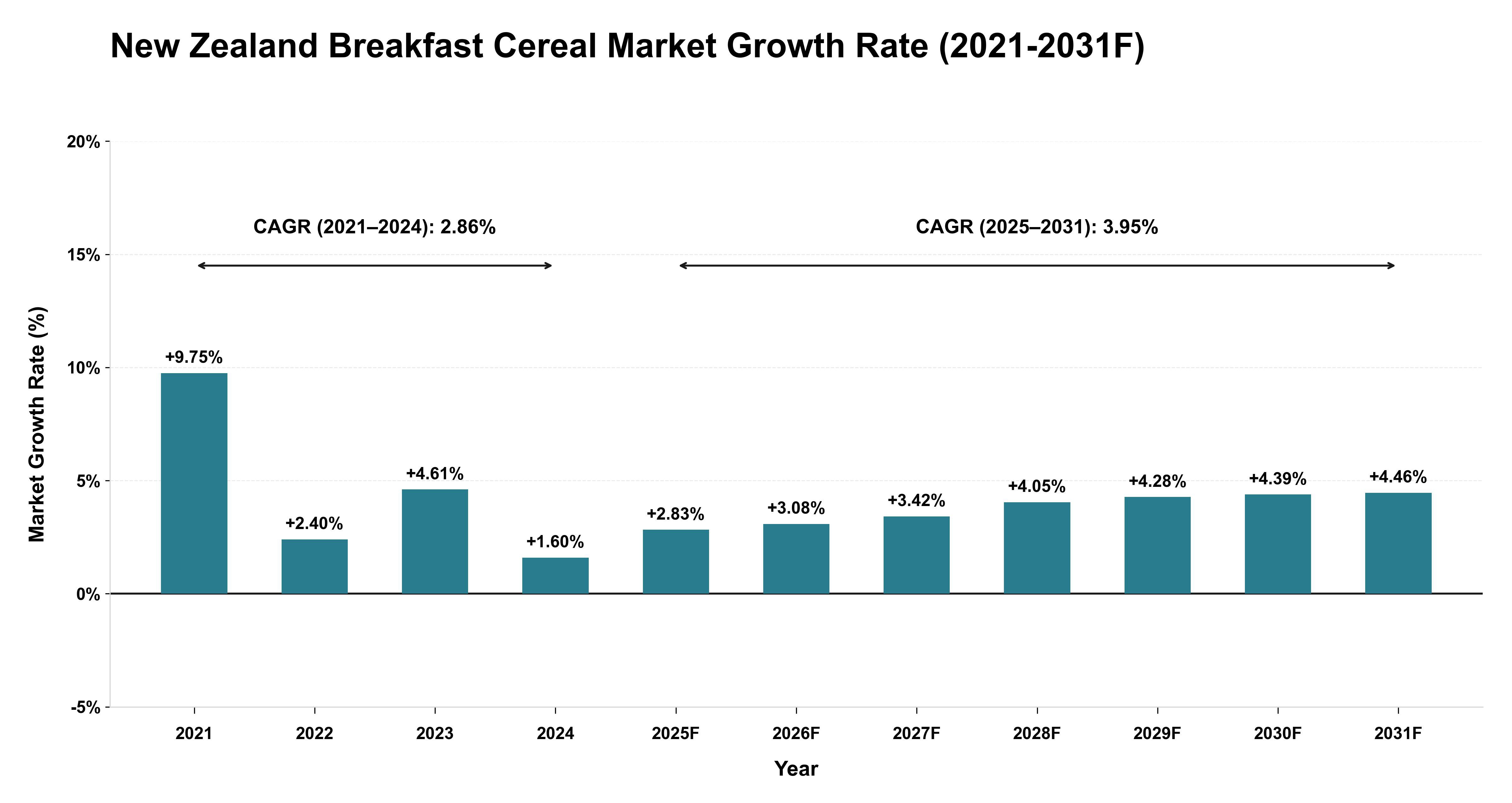
The New Zealand Breakfast Cereal Market experienced fluctuating growth rates from 2021 to 2024, starting strong at 9.75% in 2021, then slowing down in 2022 to 2.40%, picking up again in 2023 at 4.61%, and finally tapering off to 1.60% in 2024. These variations suggest changing consumer preferences, potentially influenced by health trends or marketing strategies. Looking ahead to the forecast period of 2025-2031, a more stable growth trend is expected with a CAGR of 3.95%. This forecast indicates a gradual acceleration compared to the historical period, reflecting potential market expansion through product innovation, targeted advertising, or increased health awareness driving sustained demand for breakfast cereals in New Zealand.
Key Highlights of the Report:
- New Zealand Breakfast Cereal Market Outlook
- Market Size of New Zealand Breakfast Cereal Market, 2025
- Forecast of New Zealand Breakfast Cereal Market, 2032
- Historical Data and Forecast of New Zealand Breakfast Cereal Revenues & Volume for the Period 2022 - 2032F
- New Zealand Breakfast Cereal Market Trend Evolution
- New Zealand Breakfast Cereal Market Drivers and Challenges
- New Zealand Breakfast Cereal Price Trends
- New Zealand Breakfast Cereal Porter`s Five Forces
- New Zealand Breakfast Cereal Industry Life Cycle
- Historical Data and Forecast of New Zealand Breakfast Cereal Market Revenues & Volume By Product Type for the Period 2022 - 2032F
- Historical Data and Forecast of New Zealand Breakfast Cereal Market Revenues & Volume By Hot Cereal for the Period 2022 - 2032F
- Historical Data and Forecast of New Zealand Breakfast Cereal Market Revenues & Volume By RTE for the Period 2022 - 2032F
- Historical Data and Forecast of New Zealand Breakfast Cereal Market Revenues & Volume By Distribution Channel for the Period 2022 - 2032F
- Historical Data and Forecast of New Zealand Breakfast Cereal Market Revenues & Volume By Supermarket for the Period 2022 - 2032F
- Historical Data and Forecast of New Zealand Breakfast Cereal Market Revenues & Volume By Convenience Stores for the Period 2022 - 2032F
- Historical Data and Forecast of New Zealand Breakfast Cereal Market Revenues & Volume By E-Commerce for the Period 2022 - 2032F
- Historical Data and Forecast of New Zealand Breakfast Cereal Market Revenues & Volume By Others for the Period 2022 - 2032F
- New Zealand Breakfast Cereal Import Export Trade Statistics
- Market Opportunity Assessment By Product Type
- Market Opportunity Assessment By Distribution Channel
- New Zealand Breakfast Cereal Top Companies Market Share
- New Zealand Breakfast Cereal Competitive Benchmarking By Technical and Operational Parameters
- New Zealand Breakfast Cereal Company Profiles
- New Zealand Breakfast Cereal Key Strategic Recommendations






































