New Zealand Butadiene Market Year-wise Growth Rate (2021-2031F)
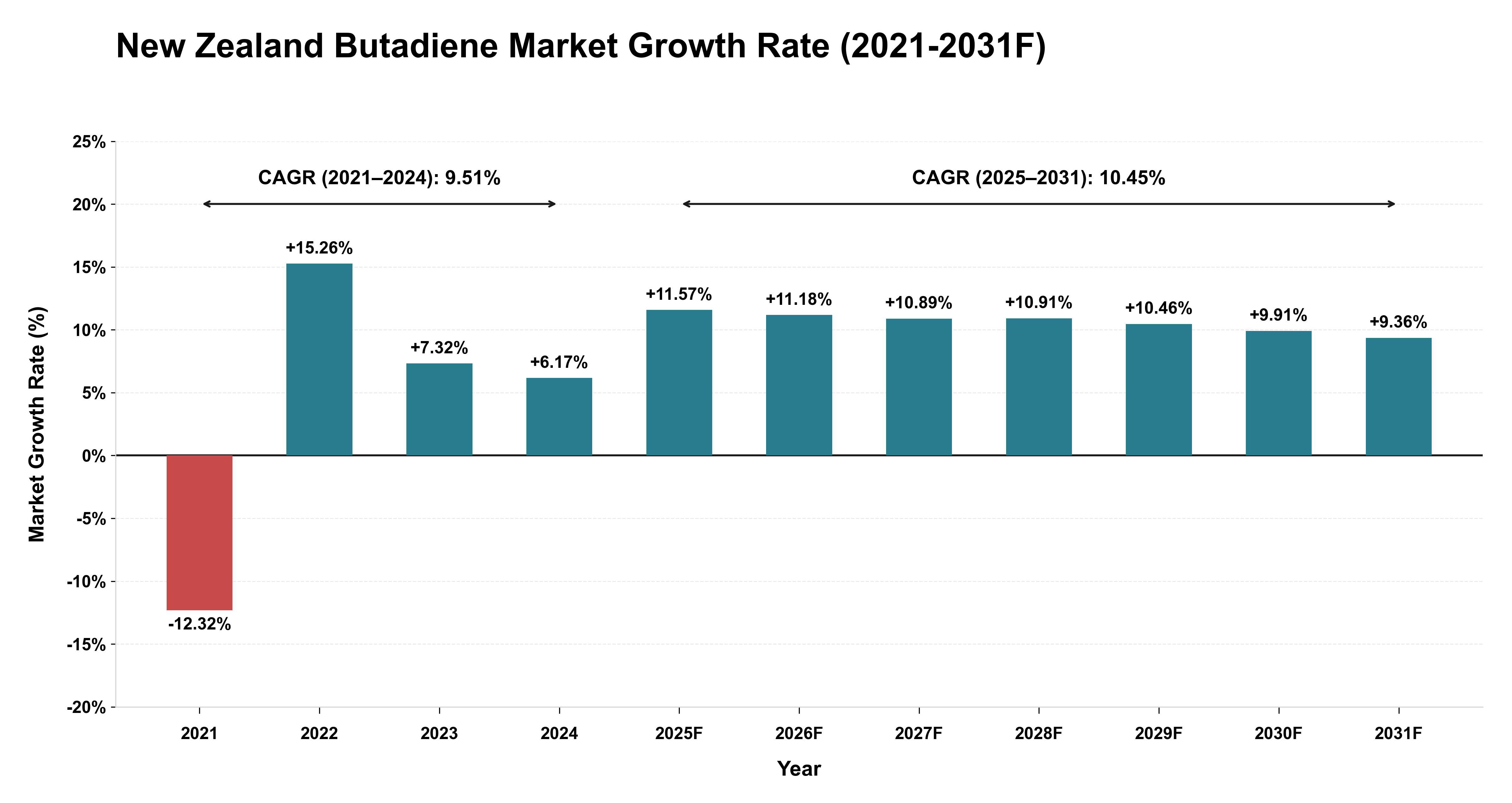
The New Zealand Butadiene Market experienced a tumultuous period from 2021 to 2024, with a sharp decline in growth of -12.32% in 2021, followed by a significant rebound of 15.26% in 2022 as demand surged. Subsequently, growth stabilized at 7.32% in 2023 and further increased to 6.17% in 2024 as supply chain disruptions eased. Looking ahead to the forecast period of 2025-2031, the market is expected to maintain a robust growth trajectory with an annual CAGR of 10.45%. This acceleration is supported by consistent growth rates ranging from 10.89% to 11.57% during the initial years of the forecast period, indicating sustained demand from end-use industries and technological advancements driving efficiency in production processes.
Key Highlights of the Report:
- New Zealand Butadiene Market Outlook
- Market Size of New Zealand Butadiene Market, 2024
- Forecast of New Zealand Butadiene Market, 2031
- Historical Data and Forecast of New Zealand Butadiene Revenues & Volume for the Period 2021-2031
- New Zealand Butadiene Market Trend Evolution
- New Zealand Butadiene Market Drivers and Challenges
- New Zealand Butadiene Price Trends
- New Zealand Butadiene Porter`s Five Forces
- New Zealand Butadiene Industry Life Cycle
- Historical Data and Forecast of New Zealand Butadiene Market Revenues & Volume By Application Type for the Period 2021-2031
- Historical Data and Forecast of New Zealand Butadiene Market Revenues & Volume By Butadiene Rubber for the Period 2021-2031
- Historical Data and Forecast of New Zealand Butadiene Market Revenues & Volume By Styrene Butadiene Rubber for the Period 2021-2031
- Historical Data and Forecast of New Zealand Butadiene Market Revenues & Volume By Acrylonitrile Butadiene Rubber for the Period 2021-2031
- Historical Data and Forecast of New Zealand Butadiene Market Revenues & Volume By Nitrile Butadiene Rubber for the Period 2021-2031
- Historical Data and Forecast of New Zealand Butadiene Market Revenues & Volume By Styrene Butadiene Latex for the Period 2021-2031
- Historical Data and Forecast of New Zealand Butadiene Market Revenues & Volume By Hexamethylenediamine for the Period 2021-2031
- Historical Data and Forecast of New Zealand Butadiene Market Revenues & Volume By Others for the Period 2021-2031
- Historical Data and Forecast of New Zealand Butadiene Market Revenues & Volume By End Use Type for the Period 2021-2031
- Historical Data and Forecast of New Zealand Butadiene Market Revenues & Volume By Plastic and Polymer for the Period 2021-2031
- Historical Data and Forecast of New Zealand Butadiene Market Revenues & Volume By Tire and Rubber for the Period 2021-2031
- Historical Data and Forecast of New Zealand Butadiene Market Revenues & Volume By Automobile for the Period 2021-2031
- Historical Data and Forecast of New Zealand Butadiene Market Revenues & Volume By Chemical for the Period 2021-2031
- Historical Data and Forecast of New Zealand Butadiene Market Revenues & Volume By Others for the Period 2021-2031
- New Zealand Butadiene Import Export Trade Statistics
- Market Opportunity Assessment By Application Type
- Market Opportunity Assessment By End Use Type
- New Zealand Butadiene Top Companies Market Share
- New Zealand Butadiene Competitive Benchmarking By Technical and Operational Parameters
- New Zealand Butadiene Company Profiles
- New Zealand Butadiene Key Strategic Recommendations






































