New Zealand Cables Market Growth Rate Analysis (2025 - 2031)
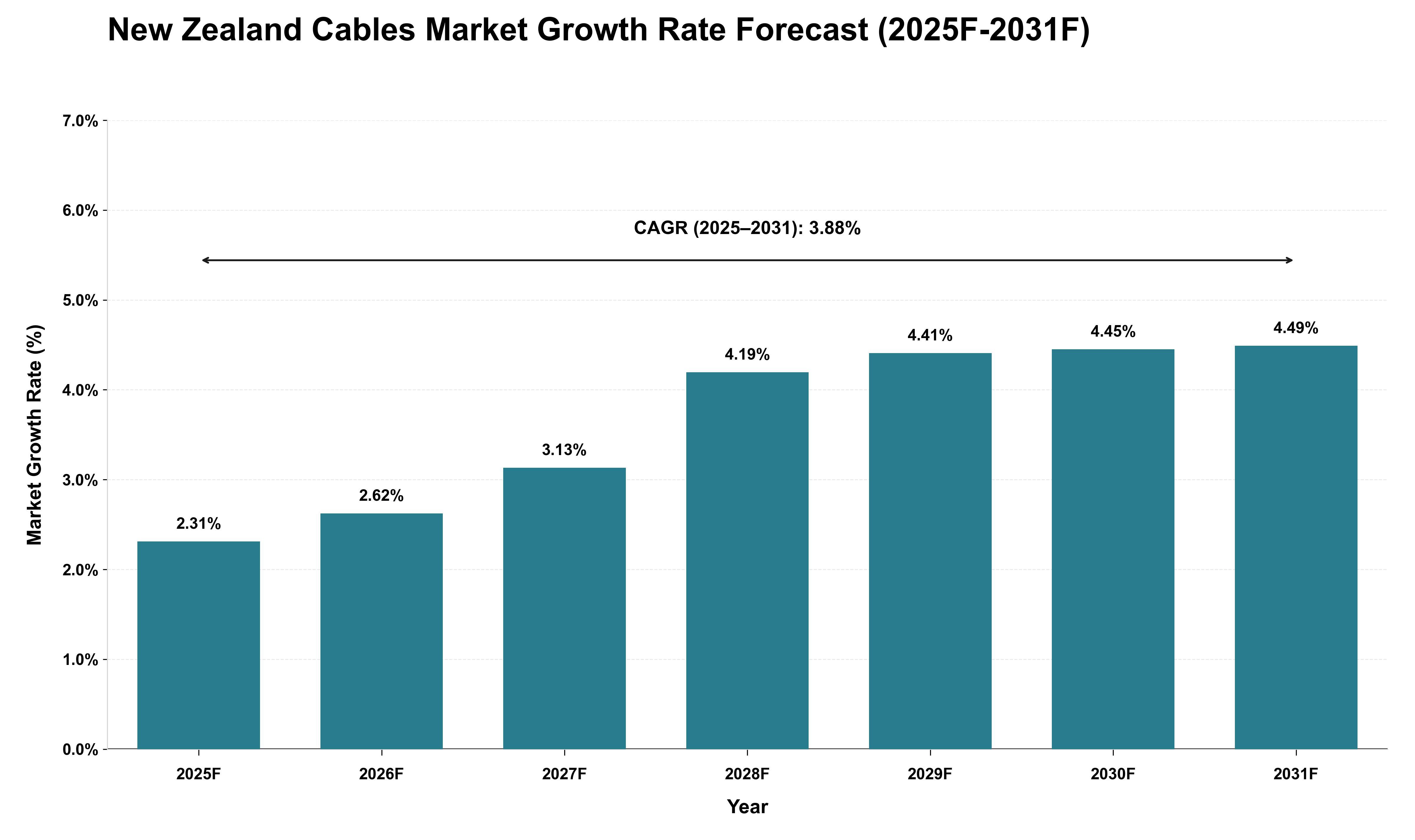
The New Zealand cables market will experience a notable evolution driven by shifts in supply chain dynamics and input costs over the 2025-2031 period. As global demand for electrical infrastructure and renewable energy solutions escalates, the market will likely see an annual growth trajectory beginning at 2.31% in 2025 and accelerating to approximately 4.49% by 2031, reflecting a compound annual growth rate of 3.88%. This growth will be influenced by rising raw material prices, particularly copper and aluminum, which are critical inputs for cable manufacturing. Additionally, New Zealand's reliance on imports for these materials may introduce volatility in pricing and availability, impacting production costs. The anticipated increase in construction activities and infrastructure projects will further drive demand, necessitating adaptive supply chain strategies to mitigate potential disruptions while capitalizing on cyclical trends within the industry.
Key Highlights of the Report:
- New Zealand Cables Market Outlook
- Market Size of New Zealand Cables Market, 2024
- Forecast of New Zealand Cables Market, 2031
- Historical Data and Forecast of New Zealand Cables Revenues & Volume for the Period 2021-2031
- New Zealand Cables Market Trend Evolution
- New Zealand Cables Market Drivers and Challenges
- New Zealand Cables Price Trends
- New Zealand Cables Porter`s Five Forces
- New Zealand Cables Industry Life Cycle
- Historical Data and Forecast of New Zealand Cables Market Revenues & Volume By Installation Type for the Period 2021-2031
- Historical Data and Forecast of New Zealand Cables Market Revenues & Volume By Overhead for the Period 2021-2031
- Historical Data and Forecast of New Zealand Cables Market Revenues & Volume By Underground for the Period 2021-2031
- Historical Data and Forecast of New Zealand Cables Market Revenues & Volume By Submarine for the Period 2021-2031
- Historical Data and Forecast of New Zealand Cables Market Revenues & Volume By Voltage Type for the Period 2021-2031
- Historical Data and Forecast of New Zealand Cables Market Revenues & Volume By High for the Period 2021-2031
- Historical Data and Forecast of New Zealand Cables Market Revenues & Volume By Medium for the Period 2021-2031
- Historical Data and Forecast of New Zealand Cables Market Revenues & Volume By Low for the Period 2021-2031
- Historical Data and Forecast of New Zealand Cables Market Revenues & Volume By End Use for the Period 2021-2031
- Historical Data and Forecast of New Zealand Cables Market Revenues & Volume By Industrial for the Period 2021-2031
- Historical Data and Forecast of New Zealand Cables Market Revenues & Volume By Aerospace and Defense for the Period 2021-2031
- Historical Data and Forecast of New Zealand Cables Market Revenues & Volume By Oil and Gas for the Period 2021-2031
- Historical Data and Forecast of New Zealand Cables Market Revenues & Volume By Energy and Power for the Period 2021-2031
- Historical Data and Forecast of New Zealand Cables Market Revenues & Volume By IT and Telecommunication for the Period 2021-2031
- Historical Data and Forecast of New Zealand Cables Market Revenues & Volume By Others for the Period 2021-2031
- New Zealand Cables Import Export Trade Statistics
- New Zealand Cables Top Companies Market Share
- New Zealand Cables Competitive Benchmarking By Technical and Operational Parameters
- New Zealand Cables Company Profiles
- New Zealand Cables Key Strategic Recommendations






































