New Zealand Chlorobenzene Market Top 5 Importing Countries and Market Competition (HHI) Analysis
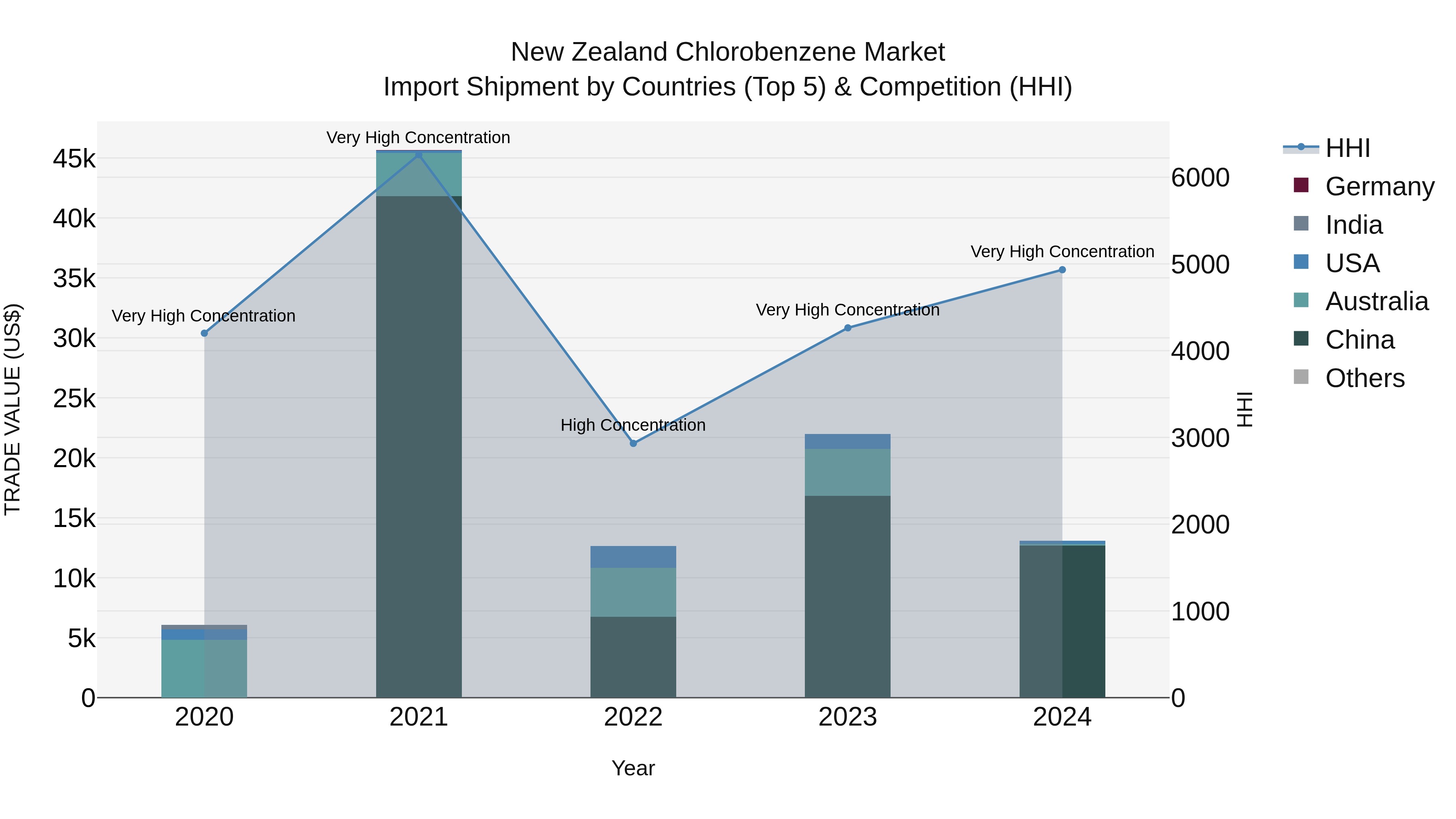
The chlorobenzene import market in New Zealand saw significant growth between 2020-2024 with a robust CAGR of 21.14%. However, the growth rate experienced a sharp decline of -40.44% in 2024. Top exporting countries to New Zealand in 2024 were China, USA, Australia, Germany, and India, indicating a diverse source of imports. Despite this diversity, the market concentration, as measured by the HHI, remained very high in 2024. This suggests a need for market players to closely monitor and adapt to changing dynamics in the chlorobenzene import market in New Zealand.
Key Highlights of the Report:
- New Zealand Chlorobenzene Market Outlook
- Market Size of New Zealand Chlorobenzene Market, 2025
- Forecast of New Zealand Chlorobenzene Market, 2032
- Historical Data and Forecast of New Zealand Chlorobenzene Revenues & Volume for the Period 2022 - 2032F
- New Zealand Chlorobenzene Market Trend Evolution
- New Zealand Chlorobenzene Market Drivers and Challenges
- New Zealand Chlorobenzene Price Trends
- New Zealand Chlorobenzene Porter`s Five Forces
- New Zealand Chlorobenzene Industry Life Cycle
- Historical Data and Forecast of New Zealand Chlorobenzene Market Revenues & Volume By Type for the Period 2022 - 2032F
- Historical Data and Forecast of New Zealand Chlorobenzene Market Revenues & Volume By Monochlorobenzene for the Period 2022 - 2032F
- Historical Data and Forecast of New Zealand Chlorobenzene Market Revenues & Volume By o-dichlorobenzene for the Period 2022 - 2032F
- Historical Data and Forecast of New Zealand Chlorobenzene Market Revenues & Volume By p-dichlorobenzene for the Period 2022 - 2032F
- Historical Data and Forecast of New Zealand Chlorobenzene Market Revenues & Volume By m-Dichlorobenzene for the Period 2022 - 2032F
- Historical Data and Forecast of New Zealand Chlorobenzene Market Revenues & Volume By Other Types for the Period 2022 - 2032F
- Historical Data and Forecast of New Zealand Chlorobenzene Market Revenues & Volume By Application for the Period 2022 - 2032F
- Historical Data and Forecast of New Zealand Chlorobenzene Market Revenues & Volume By Moth Control for the Period 2022 - 2032F
- Historical Data and Forecast of New Zealand Chlorobenzene Market Revenues & Volume By Nitrochlorobenzenes for the Period 2022 - 2032F
- Historical Data and Forecast of New Zealand Chlorobenzene Market Revenues & Volume By Polyphenylene Sulfide for the Period 2022 - 2032F
- Historical Data and Forecast of New Zealand Chlorobenzene Market Revenues & Volume By Polysulfone Polymers for the Period 2022 - 2032F
- Historical Data and Forecast of New Zealand Chlorobenzene Market Revenues & Volume By Solvents for the Period 2022 - 2032F
- Historical Data and Forecast of New Zealand Chlorobenzene Market Revenues & Volume By Room and Sanitary Deodorants for the Period 2022 - 2032F
- Historical Data and Forecast of New Zealand Chlorobenzene Market Revenues & Volume By Other Applications for the Period 2022 - 2032F
- New Zealand Chlorobenzene Import Export Trade Statistics
- Market Opportunity Assessment By Type
- Market Opportunity Assessment By Application
- New Zealand Chlorobenzene Top Companies Market Share
- New Zealand Chlorobenzene Competitive Benchmarking By Technical and Operational Parameters
- New Zealand Chlorobenzene Company Profiles
- New Zealand Chlorobenzene Key Strategic Recommendations






































