New Zealand Cocoa and Chocolate Market Year-wise Growth Rate (2021-2031F)
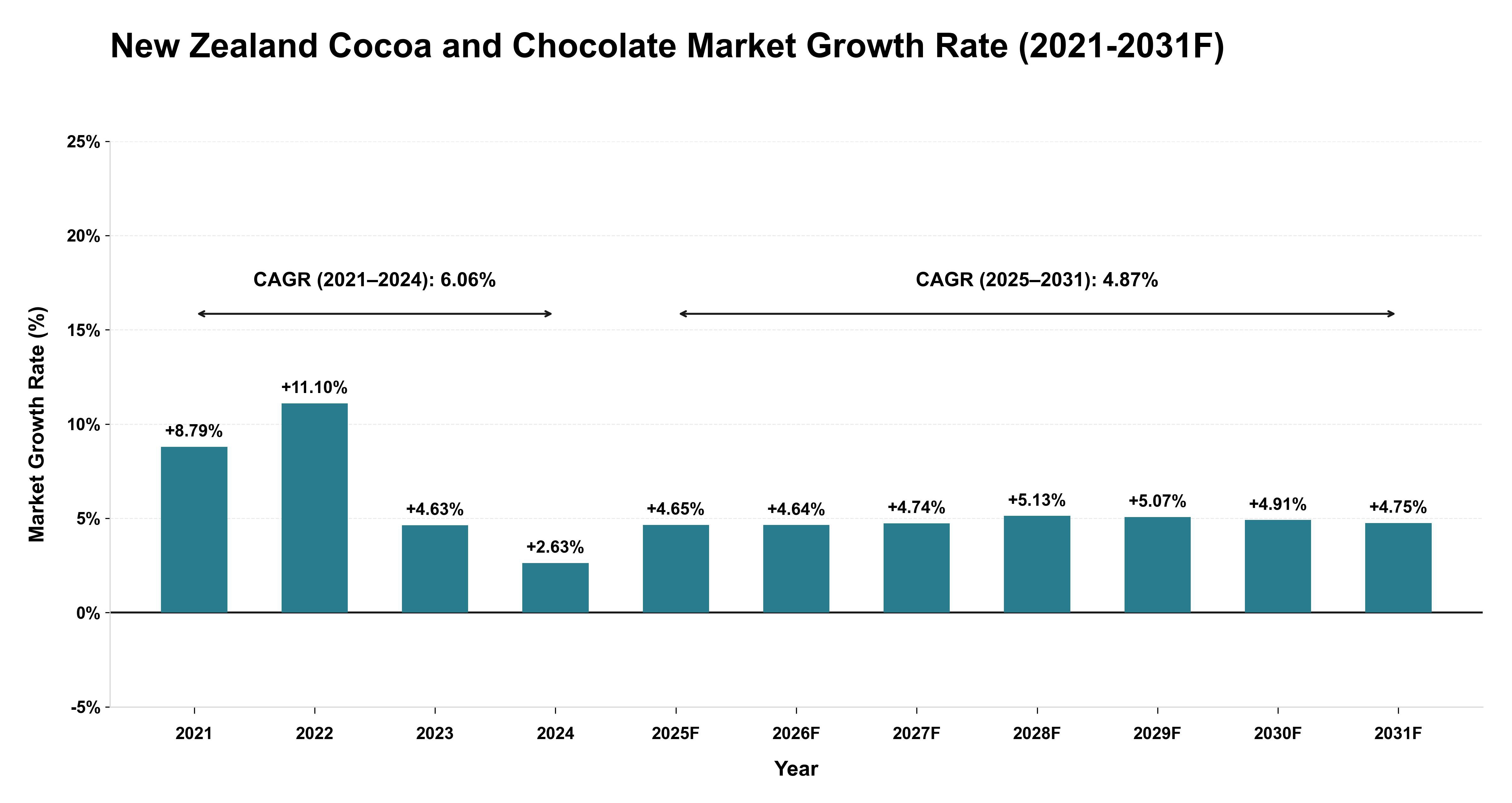
The New Zealand Cocoa and Chocolate Market experienced robust growth from 2021 to 2024, with an accelerating trend in the first two years driven by increasing consumer demand for premium and artisanal chocolate products, supported by a growing trend towards indulgent experiences. However, growth started to decelerate in 2023 and 2024 due to supply chain disruptions impacting raw material availability and production costs. Looking ahead to 2025-2031, the market is expected to maintain a steady growth trajectory, albeit at a slightly lower rate, as companies invest in sustainable sourcing practices amidst tightening regulatory frameworks and focus on product innovation to cater to evolving consumer preferences for healthier and ethically sourced chocolate products, aligning with the forecasted CAGR of 4.87%.
Key Highlights of the Report:
- New Zealand Cocoa and Chocolate Market Outlook
- Market Size of New Zealand Cocoa and Chocolate Market, 2025
- Forecast of New Zealand Cocoa and Chocolate Market, 2032
- Historical Data and Forecast of New Zealand Cocoa and Chocolate Revenues & Volume for the Period 2022 - 2032F
- New Zealand Cocoa and Chocolate Market Trend Evolution
- New Zealand Cocoa and Chocolate Market Drivers and Challenges
- New Zealand Cocoa and Chocolate Price Trends
- New Zealand Cocoa and Chocolate Porter`s Five Forces
- New Zealand Cocoa and Chocolate Industry Life Cycle
- Historical Data and Forecast of New Zealand Cocoa and Chocolate Market Revenues & Volume By Type for the Period 2022 - 2032F
- Historical Data and Forecast of New Zealand Cocoa and Chocolate Market Revenues & Volume By Dark Chocolate for the Period 2022 - 2032F
- Historical Data and Forecast of New Zealand Cocoa and Chocolate Market Revenues & Volume By Milk Chocolate for the Period 2022 - 2032F
- Historical Data and Forecast of New Zealand Cocoa and Chocolate Market Revenues & Volume By Filled Chocolate for the Period 2022 - 2032F
- Historical Data and Forecast of New Zealand Cocoa and Chocolate Market Revenues & Volume By White Chocolate for the Period 2022 - 2032F
- Historical Data and Forecast of New Zealand Cocoa and Chocolate Market Revenues & Volume By Application for the Period 2022 - 2032F
- Historical Data and Forecast of New Zealand Cocoa and Chocolate Market Revenues & Volume By Food & Beverage for the Period 2022 - 2032F
- Historical Data and Forecast of New Zealand Cocoa and Chocolate Market Revenues & Volume By Cosmetics for the Period 2022 - 2032F
- Historical Data and Forecast of New Zealand Cocoa and Chocolate Market Revenues & Volume By Pharmaceuticals for the Period 2022 - 2032F
- Historical Data and Forecast of New Zealand Cocoa and Chocolate Market Revenues & Volume By Nature for the Period 2022 - 2032F
- Historical Data and Forecast of New Zealand Cocoa and Chocolate Market Revenues & Volume By Conventional for the Period 2022 - 2032F
- Historical Data and Forecast of New Zealand Cocoa and Chocolate Market Revenues & Volume By Organic for the Period 2022 - 2032F
- Historical Data and Forecast of New Zealand Cocoa and Chocolate Market Revenues & Volume By Distribution Channel for the Period 2022 - 2032F
- Historical Data and Forecast of New Zealand Cocoa and Chocolate Market Revenues & Volume By Offline for the Period 2022 - 2032F
- Historical Data and Forecast of New Zealand Cocoa and Chocolate Market Revenues & Volume By E-commerce for the Period 2022 - 2032F
- New Zealand Cocoa and Chocolate Import Export Trade Statistics
- Market Opportunity Assessment By Type
- Market Opportunity Assessment By Application
- Market Opportunity Assessment By Nature
- Market Opportunity Assessment By Distribution Channel
- New Zealand Cocoa and Chocolate Top Companies Market Share
- New Zealand Cocoa and Chocolate Competitive Benchmarking By Technical and Operational Parameters
- New Zealand Cocoa and Chocolate Company Profiles
- New Zealand Cocoa and Chocolate Key Strategic Recommendations






































