Coffee Market: New Zealand vs Top 5 Major Economies in 2027 (Asia)
By 2027, New Zealand's Coffee market is forecasted to achieve a stable growth rate of 3.16%, with China leading the Asia region, followed by India, Japan, Australia and South Korea.
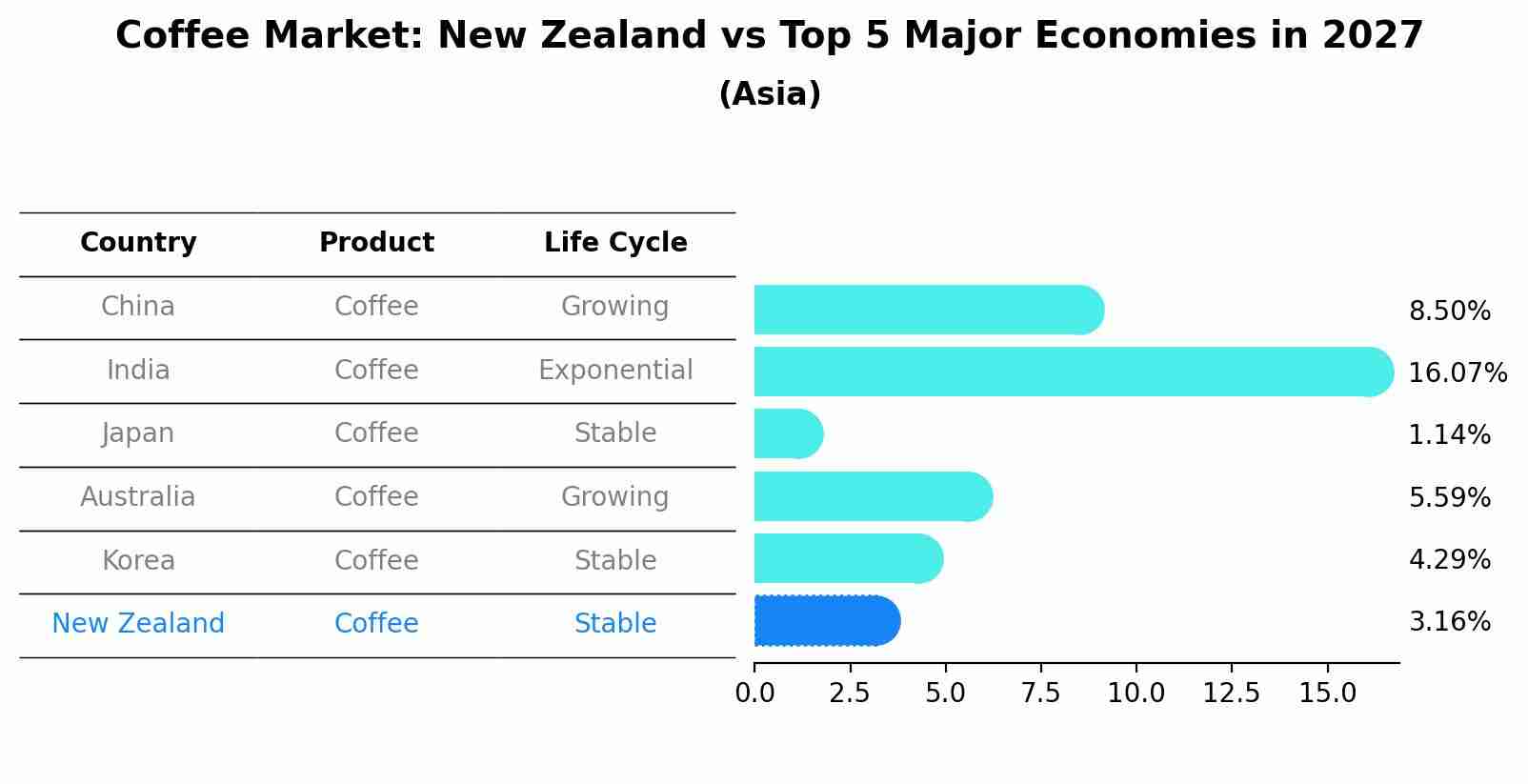
New Zealand Coffee Market Growth Rate
According to 6Wresearch internal database and industry insights, the New Zealand Coffee Market is projected to grow at a compound annual growth rate (CAGR) of 5.9% during the forecast period (2026–2032).
Five-Year Growth Trajectory of the New Zealand Coffee Market with Core Drivers
Below mentioned are the evaluation of year-wise growth rate along with key drivers:
| Years | Est. Annual Growth (%) | Growth Drivers |
| 2021 | 3.5 | Increase in café visits and demand for espresso-based drinks. |
| 2022 | 3.7 | Growing at-home coffee consumption and the rise of coffee pods. |
| 2023 | 3.8 | Demand for premium and specialty coffee growing among younger consumers. |
| 2024 | 3.9 | Rise in convenience coffee products such as instant coffee and pods. |
| 2025 | 4 | Continued growth in premium coffee consumption and café culture. |
Topics Covered in the New Zealand Coffee Market Report
The New Zealand Coffee Market report thoroughly covers the market by product types and distribution channels. It provides an unbiased and detailed analysis of ongoing market trends, opportunities, and market drivers, which would help stakeholders align their strategies with current and future market dynamics.
New Zealand Coffee Market Highlights
| Report Name | New Zealand Coffee Market |
| Forecast period | 2026–2032 |
| CAGR | 5.9% |
| Growing Sector | Food & Beverage |
New Zealand Coffee Market Synopsis
The New Zealand Coffee Market growth is estimated to gain traction owing to rising coffee culture and high per-capita coffee consumption. The coffee consumption is increasing day by day due to certain factors, such as increasing popularity of premium and specialty coffee and the growing trend of at-home brewing. Additionally, the industry expansion is driven by an increase in discretionary income and the rising expansion of modern retail infrastructure.
Evaluation of Growth Drivers in the New Zealand Coffee Market
Below mentioned are some prominent drivers and their influence on market dynamics:
| Drivers | Primary Segment Affected | Why It Matters (Evidence) |
| Strong Café Culture & Urban Lifestyle | On‑Trade, Ground/Whole‑Bean Coffee segments | Widespread consumption of coffee, especially espresso-based drinks. |
| Rising Demand for Specialty & High‑Quality Coffee | Whole‑Bean, Ground Coffee segments | Consumers are now shifting towards quality due to increased demand for freshly roasted coffee. |
| At‑Home Consumption & Convenience | Instant Coffee; Coffee Pods/Capsules; Off‑Trade channels | A rise in the popularity of home brewing, making coffee instant coffee more desirable. |
| Import‑Driven Supply Diversity | All Product Types | Diverse imports of coffee beans provide consumers with a wide variety of options. |
| Sustainability & Ethical Sourcing Awareness | Specialty Coffee, Whole‑Bean segment | Consumers are increasingly prioritizing sustainably sourced and ethically produced coffee. |
The New Zealand Coffee Market size is projected to grow at a CAGR of 5.9% during the forecast period (2026–2032). The rising expansion as consumers increasingly prioritise café-style quality at home and experiment with espresso-based beverages are contributing to the market growth. Additionally, the growing preference for ethically sourced products, recyclable packaging, and transparent origin stories, driven by the rising subscription models and omnichannel retail that makes speciality coffee more accessible beyond major cities, with innovation in flavours, functional ingredients, and low-sugar RTD variants further widening consumption occasions. These factors are estimated to surge the New Zealand Coffee Market growth.
Evaluation of Restraints in the New Zealand Coffee Market
Below mentioned are some major restraints and their influence on market dynamics:
| Restraints | Primary Segment Affected | What This Means (Evidence) |
| Market Maturity & Slow Consumption Growth | Entire Coffee Market | Modest growth rates due to the already high coffee consumption per capita. |
| Price Sensitivity & Economic Conditions | On‑Trade cafés, Retail Segment | Economic pressures could reduce discretionary spending, affecting premium coffee purchases. |
| High Dependence on Imports | All Product Types | Reliance on imported coffee leaves the market vulnerable to global price fluctuations. |
| Limited Scale of Specialty Segment | Ground/Whole‑Bean & Specialty Coffee | Specialty coffee remains a niche market, limiting overall volume potential compared to mainstream options. |
| Health Concerns Related to Dairy and Caffeine | Consumers, Retailers | Increasing health consciousness and dietary shifts may impact coffee consumption. |
New Zealand Coffee Market Challenges
On the other hand, the market deals with numerous challenges, including high dependence on imported coffee and fluctuations in global coffee prices. Also, there are some other challenges that could affect the market growth, such as increasing competition from plant-based beverages and shifting consumer preferences for health-conscious alternatives. Moreover, coffee consumption in New Zealand is high, further rapid growth may be constrained by market saturation.
New Zealand Coffee Market Trends
Several prominent trends reshaping the market growth include:
- Specialty Coffee Demand: Increasing consumer demand for premium, high-quality coffee, particularly whole-bean and freshly roasted varieties.
- Rise in Coffee Pods and Capsules: A shift toward convenient coffee formats, especially for busy urban professionals.
- Growing Popularity of Instant Coffee: Continued demand for ready-to-consume, instant coffee products due to their convenience and affordability.
- Health-Conscious Coffee Varieties: Growing interest in organic, low-caffeine, or functional coffees catering to health-conscious consumers.
Investment Opportunities in the New Zealand Coffee Industry
Some prominent investment opportunities in the market include:
- Premium Coffee Production: Investment in the production of premium, single-origin, and specialty coffee beans to cater to an increasingly discerning consumer base.
- Coffee Subscription Services: Growth in the subscription model for coffee delivery, offering customers regular access to premium or curated coffee selections.
- Convenient Coffee Formats: Opportunities in the ready-to-drink coffee segment, including single-serve pods and canned coffee beverages.
- Café Expansion: Investment in expanding independent and branded cafés to capitalize on New Zealand's thriving café culture.
Top 5 Leading Players in the New Zealand Coffee Market
Some leading players operating in the market include:
1. Flight Coffee
| Company Name | Flight Coffee |
|---|---|
| Established Year | 1998 |
| Headquarters | Wellington, New Zealand |
| Official Website | Click Here |
Flight Coffee is a specialty coffee roaster supplying cafés and workplaces across New Zealand, with a strong focus on quality roasting and consistent espresso blends for foodservice channels.
2. Hummingbird Coffee
| Company Name | Hummingbird Coffee |
|---|---|
| Established Year | 1991 |
| Headquarters | Christchurch, New Zealand |
| Official Website | Click Here |
Hummingbird Coffee provides roasted coffee for cafés and office supply, supported by in-house training and a wide range of blends and single-origin offerings suited to New Zealand’s café-led coffee culture.
3. L’affare
| Company Name | L’affare |
|---|---|
| Established Year | 1990 |
| Headquarters | Wellington, New Zealand |
| Official Website | Click Here |
L’affare is a long-established roaster supplying espresso and filter coffee to hospitality and retail customers, offering premium blends and café supply solutions that strengthen its presence in urban consumption hubs.
4. Havana Coffee Works
| Company Name | Havana Coffee Works |
|---|---|
| Established Year | 1995 |
| Headquarters | Wellington, New Zealand |
| Official Website | Click Here |
Havana Coffee Works roasts and distributes specialty coffee for cafés and consumers, known for strong brand visibility and a broad product portfolio including beans, capsules, and ready-to-brew formats.
5. Coffee Supreme
| Company Name | Coffee Supreme |
|---|---|
| Established Year | 1993 |
| Headquarters | Wellington, New Zealand |
| Official Website | Click Here |
Coffee Supreme is a specialty roaster with strong café and wholesale partnerships across New Zealand, emphasizing sourcing standards and support services that help independent cafés and premium retailers scale coffee programs.
Government Regulations Introduced in the New Zealand Coffee Market
According to New Zealand’s government data, the main government rules & regulations focus on food safety, truthful labelling, and import controls. There are some right food safety approaches, such as a Food Control Plan or National Programme and Australia New Zealand Food Standards. Which Coffee roasters, cafés, and packers must operate under the Food Act 2014 and meet code for things like hygiene, contamination limits, and labelling requirements. Also, if coffee is imported, the importer needs to be registered with MPI as a Food Importer, and imports must meet NZ food standards.
Future Insights of the New Zealand Coffee Market
The New Zealand coffee market share is projected to increase in the coming years, driven by a strong everyday consumption and continued interest in café-style coffee at home. Demand is also likely to evolve toward a mix of value choices and premium experiences, with consumers seeking quality while still managing budgets when bean and retail prices rise. At the same time, sustainability expectations should strengthen further, pushing more attention toward traceability, waste reduction, and more sustainable packaging formats, which will influence how products are positioned and purchased across both retail and foodservice channels.
Market Segmentation Analysis
The report offers a comprehensive study of the following market segments and their leading categories:
By Product Type – Whole-Bean Coffee Segment Expected to Dominate the Market
According to Priya, Senior Research Analyst at 6Wresearch, Whole-bean coffee remains the dominant product type in New Zealand, favored by consumers for its freshness and rich flavor. This segment is closely followed by ground coffee, which is also widely consumed due to convenience.
By Distribution Channel – Off-Trade Segment Expected to Dominate the Market
The off-trade channel, which includes supermarkets, retail stores, and online sales, is expected to dominate the New Zealand Coffee Market. With the increasing demand for home brewing, these retail channels are seeing higher sales of coffee beans, instant coffee, and coffee pods.
Key Attractiveness of the Report
- 10 Years of Market Numbers.
- Historical Data Starting from 2022 to 2025.
- Base Year: 2025.
- Forecast Data until 2032.
- Key Performance Indicators Impacting the Market.
- Major Upcoming Developments and Projects.
Key Highlights of the Report:
- New Zealand Coffee Market Outlook
- Market Size of New Zealand Coffee Market, 2025
- Forecast of New Zealand Coffee Market, 2032
- Historical Data and Forecast of New Zealand Coffee Revenues & Volume for the Period 2022-2032
- New Zealand Coffee Market Trend Evolution
- New Zealand Coffee Market Drivers and Challenges
- New Zealand Coffee Price Trends
- New Zealand Coffee Porter`s Five Forces
- New Zealand Coffee Industry Life Cycle
- Historical Data and Forecast of New Zealand Coffee Market Revenues & Volume By Product Type for the Period 2022-2032
- Historical Data and Forecast of New Zealand Coffee Market Revenues & Volume By Whole-Bean for the Period 2022-2032
- Historical Data and Forecast of New Zealand Coffee Market Revenues & Volume By Ground Coffee for the Period 2022-2032
- Historical Data and Forecast of New Zealand Coffee Market Revenues & Volume By Instant Coffee for the Period 2022-2032
- Historical Data and Forecast of New Zealand Coffee Market Revenues & Volume By Coffee Pods and Capsules for the Period 2022-2032
- Historical Data and Forecast of New Zealand Coffee Market Revenues & Volume By Distribution Channel for the Period 2022-2032
- Historical Data and Forecast of New Zealand Coffee Market Revenues & Volume By On-Trade for the Period 2022-2032
- Historical Data and Forecast of New Zealand Coffee Market Revenues & Volume By Off-Trade for the Period 2022-2032
- New Zealand Coffee Import Export Trade Statistics
- Market Opportunity Assessment By Product Type
- Market Opportunity Assessment By Distribution Channel
- New Zealand Coffee Top Companies Market Share
- New Zealand Coffee Competitive Benchmarking By Technical and Operational Parameters
- New Zealand Coffee Company Profiles
- New Zealand Coffee Key Strategic Recommendations
Market Covered
The report offers a comprehensive study of the subsequent market segments:
By Product Type
- Whole-Bean
- Ground Coffee
- Instant Coffee
- Coffee Pods and Capsules
By Distribution Channel
- On-Trade
- Off-Trade






































