New Zealand Communications Equipment Market Growth Rate Analysis (2025 - 2031)
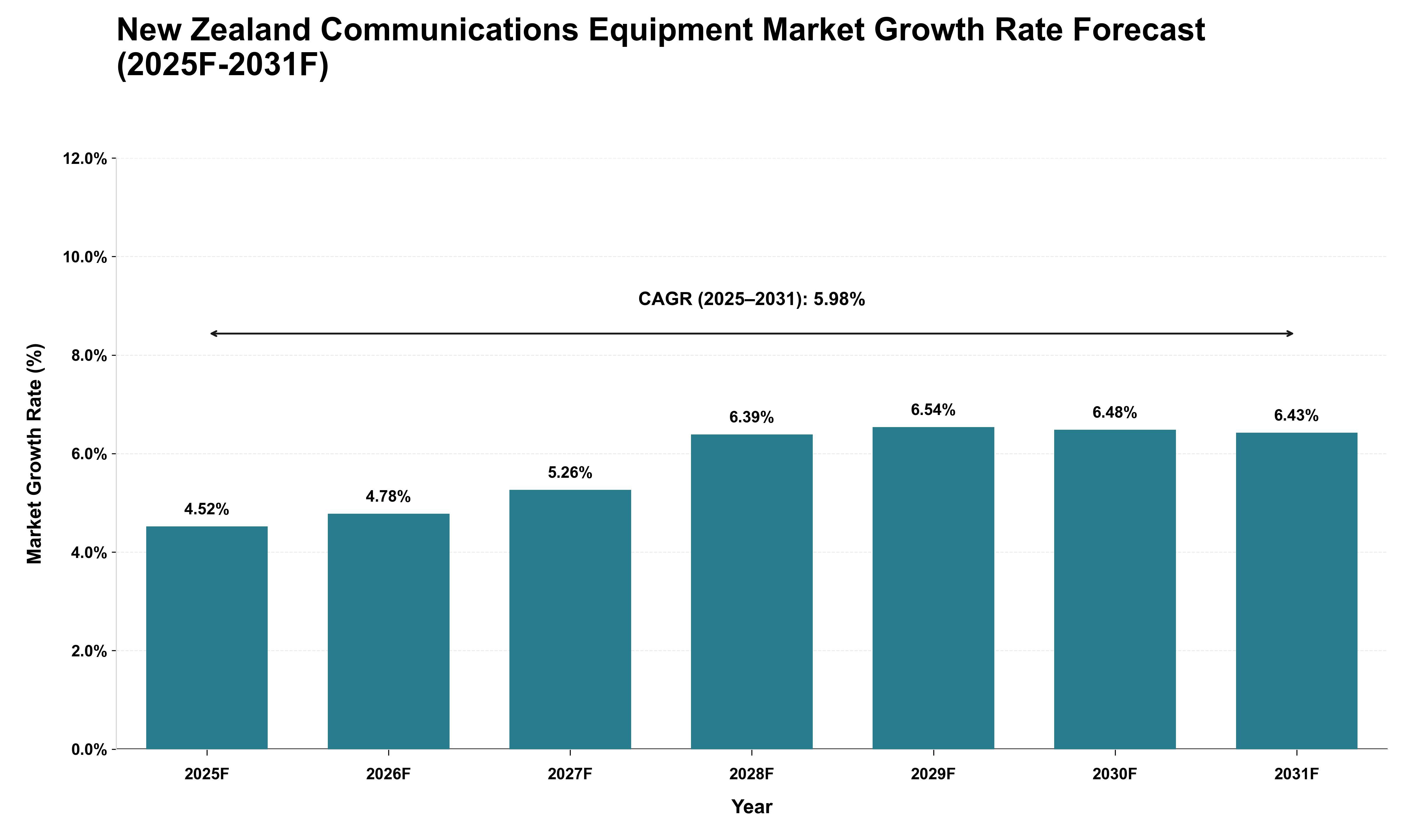
The projected growth trajectory for the New Zealand communications equipment market will exhibit a notable acceleration, particularly evident from 2027 onward, where the annual growth rate is expected to rise from 5.26% to a peak of 6.54% in 2029 before slightly tapering off. This pattern suggests an increasing demand driven by technological advancements and heightened connectivity needs, likely influenced by macroeconomic factors such as rising consumer spending and business investments in digital infrastructure. The anticipated CAGR of 5.98% reflects a robust environment for innovation and adoption of new technologies, while potential import dependencies on advanced components may introduce volatility based on global supply chain dynamics. As firms adapt to evolving market conditions, cyclical trends will likely play a crucial role in shaping competitive strategies within this sector, fostering an environment conducive to sustained growth through the forecast period.
Key Highlights of the Report:
- New Zealand Communications Equipment Market Outlook
- Market Size of New Zealand Communications Equipment Market, 2025
- Forecast of New Zealand Communications Equipment Market, 2032
- Historical Data and Forecast of New Zealand Communications Equipment Revenues & Volume for the Period 2022 - 2032F
- New Zealand Communications Equipment Market Trend Evolution
- New Zealand Communications Equipment Market Drivers and Challenges
- New Zealand Communications Equipment Price Trends
- New Zealand Communications Equipment Porter`s Five Forces
- New Zealand Communications Equipment Industry Life Cycle
- Historical Data and Forecast of New Zealand Communications Equipment Market Revenues & Volume By Type for the Period 2022 - 2032F
- Historical Data and Forecast of New Zealand Communications Equipment Market Revenues & Volume By Optical Communication Equipment for the Period 2022 - 2032F
- Historical Data and Forecast of New Zealand Communications Equipment Market Revenues & Volume By Network Communication Equipment for the Period 2022 - 2032F
- Historical Data and Forecast of New Zealand Communications Equipment Market Revenues & Volume By Mobile Communication Device for the Period 2022 - 2032F
- Historical Data and Forecast of New Zealand Communications Equipment Market Revenues & Volume By Component for the Period 2022 - 2032F
- Historical Data and Forecast of New Zealand Communications Equipment Market Revenues & Volume By WANs (Wide Area Network) for the Period 2022 - 2032F
- Historical Data and Forecast of New Zealand Communications Equipment Market Revenues & Volume By Transceiver for the Period 2022 - 2032F
- Historical Data and Forecast of New Zealand Communications Equipment Market Revenues & Volume By Switch for the Period 2022 - 2032F
- Historical Data and Forecast of New Zealand Communications Equipment Market Revenues & Volume By Routers for the Period 2022 - 2032F
- Historical Data and Forecast of New Zealand Communications Equipment Market Revenues & Volume By LANs (Local Area Network) for the Period 2022 - 2032F
- Historical Data and Forecast of New Zealand Communications Equipment Market Revenues & Volume By Exchanges for the Period 2022 - 2032F
- Historical Data and Forecast of New Zealand Communications Equipment Market Revenues & Volume By Application for the Period 2022 - 2032F
- Historical Data and Forecast of New Zealand Communications Equipment Market Revenues & Volume By Telecom Operators for the Period 2022 - 2032F
- Historical Data and Forecast of New Zealand Communications Equipment Market Revenues & Volume By Data Center for the Period 2022 - 2032F
- Historical Data and Forecast of New Zealand Communications Equipment Market Revenues & Volume By End-users for the Period 2022 - 2032F
- Historical Data and Forecast of New Zealand Communications Equipment Market Revenues & Volume By Banking, Financial Services and Insurance (BFSI) for the Period 2022 - 2032F
- Historical Data and Forecast of New Zealand Communications Equipment Market Revenues & Volume By Personal for the Period 2022 - 2032F
- Historical Data and Forecast of New Zealand Communications Equipment Market Revenues & Volume By Healthcare for the Period 2022 - 2032F
- Historical Data and Forecast of New Zealand Communications Equipment Market Revenues & Volume By Government for the Period 2022 - 2032F
- Historical Data and Forecast of New Zealand Communications Equipment Market Revenues & Volume By Enterprise for the Period 2022 - 2032F
- Historical Data and Forecast of New Zealand Communications Equipment Market Revenues & Volume By Energy & Utilities for the Period 2022 - 2032F
- Historical Data and Forecast of New Zealand Communications Equipment Market Revenues & Volume By Education for the Period 2022 - 2032F
- Historical Data and Forecast of New Zealand Communications Equipment Market Revenues & Volume By Cloud for the Period 2022 - 2032F
- New Zealand Communications Equipment Import Export Trade Statistics
- Market Opportunity Assessment By Type
- Market Opportunity Assessment By Component
- Market Opportunity Assessment By Application
- Market Opportunity Assessment By End-users
- New Zealand Communications Equipment Top Companies Market Share
- New Zealand Communications Equipment Competitive Benchmarking By Technical and Operational Parameters
- New Zealand Communications Equipment Company Profiles
- New Zealand Communications Equipment Key Strategic Recommendations






































