New Zealand Construction Vehicles Market Top 5 Importing Countries and Market Competition (HHI) Analysis
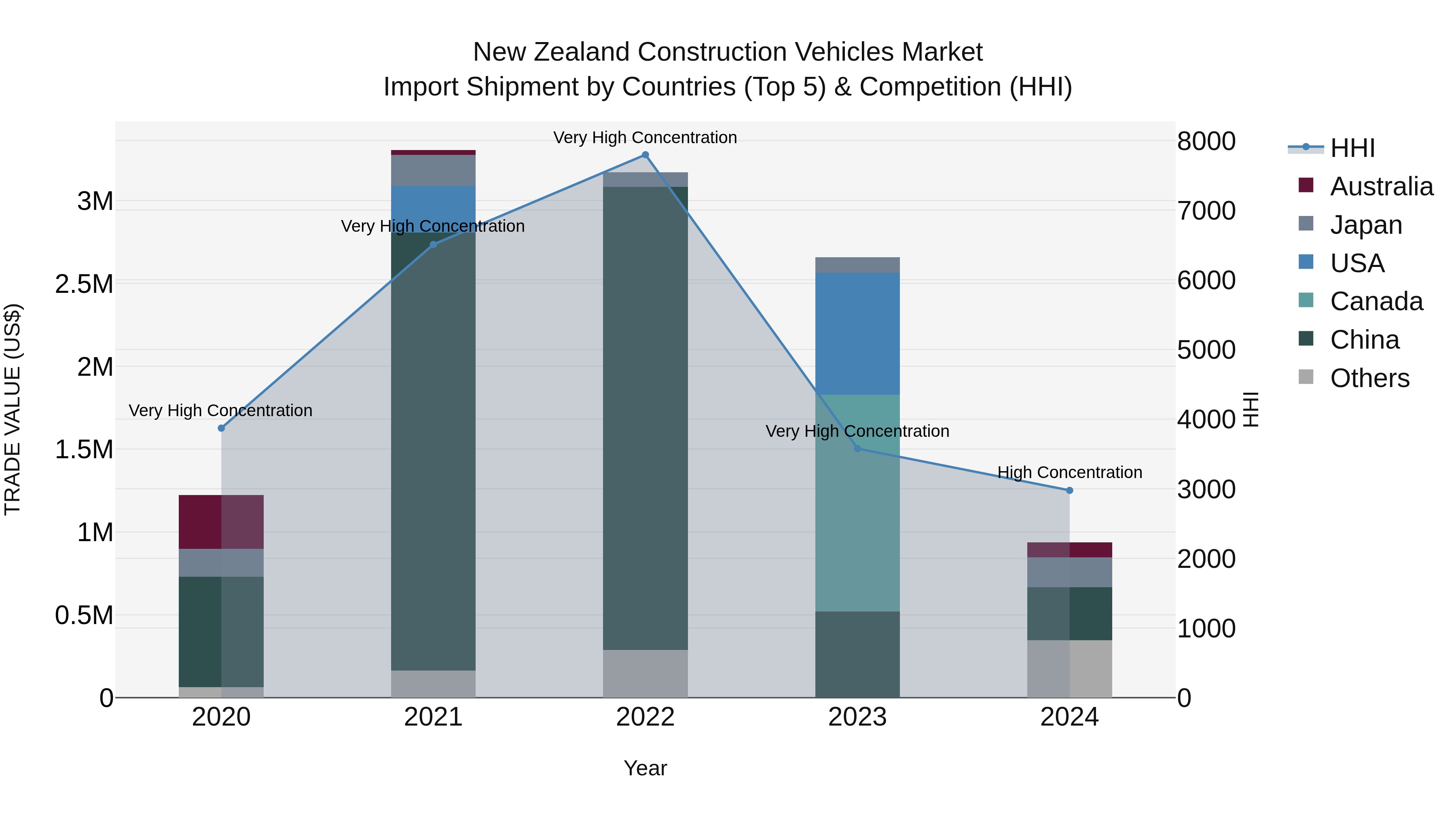
The New Zealand construction vehicles import market in 2024 saw significant contributions from Finland, China, Japan, Australia, and Canada. Despite a high concentration of imports in 2023, the concentration increased further in 2024, indicating a more competitive landscape. The market experienced a negative compound annual growth rate of -6.47% from 2020 to 2024, with a steep decline in growth rate from 2023 to 2024 at -64.75%. These trends suggest a challenging environment for construction vehicle importers in New Zealand, highlighting the need for strategic planning and adaptation to market dynamics.
Key Highlights of the Report:
- New Zealand Construction Vehicles Market Outlook
- Market Size of New Zealand Construction Vehicles Market, 2025
- Forecast of New Zealand Construction Vehicles Market, 2032
- Historical Data and Forecast of New Zealand Construction Vehicles Revenues & Volume for the Period 2022 - 2032F
- New Zealand Construction Vehicles Market Trend Evolution
- New Zealand Construction Vehicles Market Drivers and Challenges
- New Zealand Construction Vehicles Price Trends
- New Zealand Construction Vehicles Porter's Five Forces
- New Zealand Construction Vehicles Industry Life Cycle
- Historical Data and Forecast of New Zealand Construction Vehicles Market Revenues & Volume By Vehicle Type for the Period 2022 - 2032F
- Historical Data and Forecast of New Zealand Construction Vehicles Market Revenues & Volume By Excavators for the Period 2022 - 2032F
- Historical Data and Forecast of New Zealand Construction Vehicles Market Revenues & Volume By Loaders for the Period 2022 - 2032F
- Historical Data and Forecast of New Zealand Construction Vehicles Market Revenues & Volume By Bulldozers for the Period 2022 - 2032F
- Historical Data and Forecast of New Zealand Construction Vehicles Market Revenues & Volume By Dump Trucks for the Period 2022 - 2032F
- Historical Data and Forecast of New Zealand Construction Vehicles Market Revenues & Volume By Others for the Period 2022 - 2032F
- Historical Data and Forecast of New Zealand Construction Vehicles Market Revenues & Volume By Application for the Period 2022 - 2032F
- Historical Data and Forecast of New Zealand Construction Vehicles Market Revenues & Volume By Earthmoving for the Period 2022 - 2032F
- Historical Data and Forecast of New Zealand Construction Vehicles Market Revenues & Volume By Material Handling for the Period 2022 - 2032F
- Historical Data and Forecast of New Zealand Construction Vehicles Market Revenues & Volume By Road Construction for the Period 2022 - 2032F
- Historical Data and Forecast of New Zealand Construction Vehicles Market Revenues & Volume By Others for the Period 2022 - 2032F
- Historical Data and Forecast of New Zealand Construction Vehicles Market Revenues & Volume By End User for the Period 2022 - 2032F
- Historical Data and Forecast of New Zealand Construction Vehicles Market Revenues & Volume By Construction for the Period 2022 - 2032F
- Historical Data and Forecast of New Zealand Construction Vehicles Market Revenues & Volume By Mining for the Period 2022 - 2032F
- Historical Data and Forecast of New Zealand Construction Vehicles Market Revenues & Volume By Oil & Gas for the Period 2022 - 2032F
- Historical Data and Forecast of New Zealand Construction Vehicles Market Revenues & Volume By Others for the Period 2022 - 2032F
- New Zealand Construction Vehicles Import Export Trade Statistics
- Market Opportunity Assessment By Vehicle Type
- Market Opportunity Assessment By Application
- Market Opportunity Assessment By End User
- New Zealand Construction Vehicles Top Companies Market Share
- New Zealand Construction Vehicles Competitive Benchmarking By Technical and Operational Parameters
- New Zealand Construction Vehicles Company Profiles
- New Zealand Construction Vehicles Key Strategic Recommendations






































