New Zealand Consumer Battery Market Top 5 Importing Countries and Market Competition (HHI) Analysis
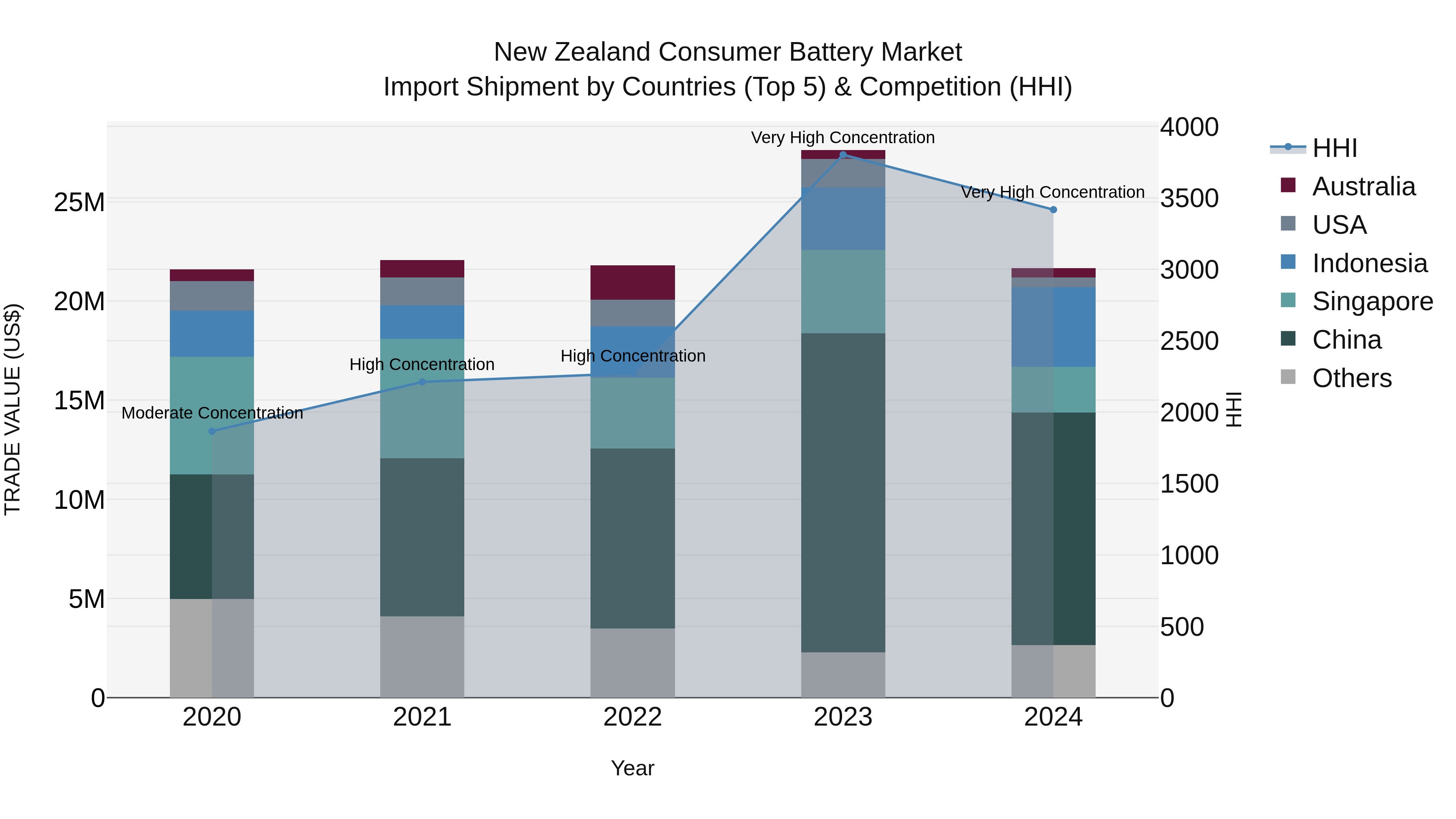
Despite a slight overall growth in the consumer battery import market in New Zealand from 2020-2024, the industry experienced a significant decline in growth rate in 2024. The top exporting countries to New Zealand remained consistent, with China, Indonesia, Singapore, Thailand, and Malaysia leading the pack. The high concentration of imports from these countries indicates a strong market presence. However, the negative growth rate in 2024 may signal potential challenges or shifts in consumer demand that importers and manufacturers should monitor closely.
New Zealand Consumer Battery Market Overview
The consumer battery market in New Zealand has witnessed steady growth in recent years, driven primarily by the increasing adoption of portable electronic devices such as smartphones, laptops, and wearables. Consumers` growing awareness of the importance of sustainability and environmental concerns has also influenced their choice of rechargeable batteries over single-use ones. Additionally, advancements in battery technology, such as lithium-ion batteries with higher energy densities and longer lifespans, have further fueled market growth. The market is characterized by intense competition among both domestic and international players, with a focus on product innovation, pricing strategies, and distribution channels.
Drivers of the market
The consumer battery market in New Zealand is driven by the rising demand for portable electronic devices, including smartphones, laptops, and wearable technology. The growing trend towards smart homes and the increasing use of battery-powered household devices also contribute to market growth. Furthermore, advancements in battery technology, offering longer life and faster charging times, are influencing consumer preferences and driving the market forward.
Challenges of the market
In the New Zealand consumer battery market, the primary challenges include the high cost of raw materials and the environmental impact of battery disposal. Manufacturers are also grappling with the need for continuous innovation to meet the rising consumer demand for longer-lasting and more efficient batteries.
Government Policy of the market
Government regulations in New Zealand play a crucial role in the consumer battery market, focusing on environmental sustainability and product safety. Policies encourage the use of rechargeable batteries over disposable ones, aiming to reduce electronic waste. Additionally, there are regulations concerning the disposal and recycling of batteries to minimize their environmental impact.
Key Highlights of the Report:
- New Zealand Consumer Battery Market Outlook
- Market Size of New Zealand Consumer Battery Market, 2024
- Forecast of New Zealand Consumer Battery Market, 2031
- Historical Data and Forecast of New Zealand Consumer Battery Revenues & Volume for the Period 2021-2031
- New Zealand Consumer Battery Market Trend Evolution
- New Zealand Consumer Battery Market Drivers and Challenges
- New Zealand Consumer Battery Price Trends
- New Zealand Consumer Battery Porter`s Five Forces
- New Zealand Consumer Battery Industry Life Cycle
- Historical Data and Forecast of New Zealand Consumer Battery Market Revenues & Volume By Type for the Period 2021-2031
- Historical Data and Forecast of New Zealand Consumer Battery Market Revenues & Volume By Lithium-ion Batteries for the Period 2021-2031
- Historical Data and Forecast of New Zealand Consumer Battery Market Revenues & Volume By Zinc-Carbon Batteries for the Period 2021-2031
- Historical Data and Forecast of New Zealand Consumer Battery Market Revenues & Volume By Alkaline Batteries for the Period 2021-2031
- Historical Data and Forecast of New Zealand Consumer Battery Market Revenues & Volume By Nickel Metal Hydride for the Period 2021-2031
- Historical Data and Forecast of New Zealand Consumer Battery Market Revenues & Volume By Nickel Cadmium for the Period 2021-2031
- Historical Data and Forecast of New Zealand Consumer Battery Market Revenues & Volume By Others for the Period 2021-2031
- Historical Data and Forecast of New Zealand Consumer Battery Market Revenues & Volume By End-User for the Period 2021-2031
- Historical Data and Forecast of New Zealand Consumer Battery Market Revenues & Volume By Residential for the Period 2021-2031
- Historical Data and Forecast of New Zealand Consumer Battery Market Revenues & Volume By Commercial for the Period 2021-2031
- New Zealand Consumer Battery Import Export Trade Statistics
- Market Opportunity Assessment By Type
- Market Opportunity Assessment By End-User
- New Zealand Consumer Battery Top Companies Market Share
- New Zealand Consumer Battery Competitive Benchmarking By Technical and Operational Parameters
- New Zealand Consumer Battery Company Profiles
- New Zealand Consumer Battery Key Strategic Recommendations






































