New Zealand Cyclohexanone Market Top 5 Importing Countries and Market Competition (HHI) Analysis
In 2024, New Zealand`s cyclohexanone import market continued to show significant concentration, with top exporters being Thailand, Singapore, Australia, Metropolitan France, and the USA. Despite experiencing a notable compound annual growth rate (CAGR) of 29.67% from 2020 to 2024, there was a sharp decline in growth rate from 2023 to 2024 at -48.85%. This fluctuation may indicate shifting market dynamics or temporary disruptions affecting import volumes. Monitoring future trends and factors influencing these changes will be crucial for stakeholders in the cyclohexanone market.
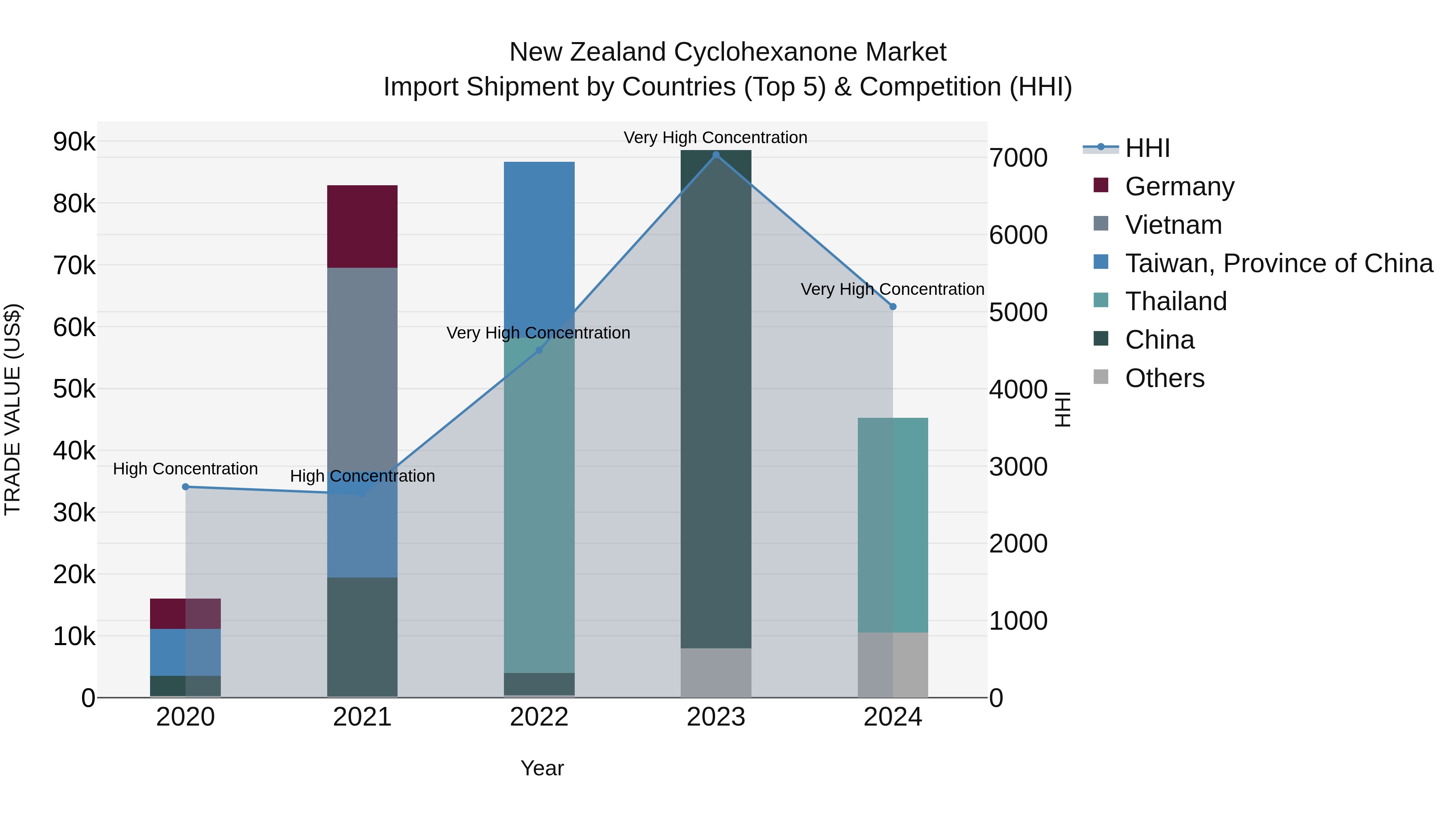
New Zealand Cyclohexanone Market Overview
The cyclohexanone market in New Zealand is driven by its diverse industrial applications, including solvent extraction, polymer production, and chemical synthesis. Cyclohexanone is a versatile chemical intermediate used in the manufacture of nylon, plasticizers, pharmaceuticals, and pesticides. With a focus on product quality and process efficiency, manufacturers are adopting advanced production technologies and process optimization strategies to meet stringent regulatory standards and customer requirements. Additionally, there is growing interest in sustainable sourcing and renewable feedstocks to minimize environmental impact and enhance the sustainability profile of cyclohexanone production in New Zealand.
Drivers of the market
Similar to cyclohexane, the Cyclohexanone market in New Zealand is driven by its use as a solvent and intermediate in various industrial applications. Cyclohexanone is utilized in the production of nylon fibers, paints, coatings, and pharmaceuticals. With the growing demand for these end products, there`s a steady need for cyclohexanone as a raw material, sustaining market growth in New Zealand.
Challenges of the market
For the New Zealand Cyclohexanone market, challenges include maintaining consistent product quality and dealing with the environmental impact of production processes. Market competition and raw material price fluctuations are additional hurdles.
Government Policy of the market
Cyclohexanone is widely used as a solvent and in the production of nylon. In New Zealand, the market for Cyclohexanone is driven by its applications in automotive, construction, and textile industries.
Key Highlights of the Report:
- New Zealand Cyclohexanone Market Outlook
- Market Size of New Zealand Cyclohexanone Market, 2024
- Forecast of New Zealand Cyclohexanone Market, 2031
- Historical Data and Forecast of New Zealand Cyclohexanone Revenues & Volume for the Period 2021-2031
- New Zealand Cyclohexanone Market Trend Evolution
- New Zealand Cyclohexanone Market Drivers and Challenges
- New Zealand Cyclohexanone Price Trends
- New Zealand Cyclohexanone Porter`s Five Forces
- New Zealand Cyclohexanone Industry Life Cycle
- Historical Data and Forecast of New Zealand Cyclohexanone Market Revenues & Volume By Type for the Period 2021-2031
- Historical Data and Forecast of New Zealand Cyclohexanone Market Revenues & Volume By Nylon 6 for the Period 2021-2031
- Historical Data and Forecast of New Zealand Cyclohexanone Market Revenues & Volume By Nylon 66 for the Period 2021-2031
- Historical Data and Forecast of New Zealand Cyclohexanone Market Revenues & Volume By Polyester Polyol for the Period 2021-2031
- Historical Data and Forecast of New Zealand Cyclohexanone Market Revenues & Volume By Others for the Period 2021-2031
- Historical Data and Forecast of New Zealand Cyclohexanone Market Revenues & Volume By End-use for the Period 2021-2031
- Historical Data and Forecast of New Zealand Cyclohexanone Market Revenues & Volume By Construction for the Period 2021-2031
- Historical Data and Forecast of New Zealand Cyclohexanone Market Revenues & Volume By Aerospace and Defence for the Period 2021-2031
- Historical Data and Forecast of New Zealand Cyclohexanone Market Revenues & Volume By Textiles for the Period 2021-2031
- Historical Data and Forecast of New Zealand Cyclohexanone Market Revenues & Volume By Automotive for the Period 2021-2031
- Historical Data and Forecast of New Zealand Cyclohexanone Market Revenues & Volume By Electrical and Electronics for the Period 2021-2031
- Historical Data and Forecast of New Zealand Cyclohexanone Market Revenues & Volume By Others for the Period 2021-2031
- Historical Data and Forecast of New Zealand Cyclohexanone Market Revenues & Volume By Application for the Period 2021-2031
- Historical Data and Forecast of New Zealand Cyclohexanone Market Revenues & Volume By Paint and Dyes for the Period 2021-2031
- Historical Data and Forecast of New Zealand Cyclohexanone Market Revenues & Volume By Soaps for the Period 2021-2031
- Historical Data and Forecast of New Zealand Cyclohexanone Market Revenues & Volume By Fertilizers for the Period 2021-2031
- Historical Data and Forecast of New Zealand Cyclohexanone Market Revenues & Volume By Films for the Period 2021-2031
- Historical Data and Forecast of New Zealand Cyclohexanone Market Revenues & Volume By Pharmaceutical for the Period 2021-2031
- Historical Data and Forecast of New Zealand Cyclohexanone Market Revenues & Volume By Caprolactam for the Period 2021-2031
- Historical Data and Forecast of New Zealand Cyclohexanone Market Revenues & Volume By Adipic Acid for the Period 2021-2031
- Historical Data and Forecast of New Zealand Cyclohexanone Market Revenues & Volume By Others for the Period 2021-2031
- New Zealand Cyclohexanone Import Export Trade Statistics
- Market Opportunity Assessment By Type
- Market Opportunity Assessment By End-use
- Market Opportunity Assessment By Application
- New Zealand Cyclohexanone Top Companies Market Share
- New Zealand Cyclohexanone Competitive Benchmarking By Technical and Operational Parameters
- New Zealand Cyclohexanone Company Profiles
- New Zealand Cyclohexanone Key Strategic Recommendations






































