New Zealand Drinkware Market Top 5 Importing Countries and Market Competition (HHI) Analysis
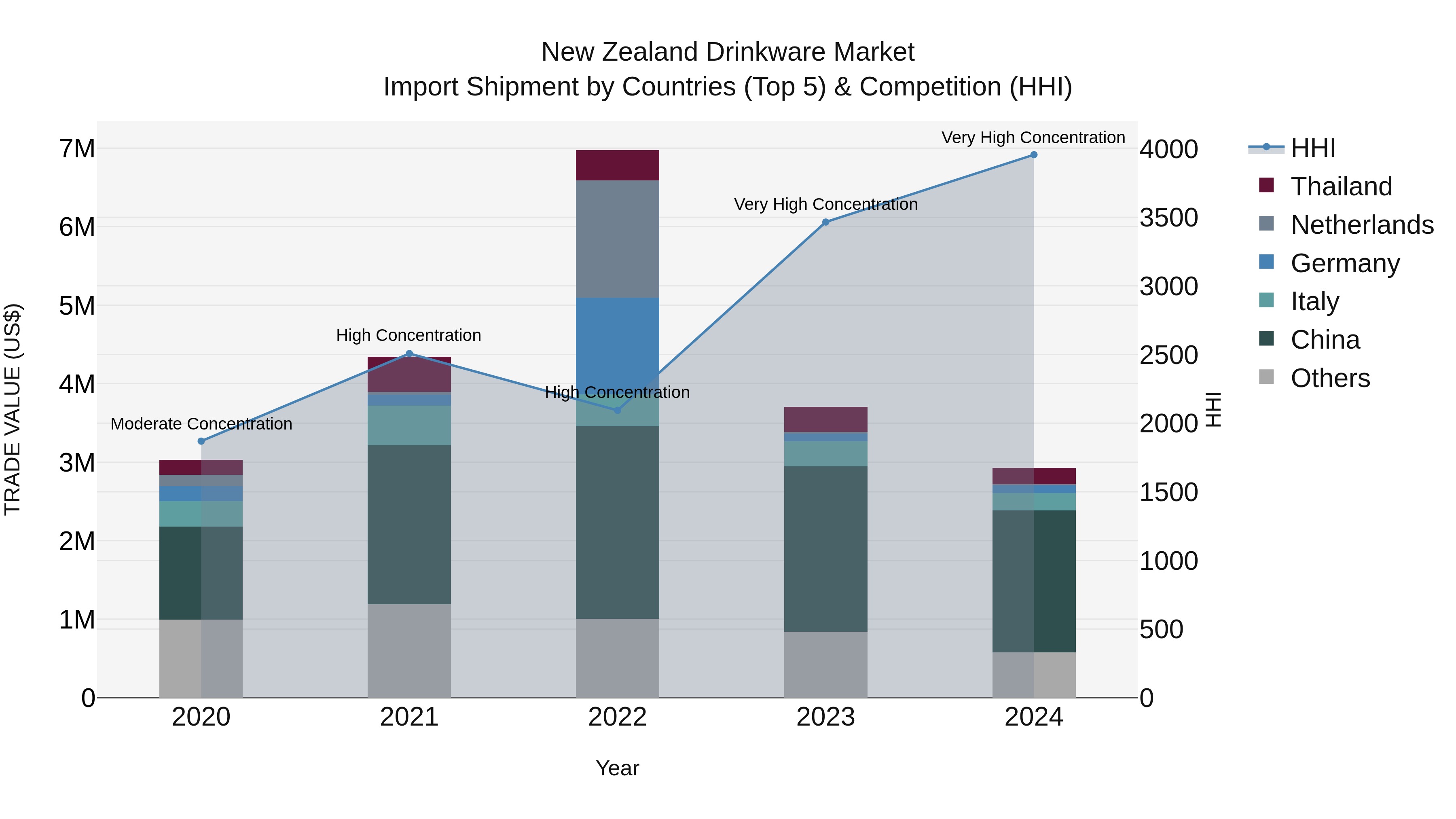
New Zealand`s drinkware import market in 2024 continued to see a high level of concentration, with top exporting countries being China, Italy, Thailand, Turkey, and Germany. Despite a negative compound annual growth rate (CAGR) of -0.86% from 2020 to 2024 and a significant decline in growth rate from 2023 to 2024 at -20.98%, the market remains stable with consistent supply from key countries. This trend indicates a competitive landscape in the New Zealand drinkware import sector, driven by quality products from leading exporting nations.
Drinkware Market: New Zealand vs Top 5 Major Economies in 2027 (Asia)
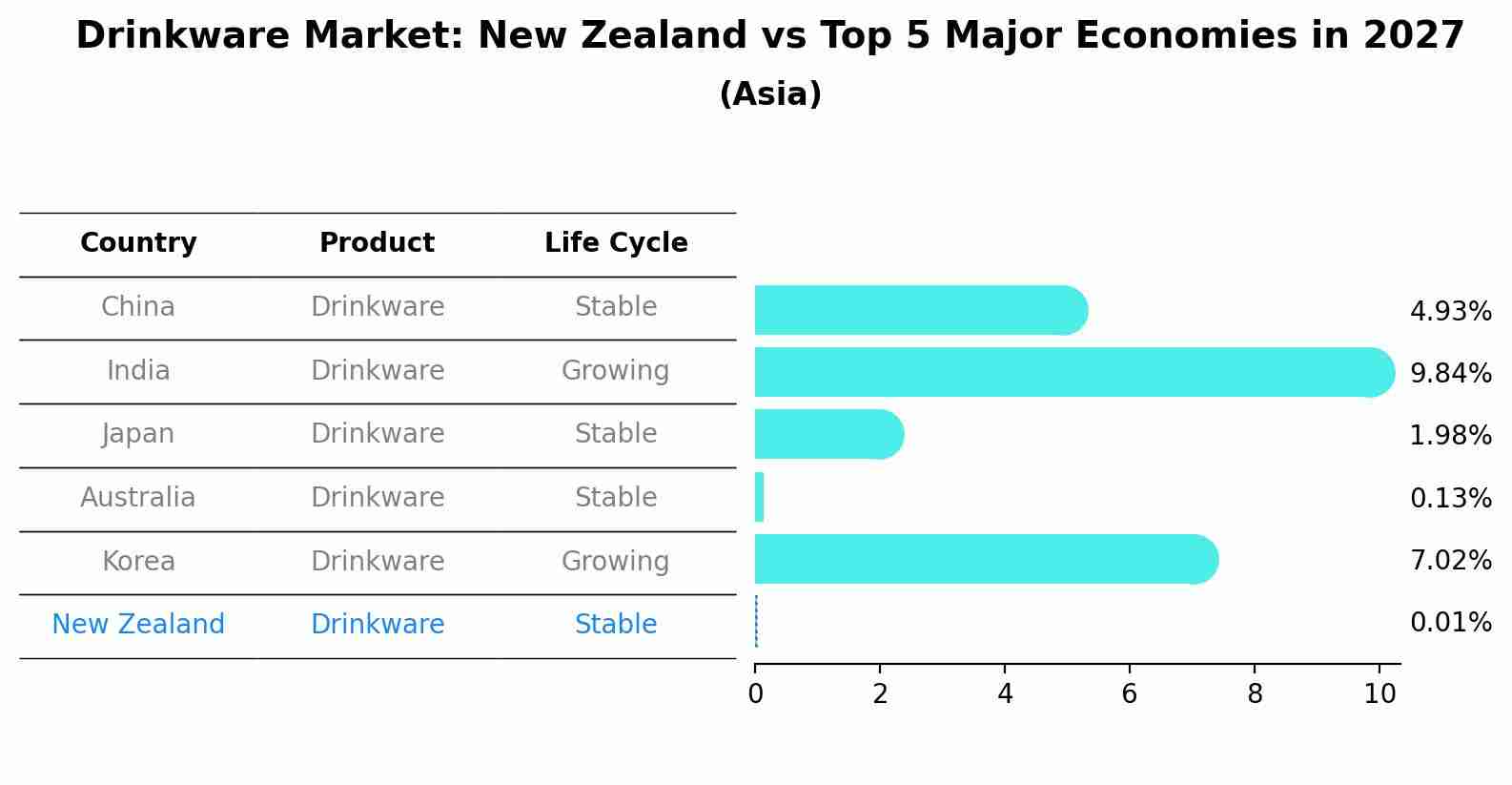
The Drinkware market in New Zealand is projected to grow at a stable growth rate of 0.01% by 2027, within the Asia region led by China, along with other countries like India, Japan, Australia and South Korea, collectively shaping a dynamic and evolving market environment driven by innovation and increasing adoption of emerging technologies.
Key Highlights of the Report:
- New Zealand Drinkware Market Outlook
- Market Size of New Zealand Drinkware Market, 2025
- Forecast of New Zealand Drinkware Market, 2032
- Historical Data and Forecast of New Zealand Drinkware Revenues & Volume for the Period 2022 - 2032F
- New Zealand Drinkware Market Trend Evolution
- New Zealand Drinkware Market Drivers and Challenges
- New Zealand Drinkware Price Trends
- New Zealand Drinkware Porter`s Five Forces
- New Zealand Drinkware Industry Life Cycle
- Historical Data and Forecast of New Zealand Drinkware Market Revenues & Volume By Types for the Period 2022 - 2032F
- Historical Data and Forecast of New Zealand Drinkware Market Revenues & Volume By Glass for the Period 2022 - 2032F
- Historical Data and Forecast of New Zealand Drinkware Market Revenues & Volume By Stainless Steel for the Period 2022 - 2032F
- Historical Data and Forecast of New Zealand Drinkware Market Revenues & Volume By Ceramic for the Period 2022 - 2032F
- Historical Data and Forecast of New Zealand Drinkware Market Revenues & Volume By Polymer for the Period 2022 - 2032F
- Historical Data and Forecast of New Zealand Drinkware Market Revenues & Volume By Other for the Period 2022 - 2032F
- Historical Data and Forecast of New Zealand Drinkware Market Revenues & Volume By Applications for the Period 2022 - 2032F
- Historical Data and Forecast of New Zealand Drinkware Market Revenues & Volume By Home for the Period 2022 - 2032F
- Historical Data and Forecast of New Zealand Drinkware Market Revenues & Volume By Hotel for the Period 2022 - 2032F
- Historical Data and Forecast of New Zealand Drinkware Market Revenues & Volume By Restaurant for the Period 2022 - 2032F
- Historical Data and Forecast of New Zealand Drinkware Market Revenues & Volume By Others for the Period 2022 - 2032F
- Historical Data and Forecast of New Zealand Drinkware Market Revenues & Volume By Product Types for the Period 2022 - 2032F
- Historical Data and Forecast of New Zealand Drinkware Market Revenues & Volume By Water bottle for the Period 2022 - 2032F
- Historical Data and Forecast of New Zealand Drinkware Market Revenues & Volume By Tumblers for the Period 2022 - 2032F
- Historical Data and Forecast of New Zealand Drinkware Market Revenues & Volume By Shakers for the Period 2022 - 2032F
- Historical Data and Forecast of New Zealand Drinkware Market Revenues & Volume By Infusers for the Period 2022 - 2032F
- Historical Data and Forecast of New Zealand Drinkware Market Revenues & Volume By Mugs & Cups for the Period 2022 - 2032F
- New Zealand Drinkware Import Export Trade Statistics
- Market Opportunity Assessment By Types
- Market Opportunity Assessment By Applications
- Market Opportunity Assessment By Product Types
- New Zealand Drinkware Top Companies Market Share
- New Zealand Drinkware Competitive Benchmarking By Technical and Operational Parameters
- New Zealand Drinkware Company Profiles
- New Zealand Drinkware Key Strategic Recommendations






































