New Zealand Fatty Acid Supplements Market Top 5 Importing Countries and Market Competition (HHI) Analysis
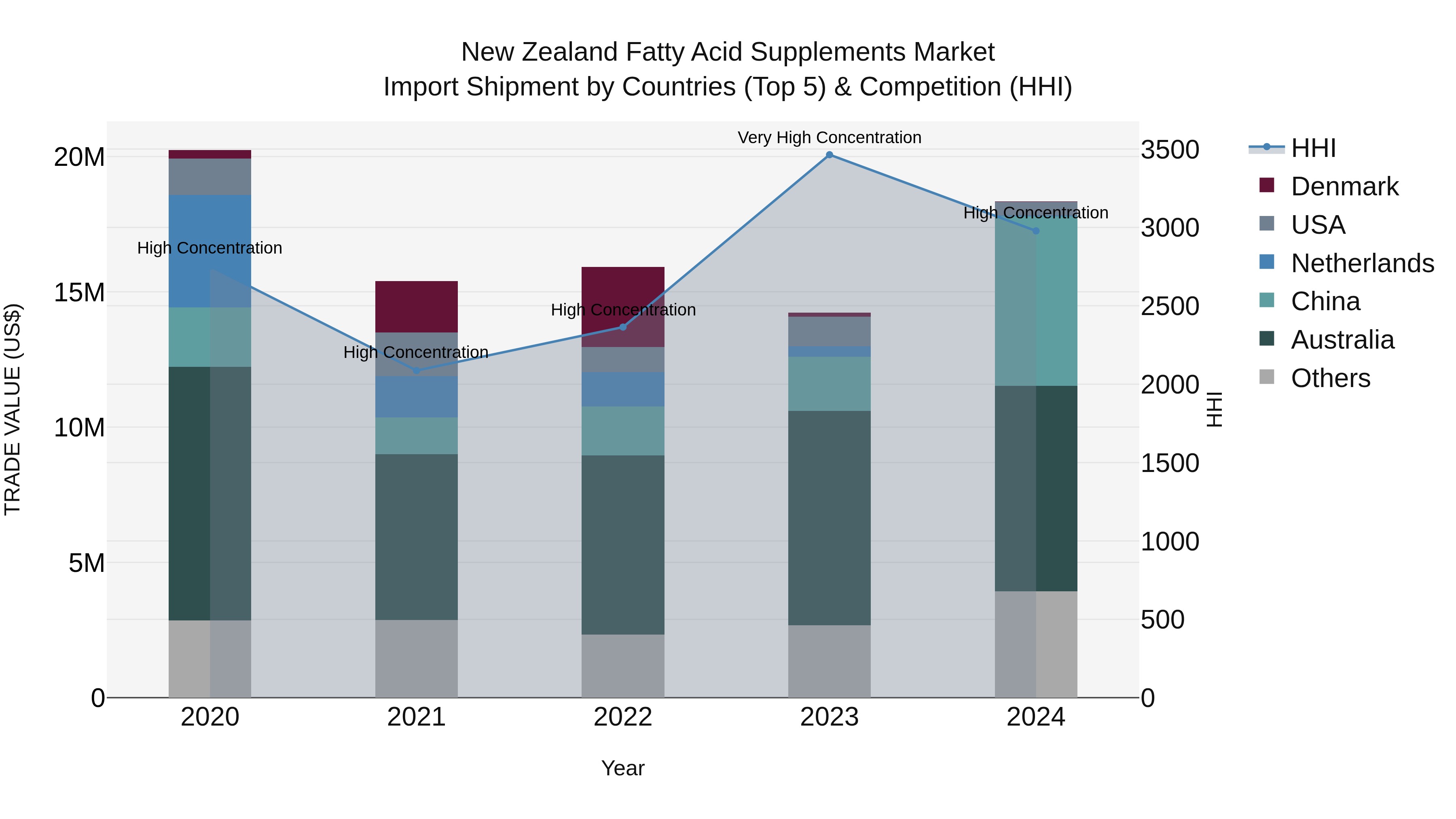
The import market for fatty acid supplements in New Zealand saw significant growth in 2024, with top exporting countries being Australia, China, New Zealand, UK, and USA. Despite a high concentration level in 2023, the market remained competitive in 2024. The compound annual growth rate (CAGR) from 2020 to 2024 was -2.43%, indicating a slight decline, but the growth rate from 2023 to 2024 surged by 28.9%, signaling a promising trend for the industry. The evolving landscape suggests opportunities for both local and international players to capitalize on the growing demand for fatty acid supplements in New Zealand.
Key Highlights of the Report:
- New Zealand Fatty Acid Supplements Market Outlook
- Market Size of New Zealand Fatty Acid Supplements Market, 2025
- Forecast of New Zealand Fatty Acid Supplements Market, 2032
- Historical Data and Forecast of New Zealand Fatty Acid Supplements Revenues & Volume for the Period 2022 - 2032F
- New Zealand Fatty Acid Supplements Market Trend Evolution
- New Zealand Fatty Acid Supplements Market Drivers and Challenges
- New Zealand Fatty Acid Supplements Price Trends
- New Zealand Fatty Acid Supplements Porter's Five Forces
- New Zealand Fatty Acid Supplements Industry Life Cycle
- Historical Data and Forecast of New Zealand Fatty Acid Supplements Market Revenues & Volume By Product Type for the Period 2022 - 2032F
- Historical Data and Forecast of New Zealand Fatty Acid Supplements Market Revenues & Volume By Omega-3 Fatty Acid Supplements for the Period 2022 - 2032F
- Historical Data and Forecast of New Zealand Fatty Acid Supplements Market Revenues & Volume By Omega-6 Fatty Acid Supplements for the Period 2022 - 2032F
- Historical Data and Forecast of New Zealand Fatty Acid Supplements Market Revenues & Volume By Medium-Chain Triglyceride Supplements for the Period 2022 - 2032F
- Historical Data and Forecast of New Zealand Fatty Acid Supplements Market Revenues & Volume By DHA Fatty Acid Supplements for the Period 2022 - 2032F
- Historical Data and Forecast of New Zealand Fatty Acid Supplements Market Revenues & Volume By Technology Type for the Period 2022 - 2032F
- Historical Data and Forecast of New Zealand Fatty Acid Supplements Market Revenues & Volume By Cold Press Extraction for the Period 2022 - 2032F
- Historical Data and Forecast of New Zealand Fatty Acid Supplements Market Revenues & Volume By Encapsulation Technology for the Period 2022 - 2032F
- Historical Data and Forecast of New Zealand Fatty Acid Supplements Market Revenues & Volume By Molecular Distillation for the Period 2022 - 2032F
- Historical Data and Forecast of New Zealand Fatty Acid Supplements Market Revenues & Volume By Microencapsulation for the Period 2022 - 2032F
- Historical Data and Forecast of New Zealand Fatty Acid Supplements Market Revenues & Volume By End User for the Period 2022 - 2032F
- Historical Data and Forecast of New Zealand Fatty Acid Supplements Market Revenues & Volume By Health Enthusiasts for the Period 2022 - 2032F
- Historical Data and Forecast of New Zealand Fatty Acid Supplements Market Revenues & Volume By Elderly Population for the Period 2022 - 2032F
- Historical Data and Forecast of New Zealand Fatty Acid Supplements Market Revenues & Volume By Athletes and Fitness Buffs for the Period 2022 - 2032F
- Historical Data and Forecast of New Zealand Fatty Acid Supplements Market Revenues & Volume By Pregnant Women and Infants for the Period 2022 - 2032F
- Historical Data and Forecast of New Zealand Fatty Acid Supplements Market Revenues & Volume By Application for the Period 2022 - 2032F
- Historical Data and Forecast of New Zealand Fatty Acid Supplements Market Revenues & Volume By Heart Health and Wellness Supplements for the Period 2022 - 2032F
- Historical Data and Forecast of New Zealand Fatty Acid Supplements Market Revenues & Volume By Joint Health and Anti-Inflammatory Uses for the Period 2022 - 2032F
- Historical Data and Forecast of New Zealand Fatty Acid Supplements Market Revenues & Volume By Weight Loss and Energy Boosting for the Period 2022 - 2032F
- Historical Data and Forecast of New Zealand Fatty Acid Supplements Market Revenues & Volume By Brain and Eye Development for Infants for the Period 2022 - 2032F
- New Zealand Fatty Acid Supplements Import Export Trade Statistics
- Market Opportunity Assessment By Product Type
- Market Opportunity Assessment By Technology Type
- Market Opportunity Assessment By End User
- Market Opportunity Assessment By Application
- New Zealand Fatty Acid Supplements Top Companies Market Share
- New Zealand Fatty Acid Supplements Competitive Benchmarking By Technical and Operational Parameters
- New Zealand Fatty Acid Supplements Company Profiles
- New Zealand Fatty Acid Supplements Key Strategic Recommendations






































