New Zealand Fencing Market Growth Rate Analysis (2025 - 2031)
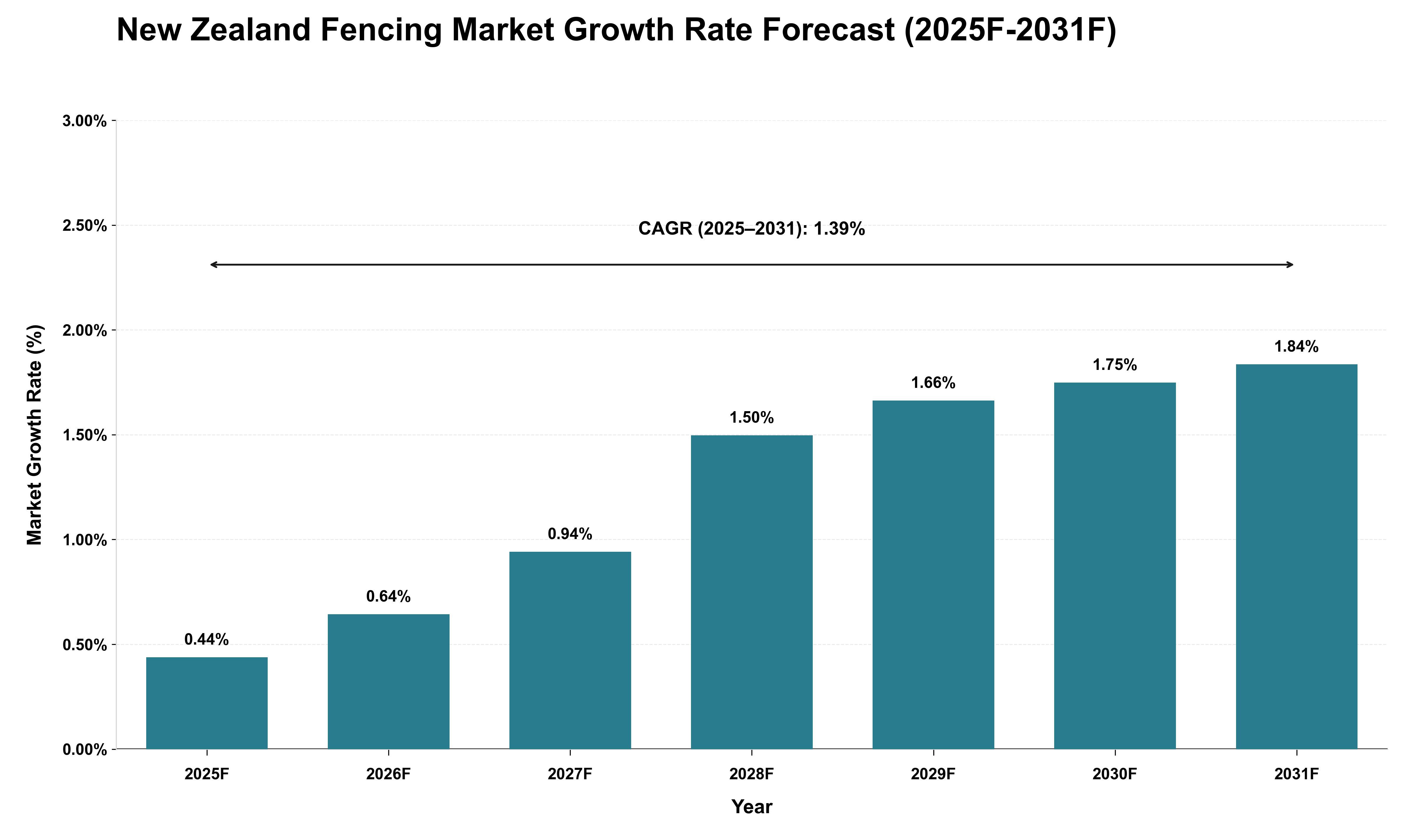
The projected growth trajectory for the New Zealand fencing market will exhibit a gradual acceleration, with the compound annual growth rate (CAGR) of 1.39% reflecting a steady increase in demand driven by regulatory and trade policy factors. The initial years, starting at 0.44% in 2025 and rising to 1.84% by 2031, indicate an evolving landscape where anticipated regulatory changes may enhance construction standards and environmental considerations, thereby boosting fencing requirements across residential and agricultural sectors. Import dependencies will likely play a crucial role as New Zealand navigates trade agreements that could facilitate access to diverse materials, impacting pricing structures and availability. Additionally, cyclical trends in construction activity are expected to influence market dynamics, with increased infrastructure investments potentially stimulating demand for fencing solutions throughout the forecast period.
Key Highlights of the Report:
- New Zealand Fencing Market Outlook
- Market Size of New Zealand Fencing Market, 2024
- Forecast of New Zealand Fencing Market, 2031
- Historical Data and Forecast of New Zealand Fencing Revenues & Volume for the Period 2021-2031
- New Zealand Fencing Market Trend Evolution
- New Zealand Fencing Market Drivers and Challenges
- New Zealand Fencing Price Trends
- New Zealand Fencing Porter`s Five Forces
- New Zealand Fencing Industry Life Cycle
- Historical Data and Forecast of New Zealand Fencing Market Revenues & Volume By Material for the Period 2021-2031
- Historical Data and Forecast of New Zealand Fencing Market Revenues & Volume By Metal for the Period 2021-2031
- Historical Data and Forecast of New Zealand Fencing Market Revenues & Volume By Wood for the Period 2021-2031
- Historical Data and Forecast of New Zealand Fencing Market Revenues & Volume By Plastic & Composite for the Period 2021-2031
- Historical Data and Forecast of New Zealand Fencing Market Revenues & Volume By Concrete for the Period 2021-2031
- Historical Data and Forecast of New Zealand Fencing Market Revenues & Volume By Distribution Channel for the Period 2021-2031
- Historical Data and Forecast of New Zealand Fencing Market Revenues & Volume By Online for the Period 2021-2031
- Historical Data and Forecast of New Zealand Fencing Market Revenues & Volume By Retail for the Period 2021-2031
- Historical Data and Forecast of New Zealand Fencing Market Revenues & Volume By Installation for the Period 2021-2031
- Historical Data and Forecast of New Zealand Fencing Market Revenues & Volume By Do-It-Yourself for the Period 2021-2031
- Historical Data and Forecast of New Zealand Fencing Market Revenues & Volume By Contractor for the Period 2021-2031
- Historical Data and Forecast of New Zealand Fencing Market Revenues & Volume By Application for the Period 2021-2031
- Historical Data and Forecast of New Zealand Fencing Market Revenues & Volume By Residential for the Period 2021-2031
- Historical Data and Forecast of New Zealand Fencing Market Revenues & Volume By Agricultural for the Period 2021-2031
- Historical Data and Forecast of New Zealand Fencing Market Revenues & Volume By Industrial for the Period 2021-2031
- Historical Data and Forecast of New Zealand Fencing Market Revenues & Volume By End-users for the Period 2021-2031
- Historical Data and Forecast of New Zealand Fencing Market Revenues & Volume By Government for the Period 2021-2031
- Historical Data and Forecast of New Zealand Fencing Market Revenues & Volume By Petroleum & Chemicals for the Period 2021-2031
- Historical Data and Forecast of New Zealand Fencing Market Revenues & Volume By Military & Defense for the Period 2021-2031
- Historical Data and Forecast of New Zealand Fencing Market Revenues & Volume By Mining for the Period 2021-2031
- Historical Data and Forecast of New Zealand Fencing Market Revenues & Volume By Energy & Power for the Period 2021-2031
- Historical Data and Forecast of New Zealand Fencing Market Revenues & Volume By Transport for the Period 2021-2031
- Historical Data and Forecast of New Zealand Fencing Market Revenues & Volume By Others for the Period 2021-2031
- New Zealand Fencing Import Export Trade Statistics
- Market Opportunity Assessment By Material
- Market Opportunity Assessment By Distribution Channel
- Market Opportunity Assessment By Installation
- Market Opportunity Assessment By Application
- Market Opportunity Assessment By End-users
- New Zealand Fencing Top Companies Market Share
- New Zealand Fencing Competitive Benchmarking By Technical and Operational Parameters
- New Zealand Fencing Company Profiles
- New Zealand Fencing Key Strategic Recommendations






































